MRC/UVRI Uganda Research Unit on AIDS, Entebbe, Uganda.
Soc Psychiatry Psychiatr Epidemiol. 2011 Jan;46(1):35-44. doi: 10.1007/s00127-009-0164-8. Epub 2009 Nov 16.
Understanding the determinants of major depression in sub-Saharan Africa is important for planning effective intervention strategies.
To investigate the social and life-event determinants of major depressive disorder in the African sociocultural context of rural Uganda.
A cross-section survey was carried out in 14 districts in Uganda from 1 June 2003 to 30 October 2004. 4,660 randomly selected respondents (15 years and above) were interviewed. The primary outcome was the presence of 'probable major depressive disorder' (PMDD) as assessed by the Hopkins symptom checklist.
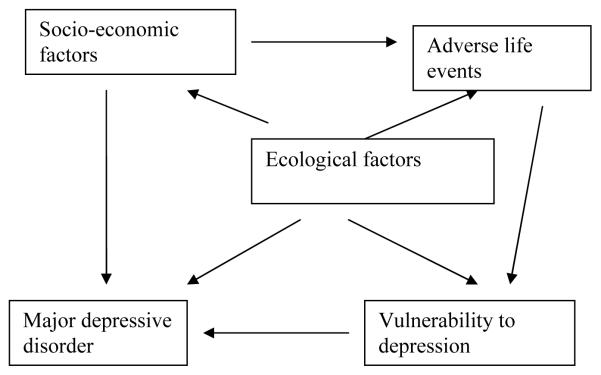
The prevalence of PMDD was 29.3% (95% confidence interval, 28.0-30.6%). Factors independently associated with depression in both genders included: the ecological factor, district; age (increase with each age category after 35 years); indices of poverty and deprivation (no formal education, having no employment, broken family, and socioeconomic classes III-V). Only a few adverse life events, notably those suggestive of a disrupted family background (death of a father in females and death of a mother in males) were associated with increased risk.
Socioeconomic and sociodemographic factors, operating at both ecological and the individual level are the strongest independent determinants of depression. Adverse life events were less strongly associated with depression in this sample.
了解撒哈拉以南非洲地区重度抑郁症的决定因素对于规划有效的干预策略非常重要。
在乌干达农村的非洲社会文化背景下,研究主要抑郁障碍的社会和生活事件决定因素。
2003 年 6 月 1 日至 2004 年 10 月 30 日,在乌干达的 14 个区进行了横断面调查。随机选择了 4660 名(15 岁及以上)受访者进行访谈。主要结局是采用 Hopkins 症状清单评估“可能患有重度抑郁症”(PMDD)的存在。
PMDD 的患病率为 29.3%(95%置信区间,28.0-30.6%)。在男女两性中与抑郁独立相关的因素包括:生态因素,区;年龄(35 岁后每增加一个年龄组);贫困和剥夺指数(没有正规教育、没有就业、家庭破裂和社会经济阶层 III-V)。只有少数不良生活事件与风险增加相关,特别是那些提示家庭背景破裂的事件(女性父亲死亡和男性母亲死亡)。
在个体和生态两个层面上运作的社会经济和社会人口因素是抑郁的最强独立决定因素。在这个样本中,不良生活事件与抑郁的相关性较弱。