Department of Cell Biology, Center for Cardiology and Cardiovascular Biology, University of Connecticut Health Center, Farmington, CT 06030, USA.
J Gen Physiol. 2009 Dec;134(6):471-88. doi: 10.1085/jgp.200910254. Epub 2009 Nov 16.
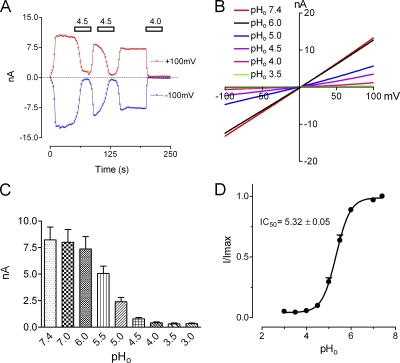
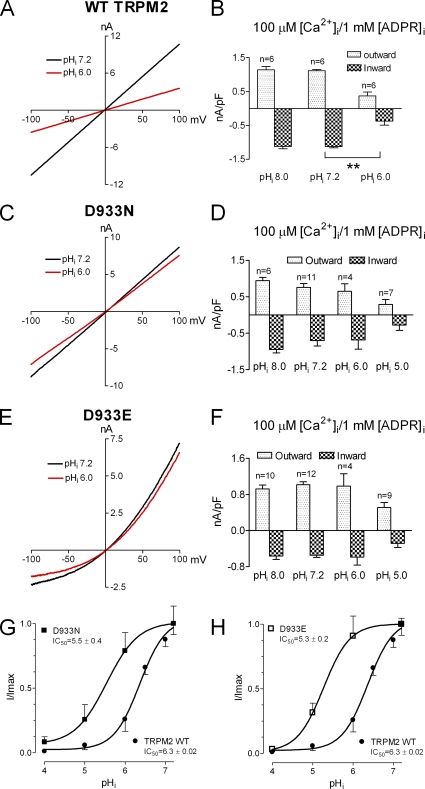
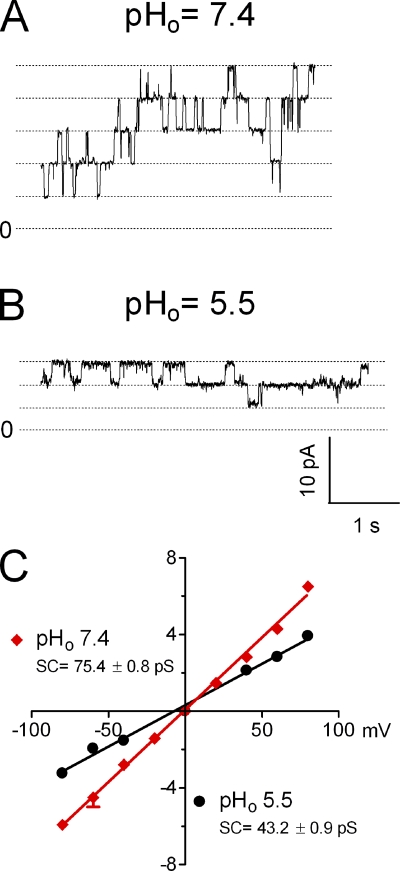
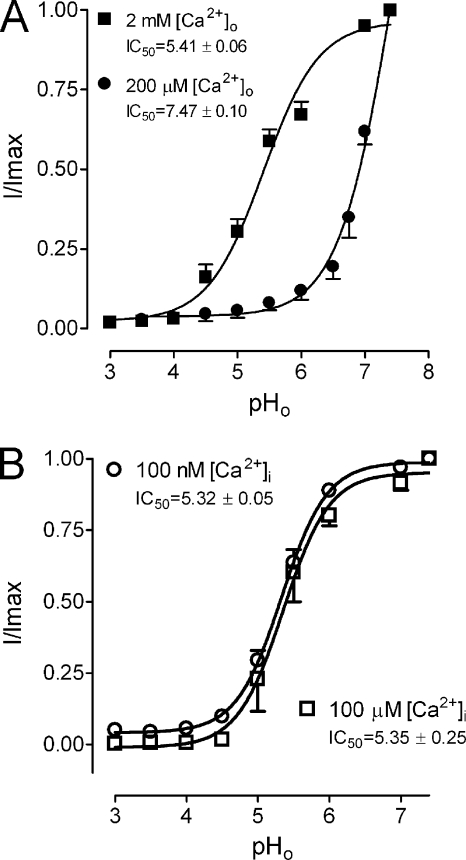
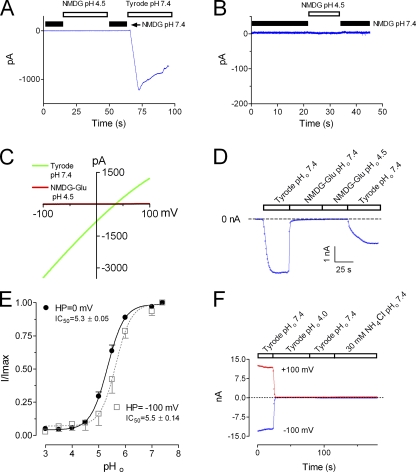
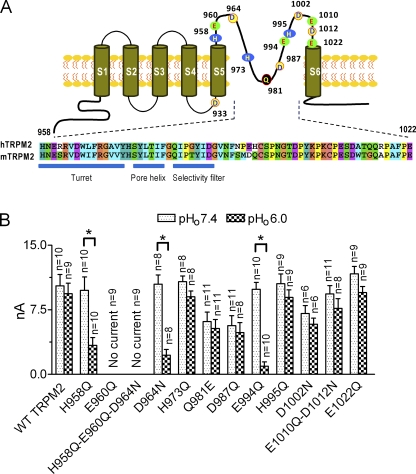
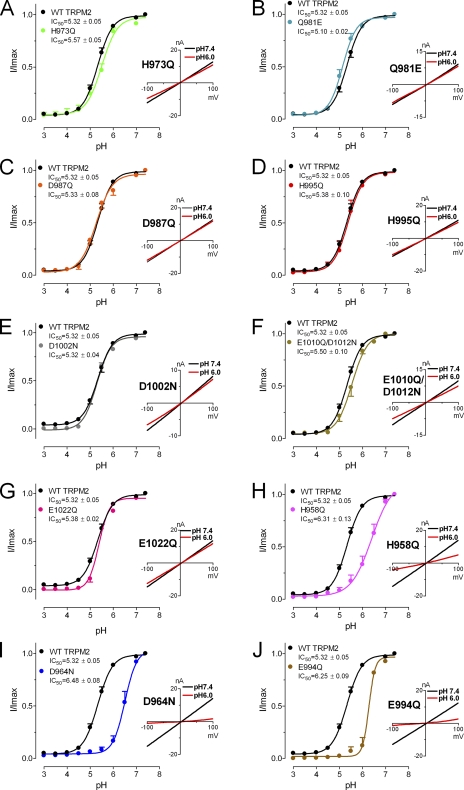
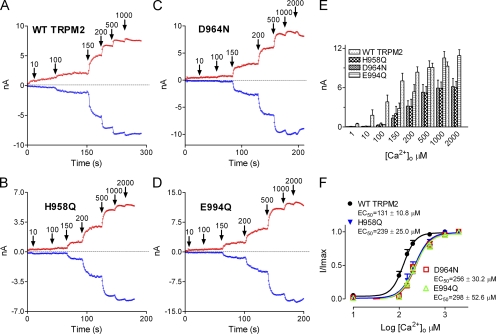
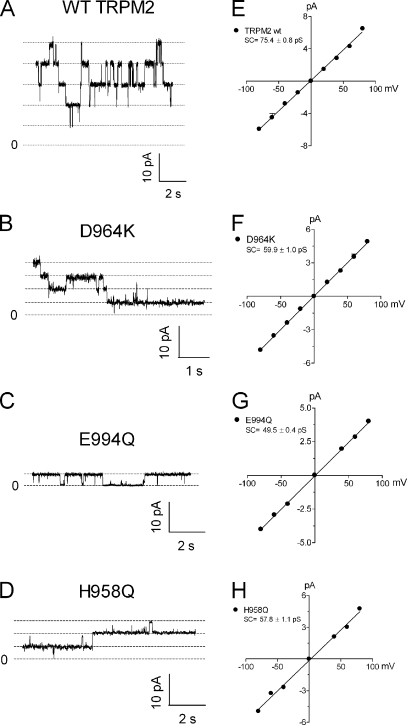
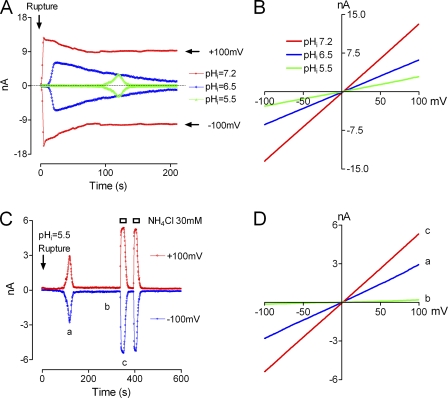
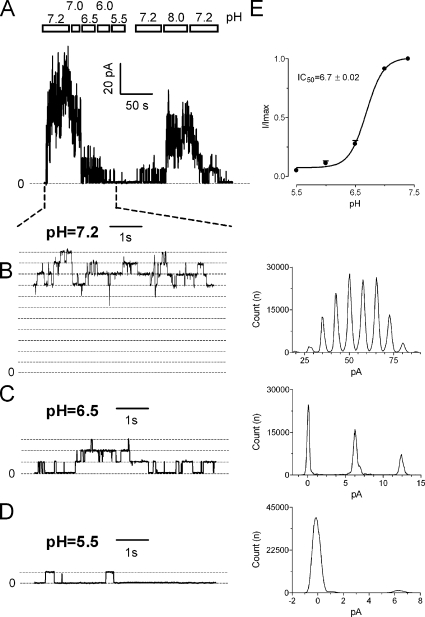
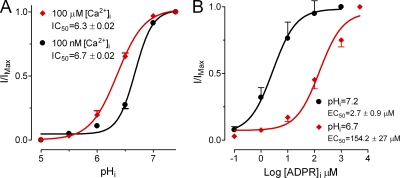
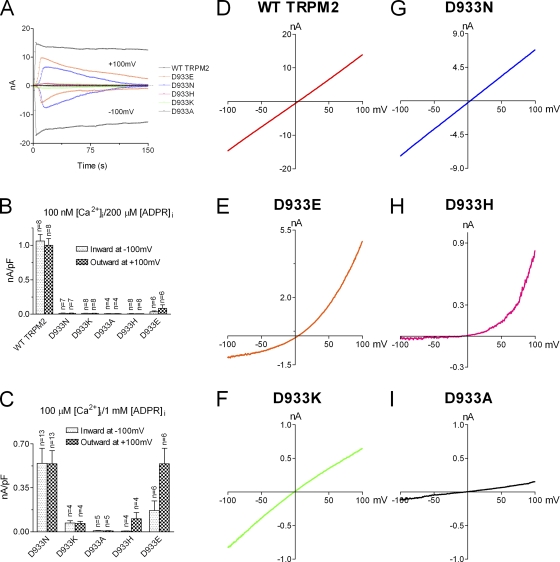
TRPM2 is a Ca(2+)-permeable nonselective cation channel that plays important roles in oxidative stress-mediated cell death and inflammation processes. However, how TRPM2 is regulated under physiological and pathological conditions is not fully understood. Here, we report that both intracellular and extracellular protons block TRPM2 by inhibiting channel gating. We demonstrate that external protons block TRPM2 with an IC(50) of pH(o) = 5.3, whereas internal protons inhibit TRPM2 with an IC(50) of pH(i) = 6.7. Extracellular protons inhibit TRPM2 by decreasing single-channel conductance. We identify three titratable residues, H958, D964, and E994, at the outer vestibule of the channel pore that are responsible for pH(o) sensitivity. Mutations of these residues reduce single-channel conductance, decrease external Ca(2+) (Ca(2+)) affinity, and inhibit Ca(2+)-mediated TRPM2 gating. These results support the following model: titration of H958, D964, and E994 by external protons inhibits TRPM2 gating by causing conformation change of the channel, and/or by decreasing local Ca(2+) concentration at the outer vestibule, therefore reducing Ca(2+) permeation and inhibiting Ca(2+)-mediated TRPM2 gating. We find that intracellular protons inhibit TRPM2 by inducing channel closure without changing channel conductance. We identify that D933 located at the C terminus of the S4-S5 linker is responsible for intracellular pH sensitivity. Replacement of Asp(933) by Asn(933) changes the IC(50) from pH(i) = 6.7 to pH(i) = 5.5. Moreover, substitution of Asp(933) with various residues produces marked changes in proton sensitivity, intracellular ADP ribose/Ca(2+) sensitivity, and gating profiles of TRPM2. These results indicate that D933 is not only essential for intracellular pH sensitivity, but it is also crucial for TRPM2 channel gating. Collectively, our findings provide a novel mechanism for TRPM2 modulation as well as molecular determinants for pH regulation of TRPM2. Inhibition of TRPM2 by acidic pH may represent an endogenous mechanism governing TRPM2 gating and its physiological/pathological functions.
瞬时受体电位阳离子通道亚家族 M 成员 2(TRPM2)是一种钙离子通透的非选择性阳离子通道,在氧化应激介导的细胞死亡和炎症过程中发挥重要作用。然而,TRPM2 在生理和病理条件下是如何被调控的,目前还不完全清楚。在这里,我们报告细胞内和细胞外质子通过抑制通道门控来阻断 TRPM2。我们证明,外部质子以 pH(o) = 5.3 的 IC(50)阻断 TRPM2,而内部质子以 pH(i) = 6.7 的 IC(50)抑制 TRPM2。细胞外质子通过降低单通道电导来抑制 TRPM2。我们鉴定出通道孔外腔三个可滴定的残基 H958、D964 和 E994,它们负责 pH(o) 敏感性。这些残基的突变降低了单通道电导,降低了细胞外钙离子(Ca(2+))亲和力,并抑制了Ca(2+)介导的 TRPM2 门控。这些结果支持以下模型:外腔质子滴定 H958、D964 和 E994 通过引起通道构象变化和/或通过降低外腔局部 Ca(2+)浓度来抑制 TRPM2 门控,从而降低Ca(2+)通透性并抑制Ca(2+)介导的 TRPM2 门控。我们发现细胞内质子通过诱导通道关闭而不改变通道电导来抑制 TRPM2。我们鉴定出位于 S4-S5 连接环 C 端的 D933 负责细胞内 pH 敏感性。用天冬酰胺(Asn)取代 D933 将 IC(50)从 pH(i) = 6.7 变为 pH(i) = 5.5。此外,用各种残基取代 Asp(933)会使质子敏感性、细胞内 ADP 核糖/Ca(2+)敏感性和 TRPM2 的门控谱发生明显变化。这些结果表明,D933 不仅对细胞内 pH 敏感性至关重要,而且对 TRPM2 通道门控也至关重要。总的来说,我们的研究结果为 TRPM2 的调节提供了一种新的机制,并为 TRPM2 的 pH 调节提供了分子决定因素。酸性 pH 对 TRPM2 的抑制可能代表一种调节 TRPM2 门控及其生理/病理功能的内源性机制。