• 文献检索
  • 文档翻译
  • 深度研究
  • 学术资讯
  • Suppr Zotero 插件Zotero 插件
  • 邀请有礼
  • 套餐&价格
  • 历史记录
应用&插件
Suppr Zotero 插件Zotero 插件浏览器插件Mac 客户端Windows 客户端微信小程序
定价
高级版会员购买积分包购买API积分包
服务
文献检索文档翻译深度研究API 文档MCP 服务
关于我们
关于 Suppr公司介绍联系我们用户协议隐私条款
关注我们

Suppr 超能文献

核心技术专利:CN118964589B侵权必究
粤ICP备2023148730 号-1Suppr @ 2026

文献检索

告别复杂PubMed语法,用中文像聊天一样搜索,搜遍4000万医学文献。AI智能推荐,让科研检索更轻松。

立即免费搜索

文件翻译

保留排版,准确专业,支持PDF/Word/PPT等文件格式,支持 12+语言互译。

免费翻译文档

深度研究

AI帮你快速写综述,25分钟生成高质量综述,智能提取关键信息,辅助科研写作。

立即免费体验

从基于相位的到基于位移的门控:一个便于呼吸门控放射治疗的软件工具。

From phase-based to displacement-based gating: a software tool to facilitate respiration-gated radiation treatment.

机构信息

Department of Medical Physics, Memorial Sloan Kettering Cancer Center, New York, NY, USA.

Department of Radiation Oncology, Memorial Sloan Kettering Cancer Center, New York, NY, USA.

出版信息

J Appl Clin Med Phys. 2009 Oct 7;10(4):132-141. doi: 10.1120/jacmp.v10i4.2982.

DOI:10.1120/jacmp.v10i4.2982
PMID:19918227
原文链接:https://pmc.ncbi.nlm.nih.gov/articles/PMC2826245/
Abstract

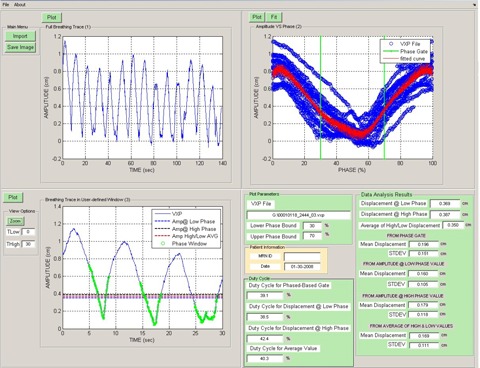
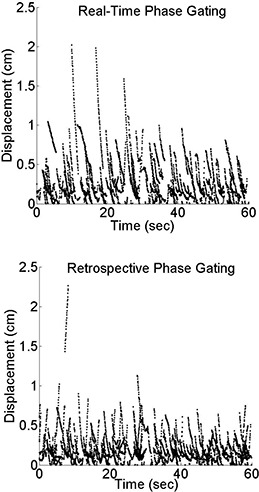
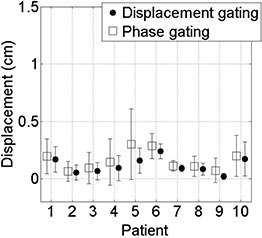
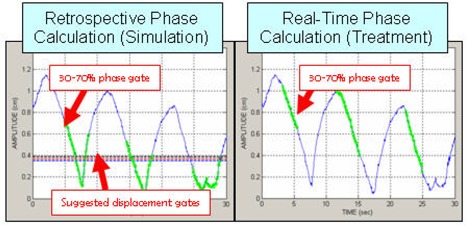
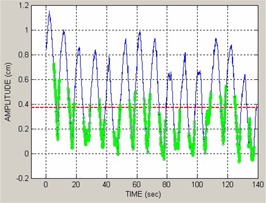
The Varian Real-time Position Management (RPM) system allows respiratory gating based on either the phase or displacement (amplitude) of the breathing waveform. A problem in clinical application is that phase-based gating, required for respiration-correlated (4D-CT) simulation, is not robust to irregular breathing patterns during treatment, and a widely used system version (1.6) does not provide an easy means to change from a phase-based gate into an equivalent displacement-based one. We report on the development and evaluation of a robust method to convert phase-gate thresholds, set by the physician, into equivalent displacement-gate thresholds to facilitate its clinical application to treatment. The software tool analyzes the respiration trace recorded during the 4D-CT simulation, and determines a relationship between displacement and phase through a functional fit. The displacement gate thresholds are determined from an average of two values of this function, corresponding to the start and end thresholds of the original phase gate. The software tool was evaluated in two ways: first, whether in-gate residual target motion and predicted treatment beam duty cycle are equivalent between displacement gating and phase gating during 4D-CT simulation (using retrospective phase recalculation); second, whether residual motion is improved with displacement gating during treatment relative to phase gating (using real-time phase calculation). Residual target motion was inferred from the respiration traces and quantified in terms of mean and standard deviation in-gate displacement measured relative to the value at the start of the recorded trace. For retrospectively-calculated breathing traces compared with real-time calculated breathing traces, we evaluate the inaccuracies of real-time phase calculation by measuring the phase gate position in each trace as well as the mean in-gate displacement and standard deviation of the displacement. Retrospectively-calculated data from ten patients were analyzed. The patient averaged in-gate mean +/- standard deviation displacement (representing residual motion) was reduced from 0.16 +/- 0.14 cm for phase gating under simulation conditions to 0.12 +/- 0.08 cm for displacement gating. Evaluation of respiration traces under treatment conditions (real-time phase calculation) showed that the average displacement gate threshold results in a lower in-gate mean and residual motion (variance) for all patients studied. The patient-averaged in-gate mean +/- standard deviation displacement was reduced from 0.26 +/- 0.18 cm for phase gating (under treatment conditions) to 0.15 +/- 0.09 cm for displacement gating. Real-time phase gating sometimes leads to gating on incorrect portions of the breathing cycle when the breathing trace is irregular. Displacement gating is less prone to such errors, as evidenced by the lower in-gate residual motion in a large majority of cases.
https://cdn.ncbi.nlm.nih.gov/pmc/blobs/079e/5720577/9677cd72aee0/ACM2-10-132-g006.jpg
https://cdn.ncbi.nlm.nih.gov/pmc/blobs/079e/5720577/20c732e154d2/ACM2-10-132-g001.jpg
https://cdn.ncbi.nlm.nih.gov/pmc/blobs/079e/5720577/d22ea1a4c2c4/ACM2-10-132-g002.jpg
https://cdn.ncbi.nlm.nih.gov/pmc/blobs/079e/5720577/12546f7e9995/ACM2-10-132-g004.jpg
https://cdn.ncbi.nlm.nih.gov/pmc/blobs/079e/5720577/49c746ff7619/ACM2-10-132-g005.jpg
https://cdn.ncbi.nlm.nih.gov/pmc/blobs/079e/5720577/9677cd72aee0/ACM2-10-132-g006.jpg
https://cdn.ncbi.nlm.nih.gov/pmc/blobs/079e/5720577/20c732e154d2/ACM2-10-132-g001.jpg
https://cdn.ncbi.nlm.nih.gov/pmc/blobs/079e/5720577/d22ea1a4c2c4/ACM2-10-132-g002.jpg
https://cdn.ncbi.nlm.nih.gov/pmc/blobs/079e/5720577/12546f7e9995/ACM2-10-132-g004.jpg
https://cdn.ncbi.nlm.nih.gov/pmc/blobs/079e/5720577/49c746ff7619/ACM2-10-132-g005.jpg
https://cdn.ncbi.nlm.nih.gov/pmc/blobs/079e/5720577/9677cd72aee0/ACM2-10-132-g006.jpg
摘要

瓦里安实时位置管理(RPM)系统允许基于呼吸波形的相位或位移(幅度)进行呼吸门控。临床应用中的一个问题是,相位门控用于与呼吸相关的(4D-CT)模拟,但在治疗期间对不规则的呼吸模式不稳定,并且广泛使用的系统版本(1.6)没有提供一种简单的方法将相位门控转换为等效的位移门控。我们报告了一种稳健的方法的开发和评估,该方法将医生设定的相位门控阈值转换为等效的位移门控阈值,以促进其在治疗中的临床应用。该软件工具分析在 4D-CT 模拟期间记录的呼吸轨迹,并通过功能拟合确定位移和相位之间的关系。通过该函数的两个值的平均值确定位移门控阈值,这两个值对应于原始相位门控的起始和结束阈值。该软件工具通过两种方式进行了评估:首先,在 4D-CT 模拟期间,位移门控和相位门控之间的门内残留目标运动和预测的治疗射束占空比是否等效(使用回顾性相位重新计算);其次,与相位门控相比,治疗期间残留运动是否通过位移门控得到改善(使用实时相位计算)。残留目标运动是从呼吸轨迹中推断出来的,并根据相对于记录轨迹起始时的值测量的门内位移的平均值和标准偏差来量化。对于与实时计算的呼吸轨迹相比的回顾性计算的呼吸轨迹,我们通过测量每个轨迹中的相位门控位置以及位移的门内位移平均值和标准偏差来评估实时相位计算的不准确性。分析了十个患者的回顾性计算数据。在模拟条件下,相位门控的患者平均门内位移(代表残留运动)从 0.16 ± 0.14cm 减少到 0.12 ± 0.08cm 用于位移门控。在治疗条件下(实时相位计算)评估呼吸轨迹表明,对于所有研究的患者,平均位移门控阈值导致门内平均位移和残留运动(方差)降低。相位门控(在治疗条件下)的患者平均门内位移为 0.26 ± 0.18cm,位移门控的患者平均门内位移为 0.15 ± 0.09cm。当呼吸轨迹不规则时,实时相位门控有时会导致在呼吸周期的不正确部分进行门控。位移门控不太容易出现此类错误,这从大多数情况下较低的门内残留运动中可以看出。

相似文献

1
From phase-based to displacement-based gating: a software tool to facilitate respiration-gated radiation treatment.从基于相位的到基于位移的门控:一个便于呼吸门控放射治疗的软件工具。
J Appl Clin Med Phys. 2009 Oct 7;10(4):132-141. doi: 10.1120/jacmp.v10i4.2982.
2
Determination of prospective displacement-based gate threshold for respiratory-gated radiation delivery from retrospective phase-based gate threshold selected at 4D CT simulation.从在4D CT模拟中选择的回顾性基于相位的门控阈值确定用于呼吸门控放射治疗的前瞻性基于位移的门控阈值。
Med Phys. 2007 Nov;34(11):4247-55. doi: 10.1118/1.2794169.
3
Amplitude gating for a coached breathing approach in respiratory gated 10 MV flattening filter-free VMAT delivery.在呼吸门控10MV无 flattening filter的容积调强弧形治疗(VMAT)放疗中,用于指导呼吸方法的幅度门控。
J Appl Clin Med Phys. 2015 Jul 8;16(4):78–90. doi: 10.1120/jacmp.v16i4.5350.
4
Quantifying the impact of respiratory-gated 4D CT acquisition on thoracic image quality: a digital phantom study.量化呼吸门控4D CT采集对胸部图像质量的影响:一项数字体模研究。
Med Phys. 2015 Jan;42(1):324-34. doi: 10.1118/1.4903936.
5
Simulation of dosimetry impact of 4DCT uncertainty in 4D dose calculation for lung SBRT.4DCT 不确定性对肺部 SBRT 四维剂量计算中剂量学影响的模拟。
Radiat Oncol. 2019 Jan 8;14(1):1. doi: 10.1186/s13014-018-1191-y.
6
Three-dimensional analysis of the respiratory interplay effect in helical tomotherapy: Baseline variations cause the greater part of dose inhomogeneities seen.螺旋断层放射治疗中呼吸相互作用效应的三维分析:基线变化导致了大部分所见的剂量不均匀性。
Med Phys. 2014 Mar;41(3):031704. doi: 10.1118/1.4864241.
7
Motion management within two respiratory-gating windows: feasibility study of dual quasi-breath-hold technique in gated medical procedures.两个呼吸门控窗口内的运动管理:门控医疗程序中双准屏气技术的可行性研究
Phys Med Biol. 2014 Nov 7;59(21):6583-94. doi: 10.1088/0031-9155/59/21/6583. Epub 2014 Oct 16.
8
Four-dimensional tissue deformation reconstruction (4D TDR) validation using a real tissue phantom.基于真实组织体模的四维组织变形重建(4D TDR)验证。
J Appl Clin Med Phys. 2013 Jan 7;14(1):4012. doi: 10.1120/jacmp.v14i1.4012.
9
Intrafraction tumor motion during deep inspiration breath hold pancreatic cancer treatment.深吸气屏气胰腺癌治疗过程中的分次内肿瘤运动。
J Appl Clin Med Phys. 2019 May;20(5):37-43. doi: 10.1002/acm2.12577. Epub 2019 Apr 1.
10
Residual motion of lung tumours in gated radiotherapy with external respiratory surrogates.使用外部呼吸替代物的门控放疗中肺肿瘤的残余运动
Phys Med Biol. 2005 Aug 21;50(16):3655-67. doi: 10.1088/0031-9155/50/16/001. Epub 2005 Jul 28.

引用本文的文献

1
Carbon-Ion Radiotherapy for Hepatocellular Carcinoma: Current Status and Future Prospects: A Narrative Review.肝细胞癌的碳离子放疗:现状与未来展望:一篇叙述性综述
J Clin Med. 2025 Aug 29;14(17):6107. doi: 10.3390/jcm14176107.
2
Stability and Reliability of Enhanced External-Internal Motion Correlation via Dynamic Phase-Shift Corrections Over 30-min Timeframe for Respiratory-Gated Radiotherapy.增强型内外运动相关的稳定性和可靠性:通过动态相移校正实现呼吸门控放射治疗 30 分钟时间框架内的跟踪
Technol Cancer Res Treat. 2022 Jan-Dec;21:15330338221111592. doi: 10.1177/15330338221111592.
3
The Clinical and Dosimetric Impact of Real-Time Target Tracking in Pancreatic SBRT.

本文引用的文献

1
Mean position tracking of respiratory motion.呼吸运动的平均位置跟踪
Med Phys. 2008 Feb;35(2):782-92. doi: 10.1118/1.2825616.
2
Determination of prospective displacement-based gate threshold for respiratory-gated radiation delivery from retrospective phase-based gate threshold selected at 4D CT simulation.从在4D CT模拟中选择的回顾性基于相位的门控阈值确定用于呼吸门控放射治疗的前瞻性基于位移的门控阈值。
Med Phys. 2007 Nov;34(11):4247-55. doi: 10.1118/1.2794169.
3
The impact of temporal inaccuracies on 4DCT image quality.时间误差对4DCT图像质量的影响。
实时靶区跟踪在胰腺癌立体定向放疗中的临床和剂量学影响。
Int J Radiat Oncol Biol Phys. 2019 Jan 1;103(1):268-275. doi: 10.1016/j.ijrobp.2018.08.021. Epub 2018 Aug 24.
4
Investigating the minimum scan parameters required to generate free-breathing motion artefact-free fast-helical CT.研究生成自由呼吸无运动伪影快速螺旋CT所需的最小扫描参数。
Br J Radiol. 2018 Feb;91(1082):20170597. doi: 10.1259/bjr.20170597. Epub 2017 Nov 21.
5
Statistical Determination of the Gating Windows for Respiratory-Gated Radiotherapy Using a Visible Guiding System.使用可见引导系统进行呼吸门控放射治疗时门控窗的统计确定
PLoS One. 2016 May 26;11(5):e0156357. doi: 10.1371/journal.pone.0156357. eCollection 2016.
6
Pancreatic cancer and SBRT: A new potential option?胰腺癌与立体定向体部放疗:一种新的潜在选择?
Rep Pract Oncol Radiother. 2015 Sep-Oct;20(5):377-84. doi: 10.1016/j.rpor.2015.05.008. Epub 2015 Jun 28.
7
A novel fast helical 4D-CT acquisition technique to generate low-noise sorting artifact-free images at user-selected breathing phases.一种新的快速螺旋 4D-CT 采集技术,可在用户选择的呼吸相位生成低噪声、无排序伪影的图像。
Int J Radiat Oncol Biol Phys. 2014 May 1;89(1):191-8. doi: 10.1016/j.ijrobp.2014.01.016. Epub 2014 Mar 7.
8
Development of real-time motion verification system using in-room optical images for respiratory-gated radiotherapy.利用室内光学图像的实时运动验证系统在呼吸门控放疗中的开发。
J Appl Clin Med Phys. 2013 Sep 6;14(5):25-42. doi: 10.1120/jacmp.v14i5.4245.
9
A novel CT acquisition and analysis technique for breathing motion modeling.一种用于呼吸运动建模的新型 CT 采集和分析技术。
Phys Med Biol. 2013 Jun 7;58(11):L31-6. doi: 10.1088/0031-9155/58/11/L31. Epub 2013 May 2.
10
External respiratory motion analysis and statistics for patients and volunteers.患者和志愿者的外部呼吸运动分析和统计。
J Appl Clin Med Phys. 2013 Mar 4;14(2):4051. doi: 10.1120/jacmp.v14i2.4051.
Med Phys. 2007 May;34(5):1615-22. doi: 10.1118/1.2717404.
4
The application of the sinusoidal model to lung cancer patient respiratory motion.
Med Phys. 2005 Sep;32(9):2850-61. doi: 10.1118/1.2001220.
5
Interfractional anatomic variation in patients treated with respiration-gated radiotherapy.呼吸门控放疗患者的分次间解剖变异
J Appl Clin Med Phys. 2005 Spring;6(2):19-32. doi: 10.1120/jacmp.v6i2.2048. Epub 2005 May 19.
6
Four-dimensional computed tomography: image formation and clinical protocol.四维计算机断层扫描:图像形成与临床方案。
Med Phys. 2005 Apr;32(4):874-89. doi: 10.1118/1.1869852.
7
Four-dimensional CT scans for treatment planning in stereotactic radiotherapy for stage I lung cancer.用于 I 期肺癌立体定向放射治疗治疗计划的四维 CT 扫描
Int J Radiat Oncol Biol Phys. 2004 Nov 15;60(4):1283-90. doi: 10.1016/j.ijrobp.2004.07.665.
8
Measurement of lung tumor motion using respiration-correlated CT.使用呼吸相关CT测量肺肿瘤运动。
Int J Radiat Oncol Biol Phys. 2004 Nov 1;60(3):933-41. doi: 10.1016/j.ijrobp.2004.06.021.
9
Acquiring 4D thoracic CT scans using a multislice helical method.使用多层螺旋方法获取4D胸部CT扫描图像。
Phys Med Biol. 2004 May 21;49(10):2053-67. doi: 10.1088/0031-9155/49/10/015.
10
4D-CT imaging of a volume influenced by respiratory motion on multi-slice CT.多层CT上受呼吸运动影响的容积的4D-CT成像。
Med Phys. 2004 Feb;31(2):333-40. doi: 10.1118/1.1639993.