Department of Genetics and Pathology, Uppsala University, Rudbeck Laboratory, Dag Hammarskjölds väg 20, Uppsala SE-75185, Sweden.
Genome Biol. 2009;10(11):R129. doi: 10.1186/gb-2009-10-11-r129. Epub 2009 Nov 17.
The forkhead box/winged helix family members FOXA1, FOXA2, and FOXA3 are of high importance in development and specification of the hepatic linage and the continued expression of liver-specific genes.
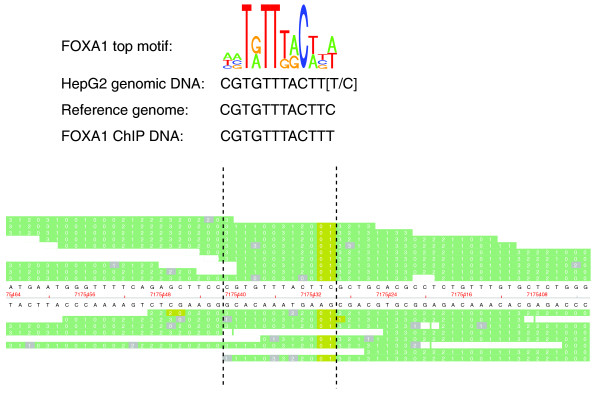
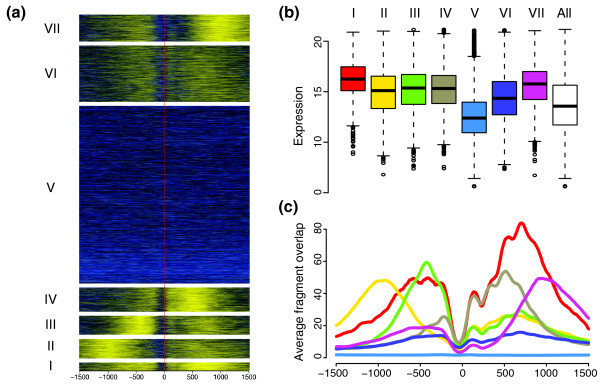
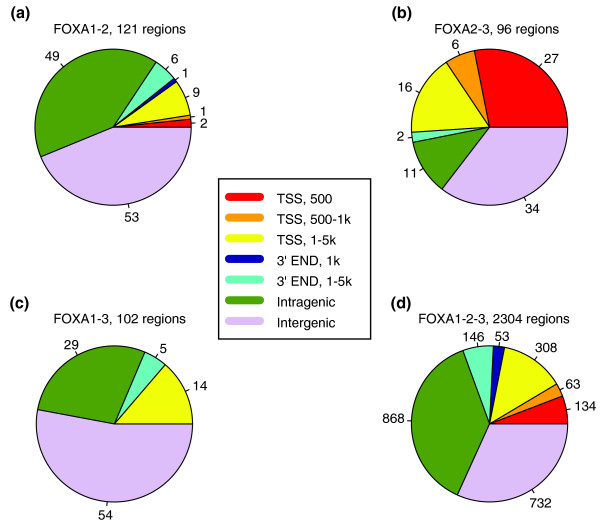
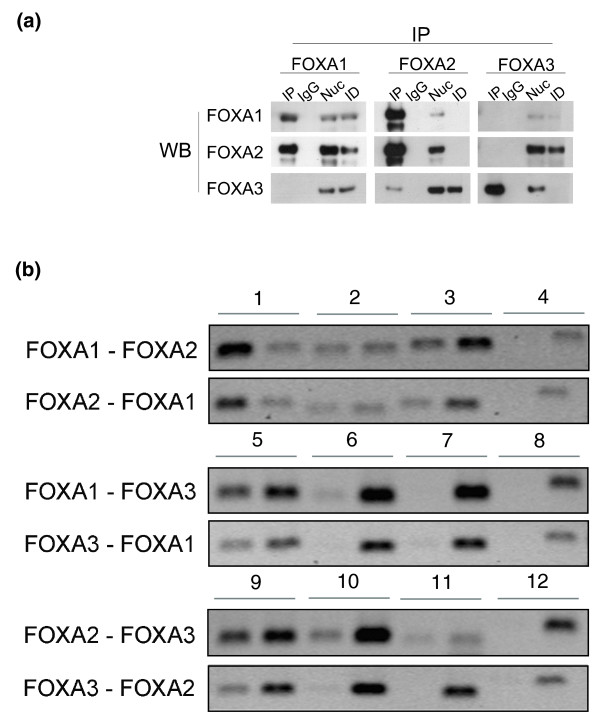
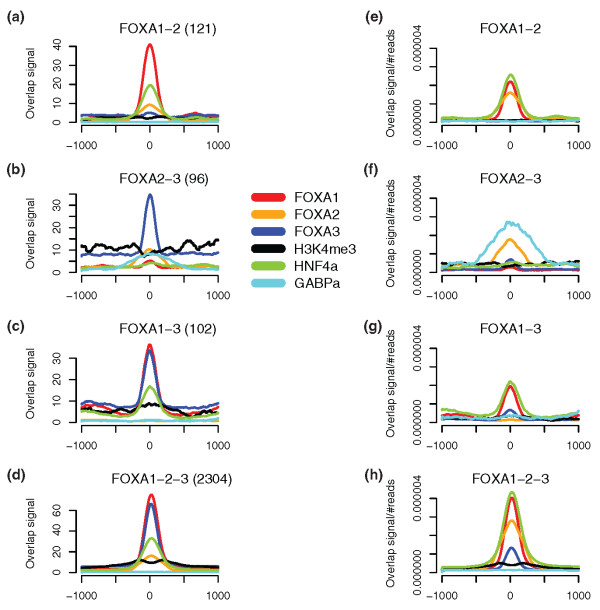
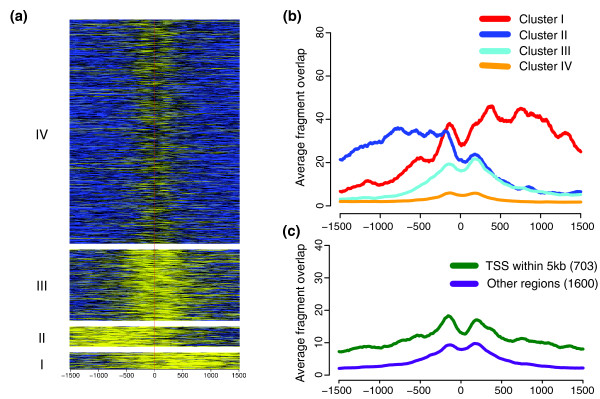
Here, we present a genome-wide location analysis of FOXA1 and FOXA3 binding sites in HepG2 cells through chromatin immunoprecipitation with detection by sequencing (ChIP-seq) studies and compare these with our previous results on FOXA2. We found that these factors often bind close to each other in different combinations and consecutive immunoprecipitation of chromatin for one and then a second factor (ChIP-reChIP) shows that this occurs in the same cell and on the same DNA molecule, suggestive of molecular interactions. Using co-immunoprecipitation, we further show that FOXA2 interacts with both FOXA1 and FOXA3 in vivo, while FOXA1 and FOXA3 do not appear to interact. Additionally, we detected diverse patterns of trimethylation of lysine 4 on histone H3 (H3K4me3) at transcriptional start sites and directionality of this modification at FOXA binding sites. Using the sequence reads at polymorphic positions, we were able to predict allele specific binding for FOXA1, FOXA3, and H3K4me3. Finally, several SNPs associated with diseases and quantitative traits were located in the enriched regions.
We find that ChIP-seq can be used not only to create gene regulatory maps but also to predict molecular interactions and to inform on the mechanisms for common quantitative variation.
叉头框/翼状螺旋转录因子家族成员 FOXA1、FOXA2 和 FOXA3 在肝脏谱系的发育和特化以及肝脏特异性基因的持续表达中具有重要作用。
在这里,我们通过染色质免疫沉淀测序(ChIP-seq)研究对 HepG2 细胞中 FOXA1 和 FOXA3 结合位点进行了全基因组定位分析,并将这些结果与我们之前关于 FOXA2 的结果进行了比较。我们发现这些因子通常以不同的组合彼此紧密结合,并且对一种因子进行连续的染色质免疫沉淀(ChIP-reChIP)后,然后对第二种因子进行免疫沉淀,表明这是在同一细胞和同一 DNA 分子上发生的,提示存在分子相互作用。通过共免疫沉淀,我们进一步证明 FOXA2 在体内与 FOXA1 和 FOXA3 相互作用,而 FOXA1 和 FOXA3 似乎不相互作用。此外,我们在转录起始位点检测到组蛋白 H3 赖氨酸 4 三甲基化(H3K4me3)的不同模式,并且在 FOXA 结合位点检测到该修饰的方向性。利用多态性位置的序列读数,我们能够预测 FOXA1、FOXA3 和 H3K4me3 的等位基因特异性结合。最后,几个与疾病和数量性状相关的 SNP 位于富集区域。
我们发现 ChIP-seq 不仅可用于创建基因调控图谱,还可用于预测分子相互作用,并为常见数量变异的机制提供信息。