INSERM UMR S665, INTS, 75015 Paris, France.
Nucleic Acids Res. 2010 Jan;38(3):1034-47. doi: 10.1093/nar/gkp962. Epub 2009 Nov 17.
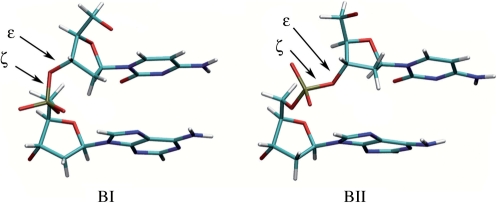
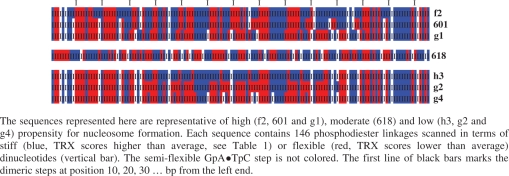
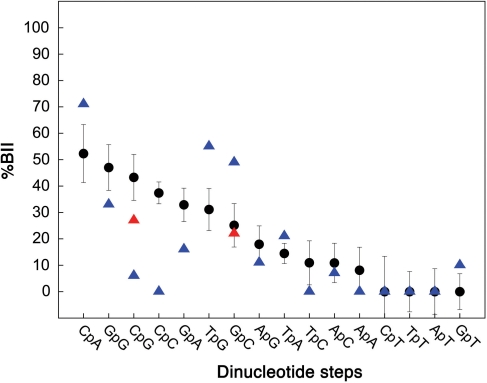
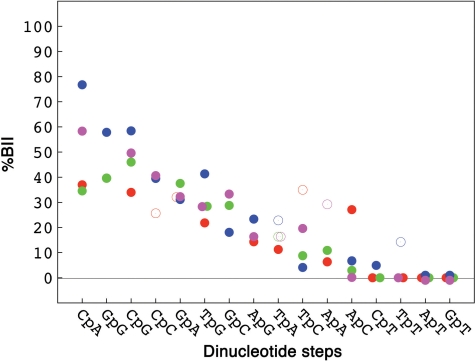
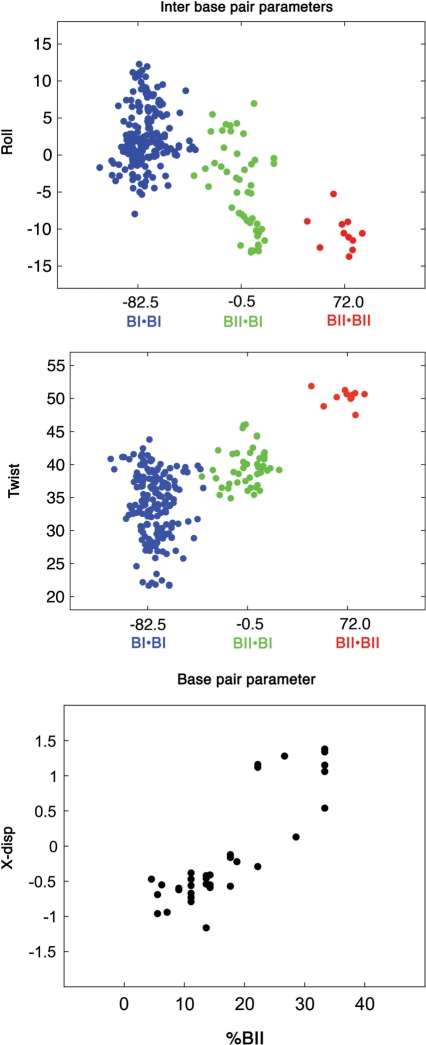
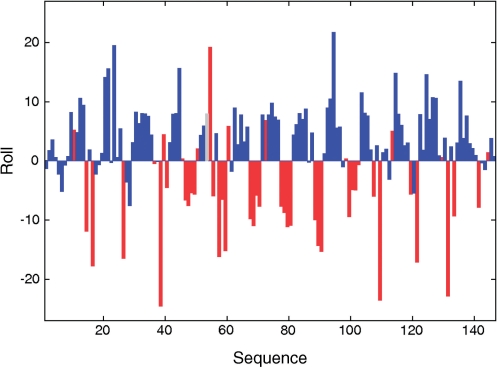
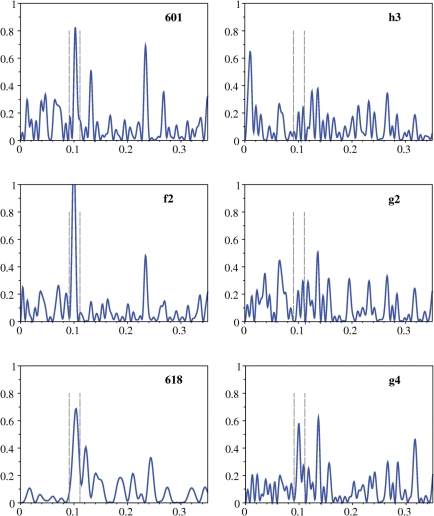
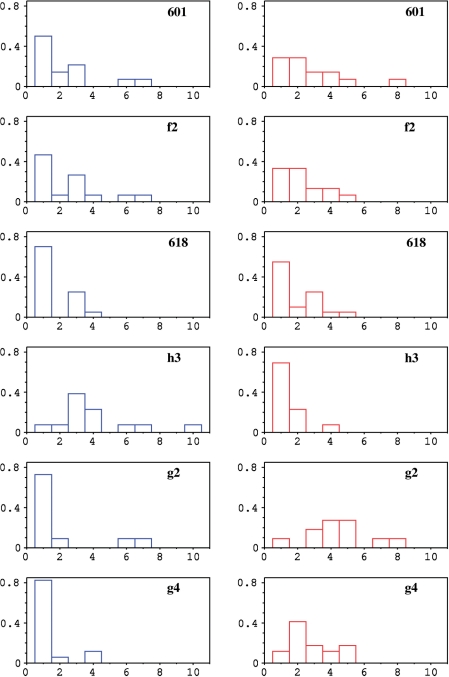
B-DNA flexibility, crucial for DNA-protein recognition, is sequence dependent. Free DNA in solution would in principle be the best reference state to uncover the relation between base sequences and their intrinsic flexibility; however, this has long been hampered by a lack of suitable experimental data. We investigated this relationship by compiling and analyzing a large dataset of NMR (31)P chemical shifts in solution. These measurements reflect the BI <--> BII equilibrium in DNA, intimately correlated to helicoidal descriptors of the curvature, winding and groove dimensions. Comparing the ten complementary DNA dinucleotide steps indicates that some steps are much more flexible than others. This malleability is primarily controlled at the dinucleotide level, modulated by the tetranucleotide environment. Our analyses provide an experimental scale called TRX that quantifies the intrinsic flexibility of the ten dinucleotide steps in terms of Twist, Roll, and X-disp (base pair displacement). Applying the TRX scale to DNA sequences optimized for nucleosome formation reveals a 10 base-pair periodic alternation of stiff and flexible regions. Thus, DNA flexibility captured by the TRX scale is relevant to nucleosome formation, suggesting that this scale may be of general interest to better understand protein-DNA recognition.
B-DNA 的柔韧性对于 DNA-蛋白质识别至关重要,其取决于序列。在溶液中的游离 DNA 原则上是揭示碱基序列与其固有柔韧性之间关系的最佳参考状态;然而,长期以来,由于缺乏合适的实验数据,这一直受到阻碍。我们通过编译和分析大量溶液中 NMR(31)P 化学位移的实验数据来研究这种关系。这些测量结果反映了 DNA 中的 BI<-->BII 平衡,与螺旋描述符曲率、缠绕和沟槽尺寸密切相关。比较十种互补的 DNA 二核苷酸步骤表明,有些步骤比其他步骤更具柔韧性。这种可变形性主要在二核苷酸水平上控制,受四核苷酸环境的调节。我们的分析提供了一个称为 TRX 的实验尺度,根据扭曲、滚动和 X 位移(碱基对位移)定量衡量十种二核苷酸步骤的固有柔韧性。将 TRX 尺度应用于优化用于核小体形成的 DNA 序列,揭示了刚性和柔性区域的 10 个碱基对周期性交替。因此,TRX 尺度捕捉到的 DNA 柔韧性与核小体形成有关,这表明该尺度可能对更好地理解蛋白质-DNA 识别具有普遍意义。