Cauffman Elizabeth, Farruggia Susan P, Goldweber Asha
University of California, Irvine.
J Res Adolesc. 2008;18(4):699-712. doi: 10.1111/j.1532-7795.2008.00577.x.
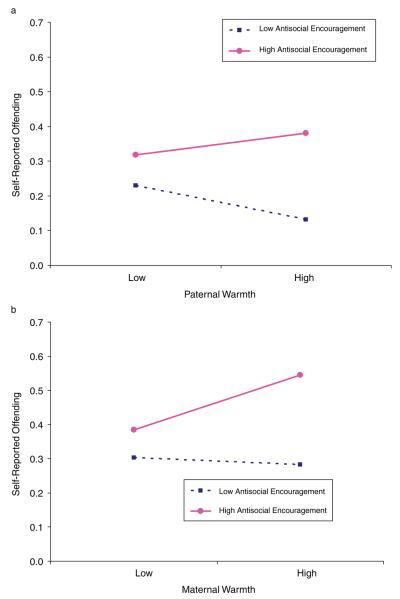
This study examined the interrelations between parental relationships, romantic relationships, and antisocial behavior among female and male juvenile delinquents. Participants from a diverse sample of 1,354 adolescents (14-17 years) adjudicated of a serious (i.e. felony) offense were matched based on age, race, and committing offense, yielding a sample of 184 girls matched with 170 boys. Results indicate that while female offenders are more likely to date boys 2 years their senior, age difference alone is not directly related to self-reported offending. Instead, findings suggest that girls who engage in self-reported delinquent behavior are more likely to experience a high degree of antisocial encouragement exerted on them by their current romantic partner. Interestingly, this relation varies with the quality (warmth) of parental relationships and the romantic partner's level of antisocial encouragement, with the association between partner encouragement and self-reported offending being strongest among youths reporting warm relationships with their opposite-sex parent.
本研究考察了青少年女性和男性罪犯中亲子关系、恋爱关系与反社会行为之间的相互关系。从1354名被判定犯有严重(即重罪)罪行的14至17岁青少年的多样化样本中选取参与者,根据年龄、种族和所犯罪行进行匹配,得到了184名女孩与170名男孩相匹配的样本。结果表明,虽然女性罪犯更有可能与比自己大两岁的男孩约会,但仅年龄差异与自我报告的犯罪行为并无直接关联。相反,研究结果表明,那些自我报告有犯罪行为的女孩更有可能受到其当前恋爱伴侣施加的高度反社会鼓励。有趣的是,这种关系会因亲子关系的质量(亲密度)以及恋爱伴侣的反社会鼓励程度而有所不同,在报告与异性父母关系亲密的青少年中,伴侣鼓励与自我报告的犯罪行为之间的关联最为强烈。