Institute for the Environment, University of North Carolina Chapel Hill, Chapel Hill NC, USA.
Int J Health Geogr. 2009 Nov 19;8:62. doi: 10.1186/1476-072X-8-62.
Evidence is growing that the built environment has the potential to influence walking--both positively and negatively. However, uncertainty remains on the best approaches to representing the pedestrian environment in order to discern associations between walking and the environment. Research into the relationship between environment and walking is complex; challenges include choice of measures (objective and subjective), quality and availability of data, and methods for managing quantitative data through aggregation and weighting. In particular, little research has examined how to aggregate built environment data to best represent the neighborhood environments expected to influence residents' behavior. This study examined associations between walking and local pedestrian supports (as measured with an environmental audit), comparing the results of models using three different methods to aggregate and weight pedestrian features.
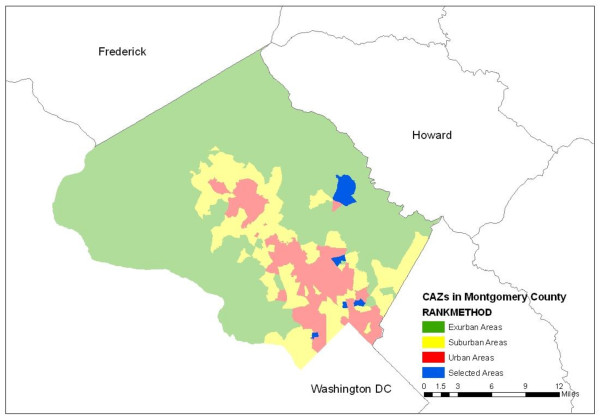
Using data collected in 2005-2006 for a sample of 251 adult residents of Montgomery County, MD, we examined associations between pedestrian facilities and walking behaviors (pedestrian trips and average daily steps). Adjusted negative binomial and ordinary least-squares regression models were used to compare three different data aggregation techniques (raw averages, length weighting, distance weighting) for measures of pedestrian facilities that included presence, condition, width and connectivity of sidewalks, and presence of crossing aids and crosswalks.
Participants averaged 8.9 walk trips during the week; daily step counts averaged 7042. The three aggregation techniques revealed different associations between walk trips and the various pedestrian facilities. Crossing aids and good sidewalk conditions were associated with walk trips more than were other pedestrian facilities, while sidewalk facilities and features showed associations with steps not observed for crossing aids and crosswalks.
Among three methods of aggregation examined, the method that accounted for distance from participant's home to the pedestrian facility (distance weighting) is promising; at the same time, it requires the most time and effort to calculate. This finding is consistent with the behavioral assumption that travelers may respond to environmental features closer to their residence more strongly than to more distant environmental qualities.
越来越多的证据表明,建筑环境有可能对步行产生积极和消极的影响。然而,在代表行人环境以辨别步行与环境之间的关联方面,最佳方法仍存在不确定性。环境与步行之间关系的研究较为复杂;挑战包括选择措施(客观和主观)、数据的质量和可用性,以及通过聚合和加权管理定量数据的方法。特别是,很少有研究探讨如何聚合建筑环境数据以最佳地代表预期影响居民行为的邻里环境。本研究比较了使用三种不同方法来聚合和加权行人特征的模型的结果,以检验步行与当地行人支持物(通过环境审计衡量)之间的关联。
本研究使用马里兰州蒙哥马利县 251 名成年人在 2005-2006 年期间收集的数据,检验了行人设施与步行行为(行人出行和平均每日步数)之间的关联。使用调整后的负二项式和普通最小二乘法回归模型,比较了三种不同的数据聚合技术(原始平均值、长度加权、距离加权)对行人设施的衡量指标,这些指标包括人行道的存在、状况、宽度和连通性,以及过街设施和横道的存在。
参与者平均每周进行 8.9 次步行出行;平均每日步数为 7042 步。三种聚合技术揭示了行人设施与步行出行之间的不同关联。过街设施和良好的人行道状况与步行出行的关联比其他行人设施更为密切,而人行道设施和特征与过街设施和横道的关联则与步数无关。
在三种聚合方法中,考虑到参与者住所到行人设施的距离(距离加权)的方法很有前途;同时,它需要花费最多的时间和精力来计算。这一发现与行为假设一致,即旅行者可能对更接近其住所的环境特征做出更强烈的反应,而不是对更远的环境质量做出反应。