Reed College, 3203 SE Woodstock Blvd., Portland, OR 97202, USA.
Drug Alcohol Depend. 2010 Mar 1;107(2-3):171-81. doi: 10.1016/j.drugalcdep.2009.10.005.
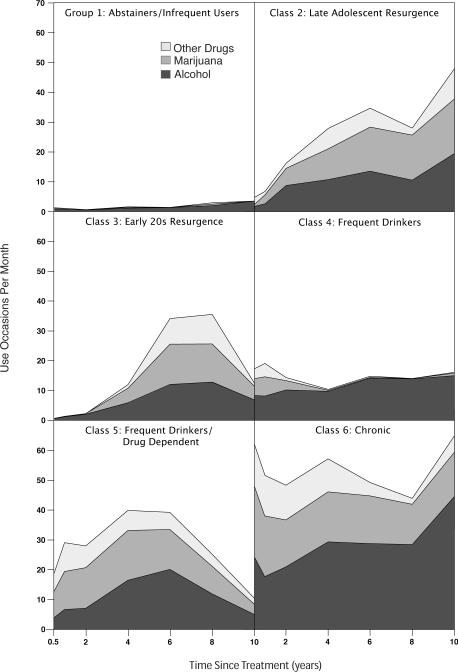
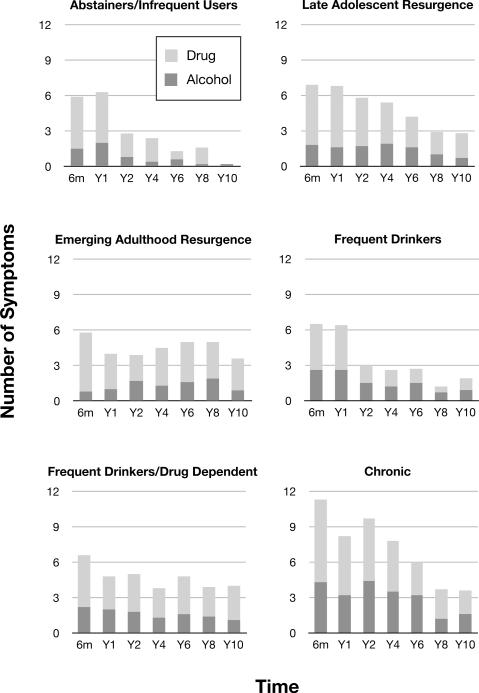
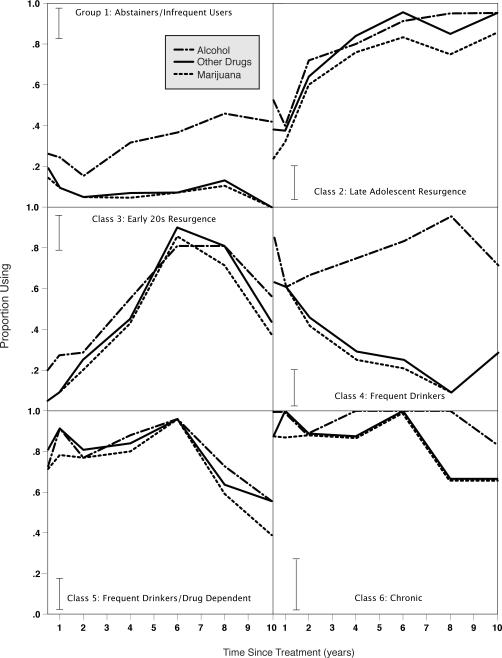
This study identified patterns of alcohol and other drug (AOD) involvement during the decade following adolescent AOD treatment and developmental outcomes in emerging adulthood. AOD and psychosocial variables were assessed at eight time points from adolescence into adulthood (n=153; 41.2% women) in an inpatient treatment sample of alcohol and other drug dependent teens. Latent class growth analysis identified six trajectories based on alcohol and substance use frequency which were consistent with developmental transitions and validated by measures of dependency symptoms. While few differences were evident at intake, the educational, occupational and interpersonal attainments were differentially associated with the alcohol/drug trajectories as youth transitioned into adulthood. High rates of high school graduation (71.1%), professional occupations (45.2%), marriage/cohabitation (48.5%), and financial responsibility for children (F[5,27]=2.75, p=.02) were evident for those with the least alcohol and drug involvement. More severe drug use trajectories were associated with higher rates of dependence, incarceration and more treatment at the final period of assessment. Outcomes of the trajectory of frequent alcohol involvement were distinct from combined alcohol and drug use. These findings highlight the long-term diversity of substance use outcomes following adolescent treatment and suggest that identification of these patterns of use following treatment can help clarify the developmental impact of youth alcohol and drug use on outcomes in young adulthood.
本研究旨在确定青少年接受酒精和其他药物(AOD)治疗后十年内 AOD 滥用模式及其对成年早期发展结果的影响。在一项青少年酒精和其他药物依赖者住院治疗样本中,从青少年期到成年期共进行了 8 次评估(n=153;41.2%为女性),评估了 AOD 和心理社会变量。基于酒精和物质使用频率的潜在类别增长分析确定了 6 个轨迹,这些轨迹与发展过渡一致,并通过依赖症状的测量得到验证。虽然在入组时差异不大,但随着青少年向成年期过渡,教育、职业和人际关系方面的成就与酒精/药物轨迹密切相关。那些酒精和药物使用量最少的青少年,高中毕业率高(71.1%)、专业职业(45.2%)、结婚/同居(48.5%)和对子女的经济责任(F[5,27]=2.75,p=.02)也高。更严重的药物使用轨迹与更高的依赖率、监禁率和在最后评估期接受更多治疗有关。频繁饮酒轨迹的结果与酒精和药物混合使用的结果不同。这些发现突出了青少年治疗后长期的物质使用结果的多样性,并表明治疗后识别这些使用模式有助于澄清青少年酒精和药物使用对成年早期结果的发展影响。