Chung Tammy, Martin Christopher S, Clark Duncan B
Western Psychiatric Institute and Clinic/Pittsburgh Adolescent Alcohol Research Center, University of Pittsburgh Medical Center, 3811 O'Hara Street, Pittsburgh, Pennsylvania 15213, USA.
J Stud Alcohol Drugs. 2008 May;69(3):420-9. doi: 10.15288/jsad.2008.69.420.
Many adolescents engage in polydrug use; however, little is known about whether alcohol and other drug problems show similar posttreatment trajectories of change. We examined concurrent patterns of change for Diagnostic and Statistical Manual of Mental Disorders, Fourth Edition, symptoms related to the use of alcohol, marijuana, and other drugs and identified predictors of the most common cross-drug patterns of change.
Adolescents (N=542) recruited from addictions treatment were assessed at baseline and at 1-and 3-year follow-up. Latent class mixture modeling identified trajectories for alcohol, marijuana, and other-drug symptoms. Latent class analysis identified cross-drug patterns of change and was used to examine conduct disorder and depression as predictors of cross-drug patterns of change.
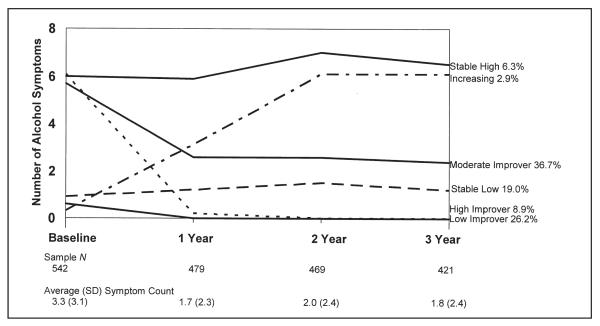
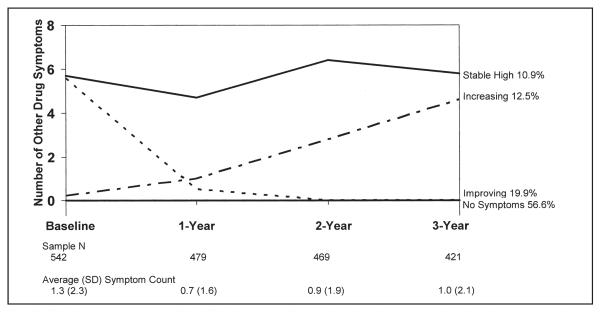
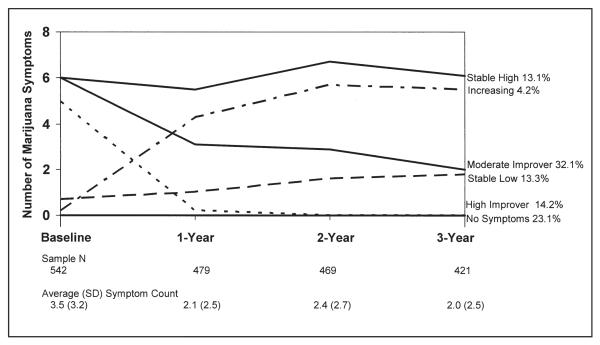
For alcohol users, three improving groups (72%), stable-low (19%) and stable-high (6%) groups, and groups with increasing trajectories (3%) were identified. For marijuana users, an asymptomatic class (23%), two improving classes (46%), stable-low (13%) and stable-high (13%) classes, and a class with an increasing trajectory (4%) were found. For users of other drugs, groups with asymptomatic (57%), improving (20%), increasing (12%), and stable-high (11%) trajectories were identified. Latent class analysis of cross-drug patterns of change identified three subtypes representing generally concordant cross-drug patterns of change and one subtype that involved stable-high marijuana problems, decreasing alcohol problems, and increasing other-drug problems. Conduct disorder was associated with greater persistence of substance problems.
The majority of treated adolescents had similar cross-drug patterns of change for alcohol, marijuana, and other drugs; however, exceptions exist. Furthermore, adolescents with co-occurring psychopathology may benefit from continuing intervention, because they tend to report more persistent posttreatment substance-related problems.
许多青少年存在多种药物滥用情况;然而,对于酒精和其他药物问题在治疗后的变化轨迹是否相似,人们知之甚少。我们研究了与酒精、大麻和其他药物使用相关的《精神疾病诊断与统计手册》第四版症状的同时变化模式,并确定了最常见的交叉药物变化模式的预测因素。
从成瘾治疗机构招募的青少年(N = 542)在基线、1年和3年随访时接受评估。潜在类别混合模型确定了酒精、大麻和其他药物症状的轨迹。潜在类别分析确定了交叉药物变化模式,并用于检验品行障碍和抑郁作为交叉药物变化模式的预测因素。
对于酒精使用者,确定了三个改善组(72%)、稳定低水平组(19%)、稳定高水平组(6%)和轨迹上升组(3%)。对于大麻使用者,发现了一个无症状类别(23%)、两个改善类别(46%)、稳定低水平类别(13%)、稳定高水平类别(13%)和一个轨迹上升类别(4%)。对于其他药物使用者,确定了无症状轨迹组(57%)、改善轨迹组(20%)、上升轨迹组(12%)和稳定高水平轨迹组(11%)。交叉药物变化模式的潜在类别分析确定了三种代表一般一致的交叉药物变化模式的亚型和一种涉及稳定高水平大麻问题、酒精问题减少和其他药物问题增加的亚型。品行障碍与物质问题的持续存在有关。
大多数接受治疗的青少年在酒精、大麻和其他药物方面有相似的交叉药物变化模式;然而,也有例外情况。此外,同时存在精神病理学问题的青少年可能会从持续干预中受益,因为他们往往报告治疗后与物质相关的问题更持久。