Peres Karen G, Peres Marco A, Araujo Cora L P, Menezes Ana M B, Hallal Pedro C
Research Group in Public Health Dentistry Post-Graduate Program in Public Health, Federal University of Santa Catarina, Florianópolis, Brazil.
Health Qual Life Outcomes. 2009 Nov 22;7:95. doi: 10.1186/1477-7525-7-95.
Harmful social conditions in early life might predispose individuals to dental status which in turn may impact on adolescents' quality of life.
To estimate the prevalence of oral health impacts among 12 yr-old Brazilian adolescents (n = 359) and its association with life course socioeconomic variables, dental status and dental services utilization in a population-based birth cohort in Southern Brazil.
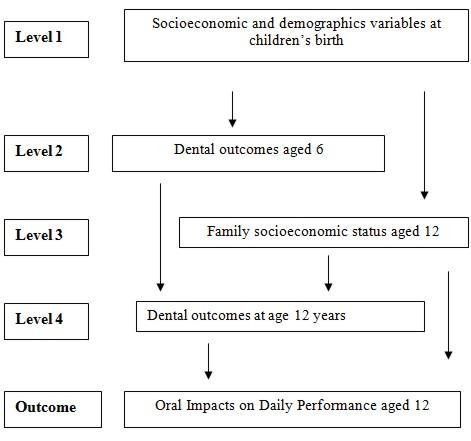
Exploratory variables were collected at birth, at 6 and 12 yr of age. The Oral Impacts on Daily Performances index (OIDP) was collected in adolescence and it was analyzed as a ranked outcome (OIDP from 0 to 9). Unadjusted and adjusted multivariable Poisson regression with robust variance was performed guided by a theoretical determination model.
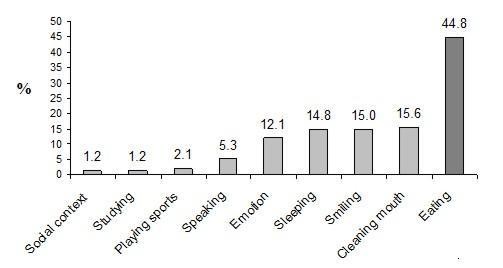
The response rate was of 94.4% (n = 339). The prevalence of OIDP = 1 was 30.1% (CI95%25.2;35.0) and OIDP >or= 2 was 28.0% (CI95%23.2;32.8). The most common daily activity affected was eating (44.8%), follow by cleaning the mouth and smiling (15.6%, and 15.0%, respectively). In the final model mother schooling and mother employment status in early cohort participant's life were associated with OIDP in adolescence. As higher untreated dental caries at age 6 and 12 years, and the presence of dental pain, gingival bleeding and incisal crowing in adolescence as higher the OIDP score. On the other hand, dental fluorosis was associated with low OIDP score.
Our findings highlight the importance of adolescent's early life social environmental as mother schooling and mother employment status and the early and later dental status on the adolescent's quality of life regardless family income and use of dental services.
早年有害的社会环境可能使个体易患牙齿问题,进而可能影响青少年的生活质量。
评估巴西12岁青少年(n = 359)口腔健康影响的患病率,及其与巴西南部一个基于人群的出生队列中的生命历程社会经济变量、牙齿状况和牙科服务利用情况之间的关联。
在出生时、6岁和12岁时收集探索性变量。在青少年时期收集日常表现口腔影响指数(OIDP),并将其作为排序结果(OIDP从0到9)进行分析。在理论决定模型的指导下,进行了未调整和调整后的稳健方差多变量泊松回归。
应答率为94.4%(n = 339)。OIDP = 1的患病率为30.1%(95%CI 25.2;35.0),OIDP≥2的患病率为28.0%(95%CI 23.2;32.8)。受影响最常见的日常活动是进食(44.8%),其次是口腔清洁和微笑(分别为15.6%和15.0%)。在最终模型中