National Institute of Floricultural Science, Tsukuba, Ibaraki 305-8519, Japan.
J Exp Bot. 2010 Mar;61(3):709-19. doi: 10.1093/jxb/erp335. Epub 2009 Nov 20.
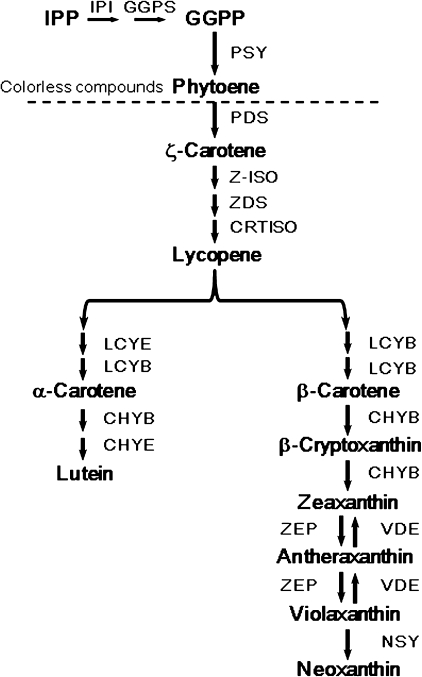
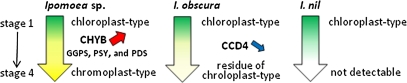
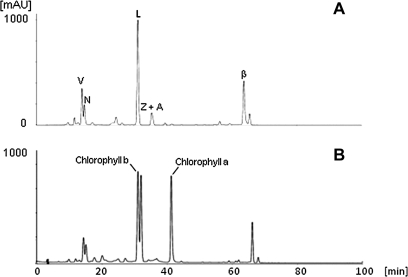
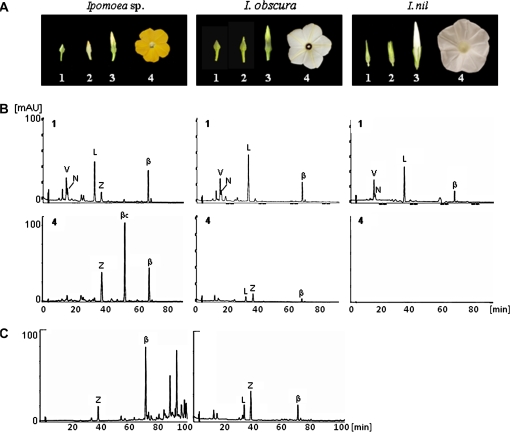
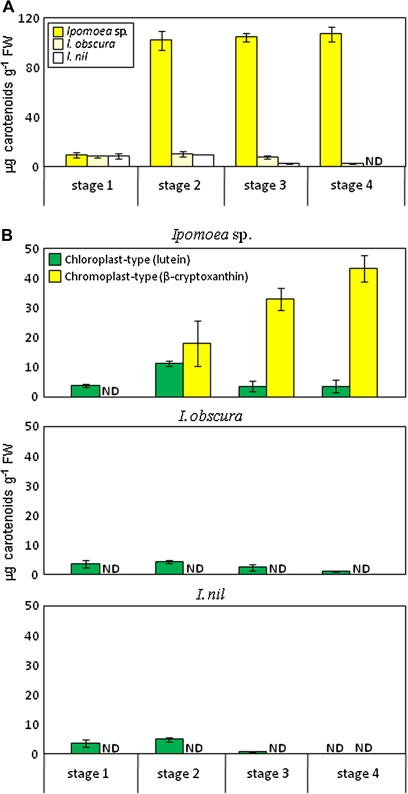
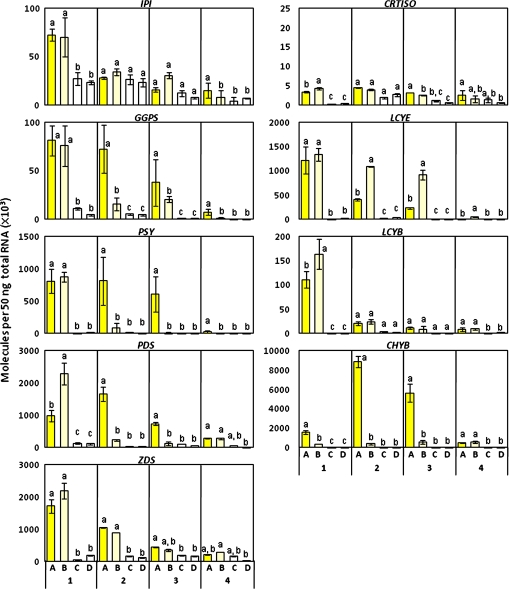
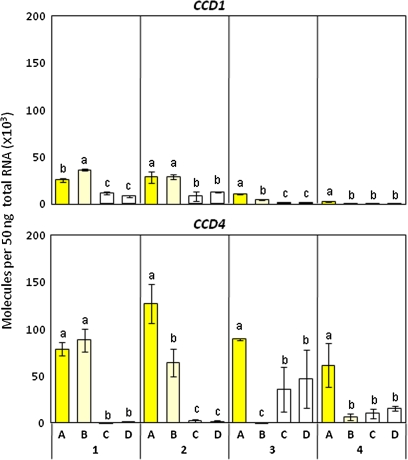
Japanese morning glory (Ipomoea nil) is a representative plant lacking a yellow-flowered cultivar, although a few wild Ipomoea species contain carotenoids in their petals such as Ipomoea sp. (yellow petals) and I. obscura (pale-yellow petals). In the present study, carotenoid composition and the expression patterns of carotenogenic genes during petal development were compared among I. nil, I. obscura, and Ipomoea sp. to identify the factors regulating carotenoid accumulation in Ipomoea plant petals. In the early stage, the carotenoid composition in petals of all the Ipomoea plants tested was the same as in the leaves mainly showing lutein, violaxanthin, and beta-carotene (chloroplast-type carotenoids). However, in fully opened flowers, chloroplast-type carotenoids were entirely absent in I. nil, whereas they were present in trace amounts in the free form in I. obscura. At the late stage of petal development in Ipomoea sp., the majority of carotenoids were beta-cryptoxanthin, zeaxanthin, and beta-carotene (chromoplast-type carotenoids). In addition, most of them were present in the esterified form. Carotenogenic gene expression was notably lower in I. nil than in Ipomoea sp. In particular, beta-ring hydroxylase (CHYB) was considerably suppressed in petals of both I. nil and I. obscura. The CHYB expression was found to be significantly high in the petals of Ipomoea sp. during the synthesis of chromoplast-type carotenoids. The expression levels of carotenoid cleavage genes (CCD1 and CCD4) were not correlated with the amount of carotenoids in petals. These results suggest that both I. obscura and I. nil lack the ability to synthesize chromoplast-type carotenoids because of the transcriptional down-regulation of carotenogenic genes. CHYB, an enzyme that catalyses the addition of a hydroxyl residue required for esterification, was found to be a key enzyme for the accumulation of chromoplast-type carotenoids in petals.
日本牵牛(Ipomoea nil)是一种缺乏黄色花卉品种的代表性植物,尽管一些野生牵牛属植物的花瓣中含有类胡萝卜素,如 Ipomoea sp.(黄色花瓣)和 I. obscura(淡黄花瓣)。在本研究中,比较了 I. nil、I. obscura 和 Ipomoea sp. 花瓣发育过程中的类胡萝卜素组成和类胡萝卜素生物合成基因的表达模式,以确定调节牵牛属植物花瓣中类胡萝卜素积累的因素。在早期,所有测试的 Ipomoea 植物花瓣中的类胡萝卜素组成与叶片中的类胡萝卜素组成相同,主要显示叶黄素、玉米黄质和β-胡萝卜素(质体型类胡萝卜素)。然而,在完全开放的花朵中,质体型类胡萝卜素在 I. nil 中完全不存在,而在 I. obscura 中则以痕量的游离形式存在。在 Ipomoea sp. 花瓣发育的晚期,大多数类胡萝卜素为β-隐黄质、玉米黄质和β-胡萝卜素(质体型类胡萝卜素)。此外,它们中的大多数以酯化形式存在。与 Ipomoea sp. 相比,I. nil 中的类胡萝卜素生物合成基因表达显著较低。特别是,β-环羟化酶(CHYB)在 I. nil 和 I. obscura 的花瓣中都受到显著抑制。在质体型类胡萝卜素合成过程中,发现 Ipomoea sp. 的花瓣中 CHYB 的表达显著升高。类胡萝卜素裂解基因(CCD1 和 CCD4)的表达水平与花瓣中的类胡萝卜素含量无关。这些结果表明,由于类胡萝卜素生物合成基因的转录下调,I. obscura 和 I. nil 都缺乏合成质体型类胡萝卜素的能力。CHYB 是一种催化酯化所需羟基残基添加的酶,是花瓣中质体型类胡萝卜素积累的关键酶。