Sutradhar Bibek Chandra, Hossain Mohammad Farhad, Das Bhajan Chandra, Kim Gonhyung, Hossain Mohammad Alamgir
Faculty of Veterinary Medicine, Chittagong Veterinary and Animal Sciences University, Chittagong -4202, Bangladesh.
J Vet Sci. 2009 Dec;10(4):343-7. doi: 10.4142/jvs.2009.10.4.343.
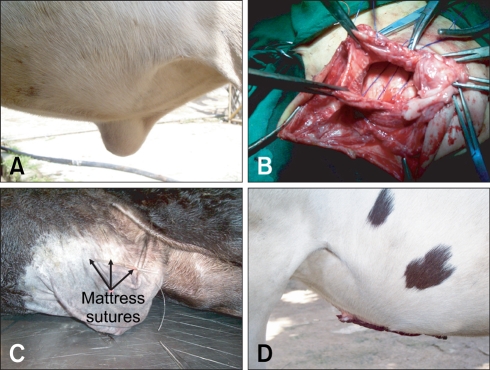
Umbilical hernias in calves commonly present to veterinary clinics, which are normally secondary to failure of the normal closure of the umbilical ring, and which result in the protrusion of abdominal contents into the overlying subcutis. The aim of this study was to compare the suitability of commonly-used herniorrhaphies for the treatment of reducible umbilical hernia in calves. Thirty-four clinical cases presenting to the Veterinary Teaching Hospital, Chittagong Veterinary and Animal Sciences University, Chittagong, Bangladesh from July 2004 to July 2007 were subjected to comprehensive study including history, classification of hernias, size of the hernial rings, presence of adhesion with the hernial sacs, postoperative care and follow-up. They were reducible, non-painful and had no evidence of infection present on palpation. The results revealed a gender influence, with the incidence of umbilical hernia being higher in female calves than in males. Out of the 34 clinical cases, 14 were treated by open method of herniorrhaphy and 20 were treated by closed method. Complications of hernia were higher (21%) in open method-treated cases than in closed method-treated cases (5%). Hernia recurred in three calves treated with open herniorrhaphy within 2 weeks of the procedure, with swelling in situ and muscular weakness at the site of operation. Shorter operation time and excellent healing rate (80%) were found in calves treated with closed herniorrhaphy. These findings suggest that the closed herniorrhaphy is better than the commonly-used open method for the correction of reducible umbilical hernia in calves.
犊牛脐疝在兽医诊所较为常见,通常继发于脐环正常闭合失败,导致腹腔内容物突出至覆盖的皮下组织。本研究的目的是比较常用的疝修补术治疗犊牛可复性脐疝的适用性。对2004年7月至2007年7月期间孟加拉国吉大港兽医和动物科学大学吉大港兽医教学医院收治的34例临床病例进行了全面研究,包括病史、疝的分类、疝环大小、与疝囊粘连情况、术后护理及随访。这些病例可复性好、无疼痛,触诊时无感染迹象。结果显示存在性别影响,雌性犊牛脐疝的发病率高于雄性。在这34例临床病例中,14例采用开放疝修补术治疗,20例采用闭合疝修补术治疗。开放手术治疗的病例疝并发症发生率(21%)高于闭合手术治疗的病例(5%)。3例接受开放疝修补术的犊牛在术后2周内疝复发,手术部位出现原位肿胀和肌肉无力。闭合疝修补术治疗的犊牛手术时间较短,愈合率良好(80%)。这些发现表明,对于犊牛可复性脐疝的矫正,闭合疝修补术优于常用的开放方法。