Barcelona Centre for International Health Research (CRESIB), Hospital Clínic, Institut d'Investigacions Biomèdiques August Pi i Sunyer, Universitat de Barcelona, Barcelona, Spain.
PLoS One. 2009 Nov 17;4(11):e7871. doi: 10.1371/journal.pone.0007871.
Artemisinin combination therapies (ACTs) are currently the preferred option for treating uncomplicated malaria. Dihydroartemisinin-piperaquine (DHA-PQP) is a promising fixed-dose ACT with limited information on its safety and efficacy in African children.
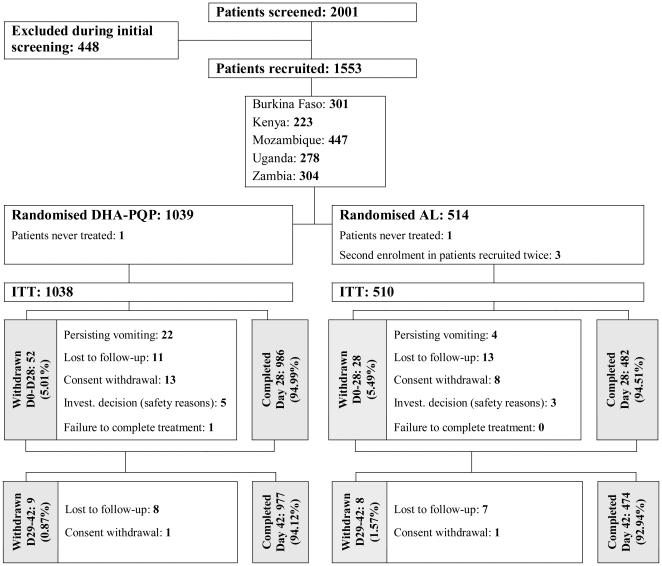
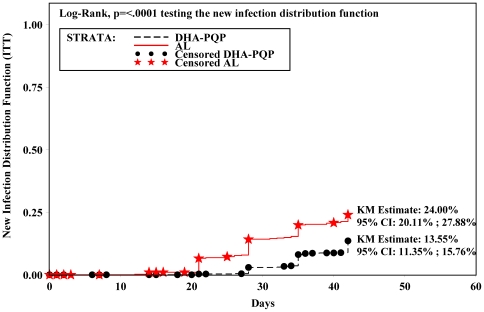
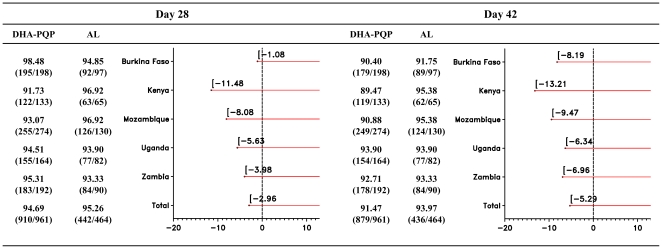
METHODOLOGY/PRINCIPAL FINDINGS: The non-inferiority of DHA-PQP versus artemether-lumefantrine (AL) in children 6-59 months old with uncomplicated P. falciparum malaria was tested in five African countries (Burkina Faso, Kenya, Mozambique, Uganda and Zambia). Patients were randomised (2:1) to receive either DHA-PQP or AL. Non-inferiority was assessed using a margin of -5% for the lower limit of the one-sided 97.5% confidence interval on the treatment difference (DHA-PQP vs. AL) of the day 28 polymerase chain reaction (PCR) corrected cure rate. Efficacy analysis was performed in several populations, and two of them are presented here: intention-to-treat (ITT) and enlarged per-protocol (ePP). 1553 children were randomised, 1039 receiving DHA-PQP and 514 AL. The PCR-corrected day 28 cure rate was 90.4% (ITT) and 94.7% (ePP) in the DHA-PQP group, and 90.0% (ITT) and 95.3% (ePP) in the AL group. The lower limits of the one-sided 97.5% CI of the difference between the two treatments were -2.80% and -2.96%, in the ITT and ePP populations, respectively. In the ITT population, the Kaplan-Meier estimate of the proportion of new infections up to Day 42 was 13.55% (95% CI: 11.35%-15.76%) for DHA-PQP vs 24.00% (95% CI: 20.11%-27.88%) for AL (p<0.0001).
CONCLUSIONS/SIGNIFICANCE: DHA-PQP is as efficacious as AL in treating uncomplicated malaria in African children from different endemicity settings, and shows a comparable safety profile. The occurrence of new infections within the 42-day follow up was significantly lower in the DHA-PQP group, indicating a longer post-treatment prophylactic effect.
Controlled-trials.com ISRCTN16263443.
青蒿素类复方疗法(ACTs)目前是治疗无并发症疟疾的首选方案。双氢青蒿素哌喹(DHA-PQP)是一种很有前途的固定剂量复方抗疟药,但其在非洲儿童中的安全性和疗效数据有限。
方法/主要发现:本研究在五个非洲国家(布基纳法索、肯尼亚、莫桑比克、乌干达和赞比亚)开展,旨在检验 6-59 月龄患有无并发症恶性疟的儿童中,DHA-PQP 相对于青蒿琥酯-阿莫地喹(AL)的非劣效性。患者按 2:1 随机分配接受 DHA-PQP 或 AL 治疗。采用治疗差异(DHA-PQP 与 AL)的 28 天聚合酶链反应(PCR)校正治愈率的单侧 97.5%置信区间下限 5%的差值作为非劣效性界值。在多个人群中进行了疗效分析,其中两种人群在此呈现:意向治疗(ITT)和扩大符合方案(ePP)。共纳入 1553 例患儿,其中 1039 例接受 DHA-PQP 治疗,514 例接受 AL 治疗。DHA-PQP 组和 AL 组的 28 天 PCR 校正治愈率分别为 90.4%(ITT)和 94.7%(ePP),90.0%(ITT)和 95.3%(ePP)。在 ITT 人群中,两种治疗方法的差异的单侧 97.5%CI 的下限分别为-2.80%和-2.96%。在 ITT 人群中,DHA-PQP 组和 AL 组第 42 天前新发感染的 Kaplan-Meier 估计比例分别为 13.55%(95%CI:11.35%-15.76%)和 24.00%(95%CI:20.11%-27.88%)(p<0.0001)。
结论/意义:DHA-PQP 治疗非洲不同流行地区儿童的无并发症疟疾与 AL 疗效相当,安全性相当。在 42 天随访期间,DHA-PQP 组新感染的发生率显著降低,表明其在治疗后具有更长的预防性作用。
controlled-trials.com ISRCTN80242409。