Université François-Rabelais de Tours, 3 rue des Tanneurs, 37041 Tours Cedex 1, France.
Arthritis Res Ther. 2009;11(6):R178. doi: 10.1186/ar2867. Epub 2009 Nov 25.
Adjustment of infliximab dosage for individuals may be useful in improving therapeutic response in rheumatoid arthritis (RA). Herein, we aimed to determine whether measurement of infliximab serum concentration modifies the therapeutic decision and improves the control of disease activity.
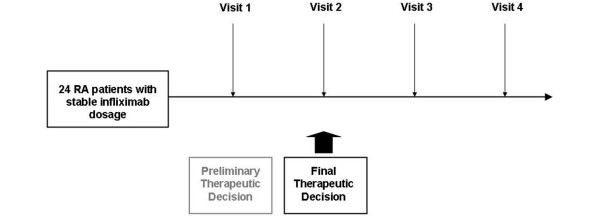
RA patients routinely treated with infliximab were included in an observational open-label study. On visit 1 (V1), according to the disease activity, a preliminary therapeutic decision was selected among four therapeutic options and a blood sample was collected to measure trough serum infliximab concentration. The final therapeutic decision, based on both disease activity and serum infliximab concentration assessed at V1, was applied at the following infusion (V2). Clinical and biological evaluations were performed at V3 and V4 and compared with those at V1.
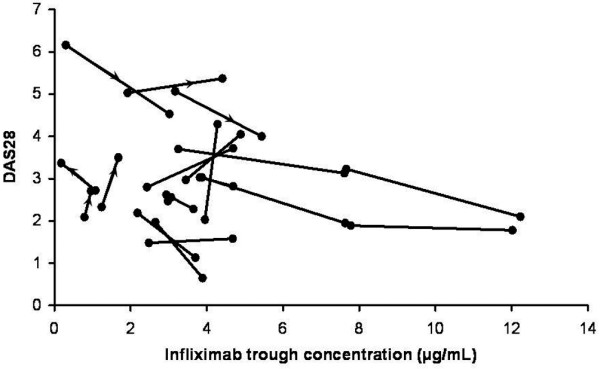
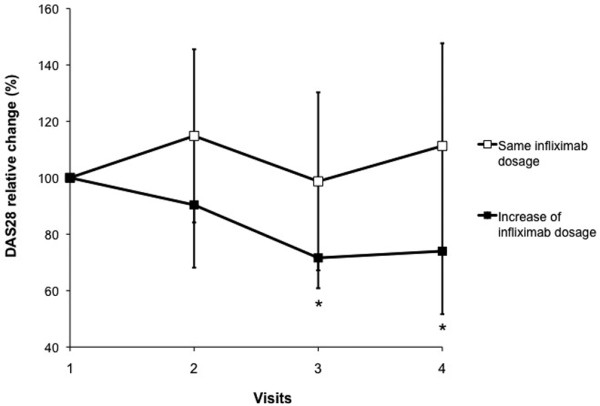
We included 24 patients. The final therapeutic decision differed from the preliminary decision for 12 patients (50%). For patients with increased infliximab dosage at V2, mean disease activity score for 28 joints (DAS28) decreased by about 20% at V3 or V4 as compared with V1 (P < 0.05). Decreased DAS28 was correlated with increased serum infliximab concentration (P < 0.02).
The measurement of infliximab trough concentration modifies the therapeutic decision for RA patients and helps improve control of disease activity. Therapeutic drug monitoring of infliximab in RA may be useful for individual dosage adjustment.
调整英夫利昔单抗的剂量可能有助于改善类风湿关节炎(RA)的治疗反应。在此,我们旨在确定英夫利昔单抗的血清浓度测量是否会改变治疗决策并改善疾病活动的控制。
纳入常规接受英夫利昔单抗治疗的 RA 患者进行一项观察性、开放标签研究。在第 1 次就诊(V1),根据疾病活动度,在四种治疗方案中选择初步治疗决策,并采集血样以测量英夫利昔单抗的血清谷浓度。根据 V1 时的疾病活动度和血清英夫利昔单抗浓度评估,在随后的输注(V2)时做出最终治疗决策。在 V3 和 V4 时进行临床和生物学评估,并与 V1 时进行比较。
共纳入 24 例患者。12 例患者(50%)的最终治疗决策与初步决策不同。对于 V2 时增加英夫利昔单抗剂量的患者,V3 或 V4 时的 28 个关节疾病活动度评分(DAS28)较 V1 时降低约 20%(P < 0.05)。DAS28 的降低与血清英夫利昔单抗浓度的增加相关(P < 0.02)。
英夫利昔单抗的血清谷浓度测量改变了 RA 患者的治疗决策,并有助于改善疾病活动的控制。RA 患者英夫利昔单抗的治疗药物监测可能有助于个体化剂量调整。