Department of Biological Sciences, Vanderbilt University, Nashville, Tennessee, United States of America.
PLoS One. 2009 Nov 25;4(11):e7509. doi: 10.1371/journal.pone.0007509.
KaiC, a central clock protein in cyanobacteria, undergoes circadian oscillations between hypophosphorylated and hyperphosphorylated forms in vivo and in vitro. Structural analyses of KaiC crystals have identified threonine and serine residues in KaiC at three residues (T426, S431, and T432) as potential sites at which KaiC is phosphorylated; mutation of any of these three sites to alanine abolishes rhythmicity, revealing an essential clock role for each residue separately and for KaiC phosphorylation in general. Mass spectrometry studies confirmed that the S431 and T432 residues are key phosphorylation sites, however, the role of the threonine residue at position 426 was not clear from the mass spectrometry measurements.
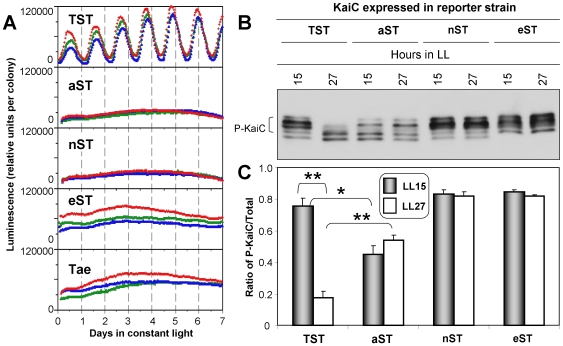
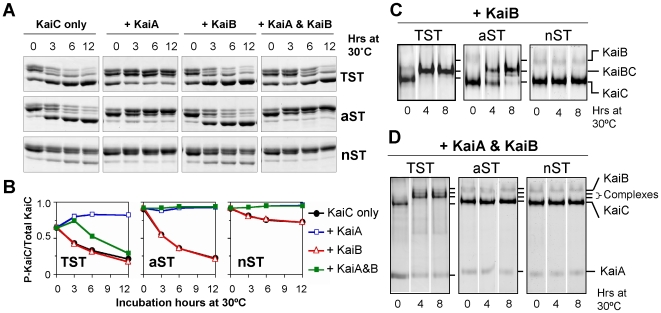
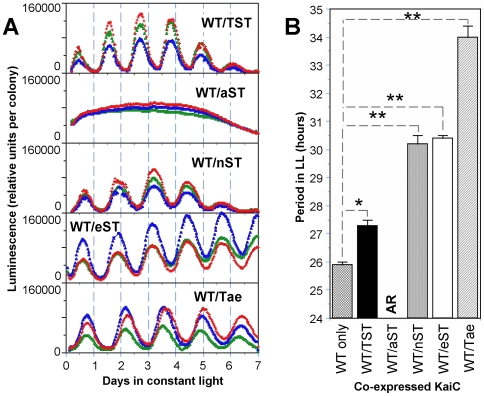
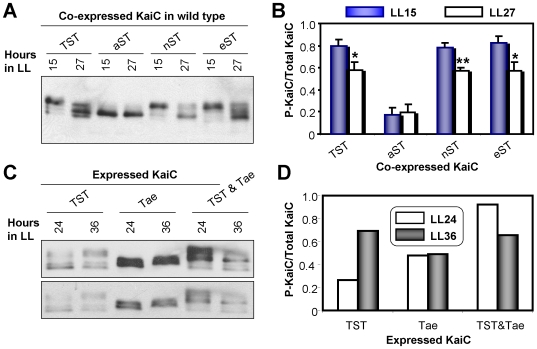
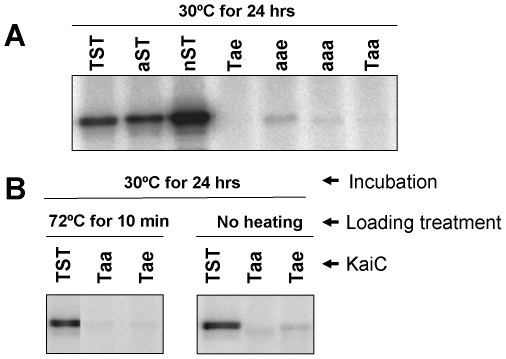
Mutational approaches and biochemical analyses of KaiC support a key role for T426 in control of the KaiC phosphorylation status in vivo and in vitro and demonstrates that alternative amino acids at residue 426 dramatically affect KaiC's properties in vivo and in vitro, especially genetic dominance/recessive relationships, KaiC dephosphorylation, and the formation of complexes of KaiC with KaiA and KaiB. These mutations alter key circadian properties, including period, amplitude, robustness, and temperature compensation. Crystallographic analyses indicate that the T426 site is phosphorylatible under some conditions, and in vitro phosphorylation assays of KaiC demonstrate labile phosphorylation of KaiC when the primary S431 and T432 sites are blocked.
T426 is a crucial site that regulates KaiC phosphorylation status in vivo and in vitro and these studies underscore the importance of KaiC phosphorylation status in the essential cyanobacterial circadian functions. The regulatory roles of these phosphorylation sites--including T426--within KaiC enhance our understanding of the molecular mechanism underlying circadian rhythm generation in cyanobacteria.
蓝藻中的中央生物钟蛋白 KaiC 在体内和体外会经历去磷酸化和高磷酸化形式的昼夜振荡。对 KaiC 晶体的结构分析鉴定了 KaiC 中的三个残基(T426、S431 和 T432)上的苏氨酸和丝氨酸残基是 KaiC 磷酸化的潜在位点;将这三个位点中的任何一个突变为丙氨酸都会消除节律性,从而分别揭示了每个残基和 KaiC 磷酸化在总体上对生物钟的重要作用。质谱研究证实 S431 和 T432 残基是关键的磷酸化位点,然而,从质谱测量中尚不清楚位置 426 上的苏氨酸残基的作用。
KaiC 的突变方法和生化分析支持 T426 在控制体内和体外 KaiC 磷酸化状态中的关键作用,并表明 426 位上的替代氨基酸会极大地影响 KaiC 在体内和体外的特性,尤其是遗传显性/隐性关系、KaiC 去磷酸化和 KaiC 与 KaiA 和 KaiB 形成复合物。这些突变改变了关键的昼夜节律特性,包括周期、幅度、稳健性和温度补偿。晶体学分析表明,在某些条件下 T426 位点是可磷酸化的,并且体外 KaiC 磷酸化实验表明,当主要的 S431 和 T432 位点被阻断时,KaiC 的磷酸化是不稳定的。
T426 是一个关键的位点,调节 KaiC 在体内和体外的磷酸化状态,这些研究强调了 KaiC 磷酸化状态在蓝藻基本生物钟功能中的重要性。这些磷酸化位点——包括 T426——在 KaiC 中的调节作用增强了我们对蓝藻昼夜节律产生分子机制的理解。