Paddison Charlotte A M, Eborall Helen C, Sutton Stephen, French David P, Vasconcelos Joana, Prevost A Toby, Kinmonth Ann-Louise, Griffin Simon J
General Practice and Primary Care Research Unit, University of Cambridge, Institute of Public Health, Cambridge CB2 0SR.
BMJ. 2009 Nov 30;339:b4535. doi: 10.1136/bmj.b4535.
To assess whether receiving a negative test result at primary care based stepwise diabetes screening results in false reassurance.
Parallel group cohort study embedded in a randomised controlled trial.
15 practices (10 screening, 5 control) in the ADDITION (Cambridge) trial.
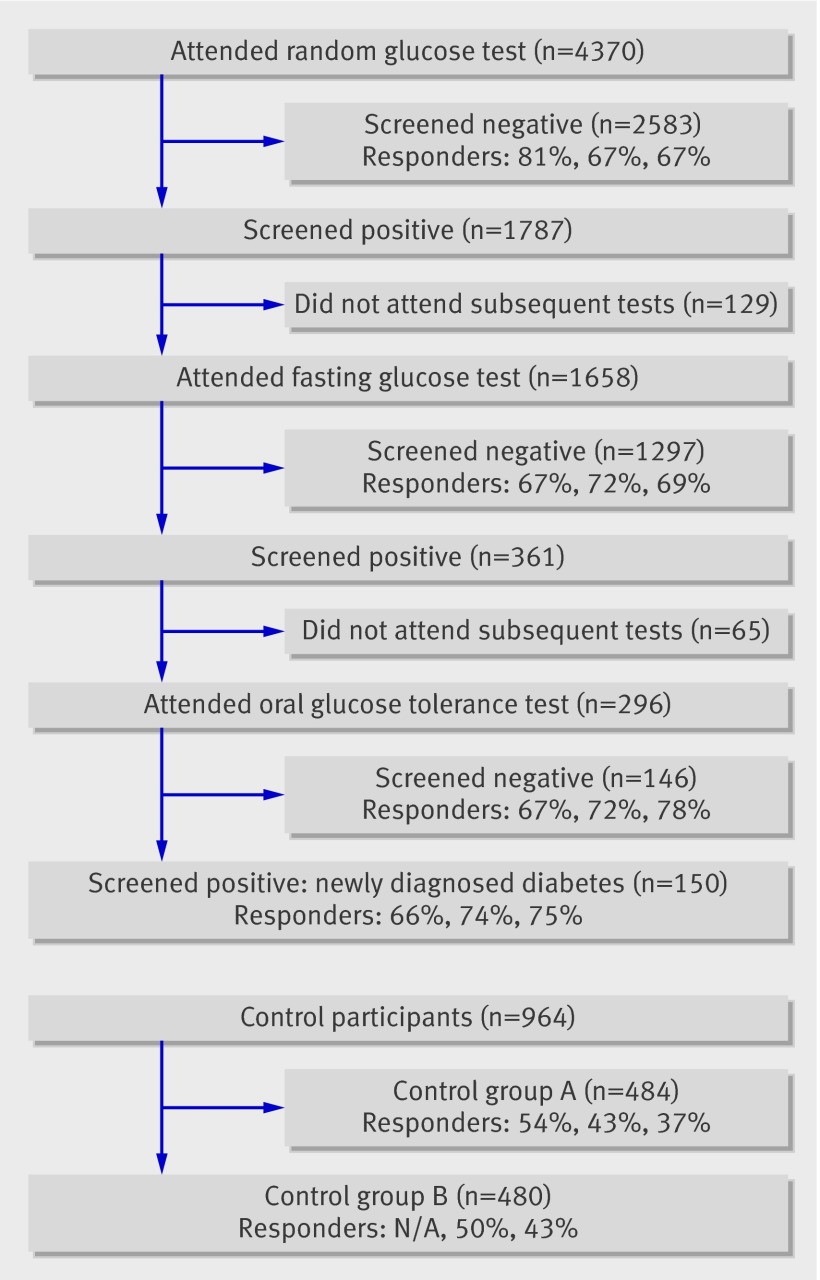
5334 adults (aged 40-69) in the top quarter for risk of having undiagnosed type 2 diabetes (964 controls and 4370 screening attenders).
Perceived personal and comparative risk of diabetes, intentions for behavioural change, and self rated health measured after an initial random blood glucose test and at 3-6 and 12-15 months later (equivalent time points for controls).
A linear mixed effects model with control for clustering by practice found no significant differences between controls and people who screened negative for diabetes in perceived personal risk, behavioural intentions, or self rated health after the first appointment or at 3-6 months or 12-15 months later. After the initial test, people who screened negative reported significantly (but slightly) lower perceived comparative risk (mean difference -0.16, 95% confidence interval -0.30 to -0.02; P=0.04) than the control group at the equivalent time point; no differences were evident at 3-6 and 12-15 months.
A negative test result at diabetes screening does not seem to promote false reassurance, whether this is expressed as lower perceived risk, lower intentions for health related behavioural change, or higher self rated health. Implementing a widespread programme of primary care based stepwise screening for type 2 diabetes is unlikely to cause an adverse shift in the population distribution of plasma glucose and cardiovascular risk resulting from an increase in unhealthy behaviours arising from false reassurance among people who screen negative. Trial registration Current controlled trials ISRCTN99175498.
评估在基层医疗逐步进行的糖尿病筛查中获得阴性检测结果是否会导致错误的安心感。
嵌入随机对照试验的平行组队列研究。
ADDITION(剑桥)试验中的15家医疗机构(10家筛查机构,5家对照机构)。
处于未诊断2型糖尿病风险最高四分之一的5334名成年人(年龄40 - 69岁)(964名对照者和4370名筛查参与者)。
在首次随机血糖检测后以及3 - 6个月和12 - 15个月后(对照者的等效时间点)测量的糖尿病个人感知风险和比较风险、行为改变意图以及自我健康评分。
采用考虑机构聚类因素的线性混合效应模型,发现在首次就诊后、3 - 6个月或12 - 15个月后,对照者与糖尿病筛查阴性者在个人感知风险、行为意图或自我健康评分方面无显著差异。首次检测后,筛查阴性者报告的感知比较风险显著(但轻微)低于等效时间点的对照组(平均差异 -0.16,95%置信区间 -0.30至 -0.02;P = 0.04);在3 - 6个月和12 - 15个月时无明显差异。
糖尿病筛查的阴性检测结果似乎不会导致错误的安心感,无论是表现为较低的感知风险、较低的健康相关行为改变意图还是较高的自我健康评分。实施广泛的基于基层医疗的2型糖尿病逐步筛查计划不太可能因筛查阴性者错误安心导致的不健康行为增加而使人群血浆葡萄糖和心血管风险的分布出现不利变化。试验注册 现行对照试验ISRCTN99175498 。