Department of Translational Physiology, Academic Medical Center, University of Amsterdam, Meibergdreef 9, 1105 AZ Amsterdam, the Netherlands.
Crit Care. 2009;13 Suppl 5(Suppl 5):S5. doi: 10.1186/cc8003. Epub 2009 Nov 30.
Hypovolemia and hypovolemic shock are life-threatening conditions that occur in numerous clinical scenarios. Near-infrared spectroscopy (NIRS) has been widely explored, successfully and unsuccessfully, in an attempt to use it as an early detector of hypovolemia by measuring tissue oxygen saturation (StO2). In order to investigate the measurement site dependence and probe dependence of NIRS in response to hemodynamic changes, such as hypovolemia, we applied a simple cardiovascular challenge: a posture change from supine to upright, causing a decrease in stroke volume (as in hypovolemia) and a heart rate increase in combination with peripheral vasoconstriction to maintain adequate blood pressure.
Multi-depth NIRS was used in nine healthy volunteers to assess changes in StO2 in the thenar and forearm in response to the hemodynamic changes associated with a posture change from supine to upright.
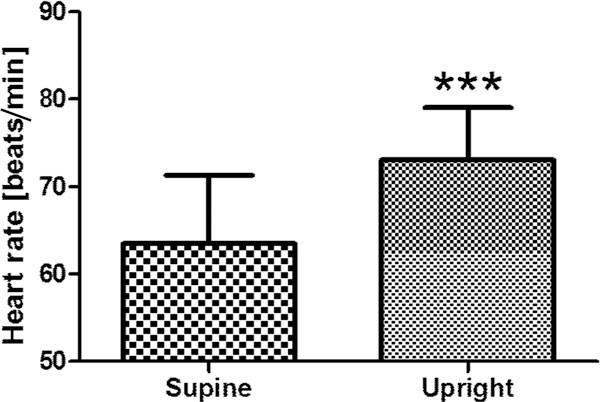
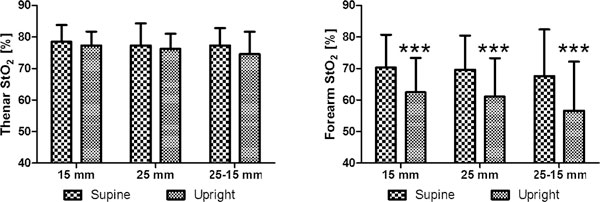
A posture change from supine to upright resulted in a significant increase (P < 0.001) in heart rate. Thenar StO2 did not respond to the hemodynamic changes following the posture change, whereas forearm StO2 did. Forearm StO2 was significantly lower (P < 0.001) in the upright position compared to supine for all probing depths.
The primary findings in this study were that forearm StO2 is a more sensitive parameter to hemodynamic changes than thenar StO2 and that the depth at which StO2 is measured is of minor influence. Our data support the use of forearm StO2 as a sensitive parameter for the detection of central hypovolemia and hypovolemic shock in (trauma) patients.
低血容量和低血容量性休克是发生在许多临床情况下的危及生命的情况。近红外光谱(NIRS)已被广泛探索,成功和不成功地试图通过测量组织氧饱和度(StO2)将其用作低血容量的早期检测器。为了研究 NIRS 对血流动力学变化(如低血容量)的测量部位依赖性和探头依赖性,我们应用了一种简单的心血管挑战:从仰卧位变为直立位的姿势变化,导致心输出量减少(如低血容量),心率增加,同时外周血管收缩以维持足够的血压。
九名健康志愿者使用多深度 NIRS 评估仰卧位变为直立位时,大鱼际和前臂的 StO2 变化对与姿势变化相关的血流动力学变化的反应。
从仰卧位变为直立位导致心率显著增加(P <0.001)。大鱼际 StO2 对姿势变化后的血流动力学变化没有反应,而前臂 StO2 有反应。与仰卧位相比,所有探测深度的直立位前臂 StO2 均显著降低(P <0.001)。
本研究的主要发现是,前臂 StO2 是对血流动力学变化比大鱼际 StO2 更敏感的参数,并且测量 StO2 的深度影响较小。我们的数据支持使用前臂 StO2 作为(创伤)患者中心性低血容量和低血容量性休克的敏感参数。