Department of Anesthesiology & Critical Care Medicine - SAMU and Laboratory of Anesthesiology, EA322, Hospital Lariboisière, AP-HP and Paris 7 Diderot University, 2 rue Ambroise Paré, 75010 Paris, France.
Crit Care. 2009;13 Suppl 5(Suppl 5):S6. doi: 10.1186/cc8004. Epub 2009 Nov 30.
The study objectives were to evaluate septic shock-induced alterations in skeletal muscle hemoglobin oxygenation saturation (StO2) using near-infrared spectroscopy (NIRS) and forearm skin blood flow velocity using laser Doppler (LD) to determine the relationship of macroperfusion and microperfusion parameters, and to test the relationship of the worst NIRS parameters during the first 24 hours of shock with 28-day prognosis.
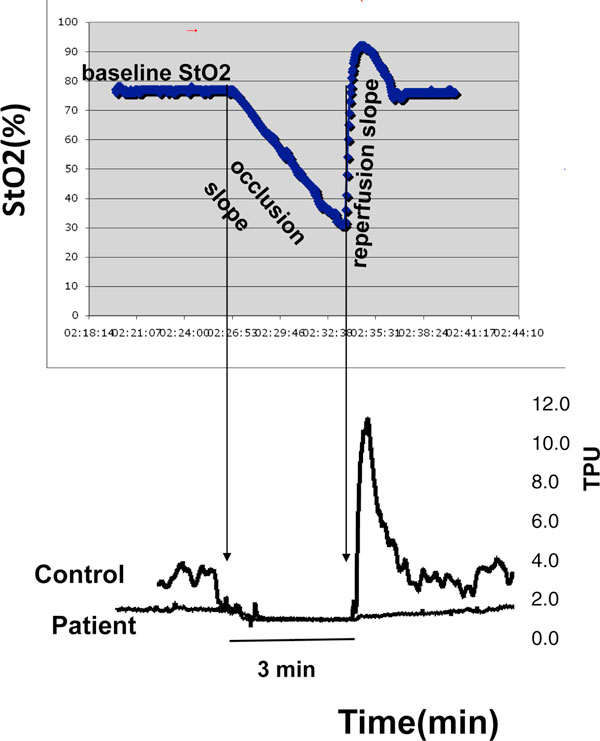
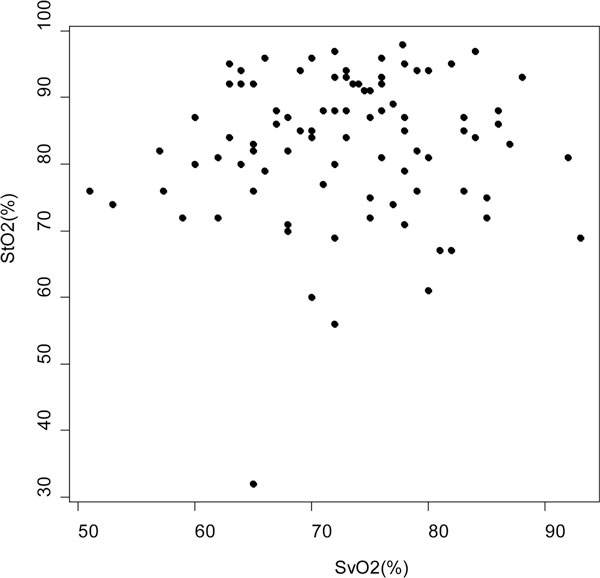
A prospective, observational study was performed in a 21-bed university hospital surgical intensive care unit. Forty-three septic shock patients with at least another organ failure underwent a 3-minute, upper arm (brachial artery) vascular occlusion test (VOT). Microperfusion parameters (thenar eminence StO2 and forearm LD skin blood flow) were collected on days 1, 2 and 3, before (baseline StO2 and LD values) and during the 3-minute VOT with calculation of occlusion and reperfusion slopes for StO2 and LD. Daily Sequential Organ Failure Assessment (SOFA) score, macrohemodynamic parameters (systolic arterial blood pressure, cardiac output (pulmonary artery catheter or transesophageal Doppler), mixed venous oxygen saturation (pulmonary artery or superior vena cava catheter)) and metabolic parameters (pH, base excess, lactate) were determined.
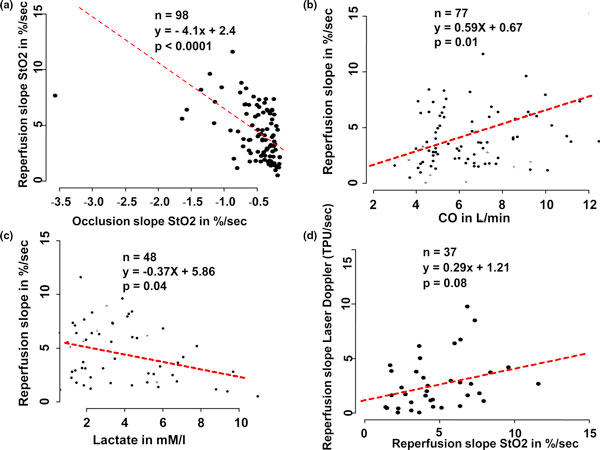
Baseline StO2 (82% (75 to 88) vs. 89% (85 to 92), P = 0.04) and reperfusion slope (2.79%/second (1.75 to 4.32) vs. 9.35%/second (8.32 to 11.57), P < 0.0001) were lower in septic shock patients than in healthy volunteers. StO2 reperfusion slope correlated with occlusion slope (P < 0.0001), cardiac output (P = 0.01) and LD reperfusion slope (P = 0.08), and negatively with lactate level (P = 0.04). The worst StO2 reperfusion slope during the first day of shock was lower in nonsurvivors than in survivors (P = 0.003) and improved significantly the predictive value of Simplified Acute Physiology Score II and SOFA scores.
The alteration of StO2 reperfusion slope in septic shock patients compared with healthy volunteers was related with macrohemodynamic, microhemodynamic and metabolic parameters. The addition of the worst value of the day 1 StO2 reperfusion slope improved the outcome prediction of Simplified Acute Physiology Score II and SOFA scores.
本研究旨在通过近红外光谱(NIRS)评估脓毒性休克患者骨骼肌血红蛋白氧饱和度(StO2)的变化,并通过激光多普勒(LD)评估前臂皮肤血流速度,以确定宏观灌注和微观灌注参数之间的关系,并检验休克后 24 小时内最差 NIRS 参数与 28 天预后的关系。
本前瞻性观察性研究在一家 21 床位的大学医院外科重症监护病房进行。43 例至少伴有其他器官衰竭的脓毒性休克患者进行了 3 分钟的上臂(肱动脉)血管闭塞试验(VOT)。在 VOT 前(基础 StO2 和 LD 值)和 3 分钟内,收集微灌注参数(鱼际区 StO2 和前臂 LD 皮肤血流),并计算 StO2 和 LD 的闭塞和再灌注斜率。每日序贯器官衰竭评估(SOFA)评分、宏观血流动力学参数(收缩压、心输出量(肺动脉导管或经食管多普勒)、混合静脉血氧饱和度(肺动脉或上腔静脉导管))和代谢参数(pH 值、碱剩余、乳酸)。
与健康志愿者相比,脓毒性休克患者的基础 StO2(82%(75 至 88)比 89%(85 至 92),P=0.04)和再灌注斜率(2.79%/秒(1.75 至 4.32)比 9.35%/秒(8.32 至 11.57),P<0.0001)较低。StO2 再灌注斜率与闭塞斜率(P<0.0001)、心输出量(P=0.01)和 LD 再灌注斜率(P=0.08)相关,与乳酸水平呈负相关(P=0.04)。休克后第 1 天最差 StO2 再灌注斜率在非幸存者中低于幸存者(P=0.003),并显著提高了简化急性生理学评分 II 和 SOFA 评分的预测价值。
与健康志愿者相比,脓毒性休克患者 StO2 再灌注斜率的改变与宏观血流动力学、微观血流动力学和代谢参数有关。第 1 天 StO2 再灌注斜率的最差值的加入提高了简化急性生理学评分 II 和 SOFA 评分的预后预测。