Cancer Research UK Cancer Survival Group, Non-Communicable Disease Epidemiology Unit, Department of Epidemiology and Population Health, London School of Hygiene and Tropical Medicine, Keppel Street, London, UK.
Br J Cancer. 2009 Dec 3;101 Suppl 2(Suppl 2):S115-24. doi: 10.1038/sj.bjc.6605401.
To estimate the number of deaths among cancer patients diagnosed in Great Britain that would be avoidable within 5 years of diagnosis if the mean (or highest) survival in Europe for patients diagnosed during 1985-1989, 1990-1994 and 1995-1999 were achieved.
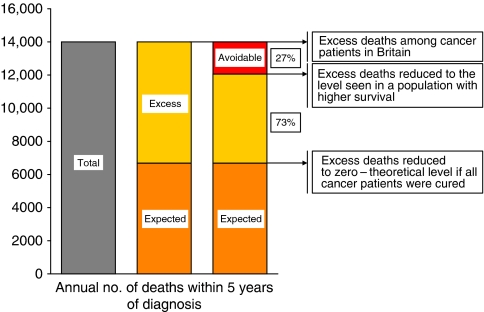
Five-year relative survival for cancers in Great Britain compared with that from other countries in the EUROCARE-2, -3 and -4 studies. Calculation of excess deaths (those more than expected from mortality in the general population) that would be avoidable among cancer patients in Britain if relative survival were the same as in Europe.
Great Britain (England, Wales, Scotland) and 13 other European countries.
2.8 million adults diagnosed in Britain with 1 of 39 cancers during 1985-1989 (followed up to 1994), 1990-1994 (followed up to 1999) and 1995-1999 (followed up to 2003).
Annual number of avoidable deaths within 5 years of diagnosis. Percentage of the excess (cancer-related) deaths among cancer patients that would be avoidable.
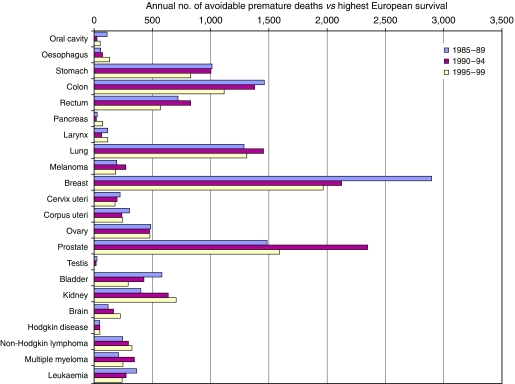
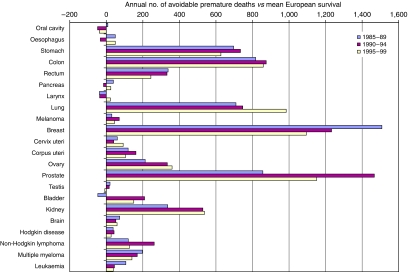
Compared with the mean European 5-year relative survival, the largest numbers of avoidable deaths for patients diagnosed during 1985-1989 were for cancers of the breast (about 18% of the excess mortality from this cancer, 7541 deaths), prostate (14%, 4285), colon (9%, 4090), stomach (8%, 3483) and lung (2%, 3548). For 1990-1994, the largest numbers of avoidable deaths were for cancers of the prostate (20%, 7335), breast (15%, 6165), colon (9%, 4376), stomach (9%, 3672), lung (2%, 3735) and kidney (22%, 2644). For 1995-1999, most of the avoidable deaths were for cancers of the prostate (17%, 5758), breast (15%, 5475), lung (3%, 4923), colon (10%, 4295), stomach (9%, 3137) and kidney (21%, 2686).Overall, some 6600-7500 premature deaths would have been avoided each year among cancer patients diagnosed in Britain during 1985-1999 if the mean survival in Europe had been achieved. This represents 6-7% of cancer-related mortality. Compared with the highest European survival, avoidable premature mortality among cancer patients fell from about 12 800 deaths a year (12.2% of cancer-related mortality) to about 11 400 deaths a year (10.6%) over the same period.A large component of the avoidable mortality is due to prostate cancer: excluding this cancer from comparison with the European mean survival reduces the annual number of avoidable deaths by 1000-1500, and the percentage of excess mortality by up to 1%. Compared with the highest survival, the annual number of avoidable deaths would be 1500-2000 fewer, and 1-2% lower as a percentage of excess mortality, but the overall trend in avoidable premature mortality among cancer patients would be similar, falling from 11.4% (1985-1989) to 10.3% (1990-1994) and 9.7% for those diagnosed during 1995-1999.For several cancers, survival in Britain was slightly higher than the mean survival in Europe; this represented some 110-180 premature deaths avoided each year during the period 1985-2003.
Avoidable premature mortality among cancer patients diagnosed in Britain during 1985-1999 has represented 6-7% of cancer-related mortality compared with the mean survival in Europe. Compared with the highest levels of survival in Europe, the reduction from 12.2% to 10.6% of cancer-related mortality reflects small but steady progress over the period 1985-2003.
如果英国在诊断后 5 年内达到欧洲 1985-1989 年、1990-1994 年和 1995-1999 年期间诊断的患者的平均(或最高)生存率,则估计英国癌症患者中有多少死亡是可以避免的。
英国癌症的 5 年相对生存率与 EUROCARE-2、-3 和 -4 研究中其他国家的生存率进行比较。计算如果英国癌症患者的相对生存率与欧洲相同,那么英国癌症患者中每年可能会有多少超额死亡(即超过一般人群死亡率的死亡)。
英国(英格兰、威尔士、苏格兰)和其他 13 个欧洲国家。
1985-1989 年期间(随访至 1994 年)、1990-1994 年期间(随访至 1999 年)和 1995-1999 年期间(随访至 2003 年)在英国被诊断出患有 39 种癌症之一的 280 万成年人。
诊断后 5 年内可避免的每年死亡人数。癌症患者中可避免的超额死亡(与癌症相关)的百分比。
与欧洲 5 年平均相对生存率相比,1985-1989 年期间诊断出的癌症患者中,乳腺癌(约占这种癌症超额死亡率的 18%,7541 例死亡)、前列腺癌(14%,4285 例)、结肠癌(9%,4090 例)、胃癌(8%,3483 例)和肺癌(2%,3548 例)的死亡人数最多。对于 1990-1994 年,可避免的死亡人数最多的是前列腺癌(20%,7335 例)、乳腺癌(15%,6165 例)、结肠癌(9%,4376 例)、胃癌(9%,3672 例)、肺癌(2%,3735 例)和肾癌(22%,2644 例)。对于 1995-1999 年,前列腺癌(17%,5758 例)、乳腺癌(15%,5475 例)、肺癌(3%,4923 例)、结肠癌(10%,4295 例)、胃癌(9%,3137 例)和肾癌(21%,2686 例)的可避免死亡人数最多。总体而言,如果英国在 1985-1999 年期间诊断出的癌症患者的平均生存率达到欧洲水平,每年将有 6600-7500 例癌症患者过早死亡。这占癌症相关死亡率的 6-7%。与欧洲最高生存率相比,同期癌症患者的可避免过早死亡率从每年约 12800 例(占癌症相关死亡率的 12.2%)降至每年约 11400 例(10.6%)。可避免死亡率的很大一部分是由前列腺癌引起的:如果将前列腺癌与欧洲平均生存率进行比较,则每年可避免的死亡人数减少 1000-1500 人,超额死亡率降低 1%。与最高生存率相比,每年可避免的死亡人数将减少 1500-2000 人,超额死亡率降低 1-2%,但癌症患者可避免的过早死亡率总体趋势相似,从 1985-1989 年的 11.4%降至 1990-1994 年的 10.3%和 1995-1999 年的 9.7%。对于一些癌症,英国的生存率略高于欧洲的平均生存率;这代表在 1985-2003 年期间每年可避免 110-180 例过早死亡。
与欧洲平均生存率相比,1985-1999 年期间在英国诊断出的癌症患者的可避免过早死亡率占癌症相关死亡率的 6-7%。与欧洲最高生存率相比,从 12.2%降至 10.6%的癌症相关死亡率反映了 1985-2003 年期间的稳步进展。