Fraser James S, Clarkson Michael W, Degnan Sheena C, Erion Renske, Kern Dorothee, Alber Tom
Department of Molecular and Cell Biology/QB3, University of California, Berkeley, California 94720-3220, USA.
Nature. 2009 Dec 3;462(7273):669-73. doi: 10.1038/nature08615.
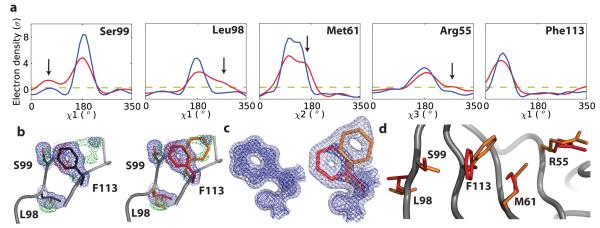
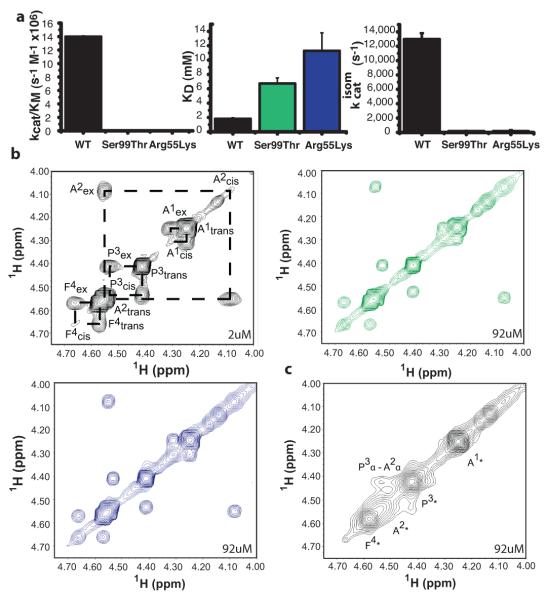
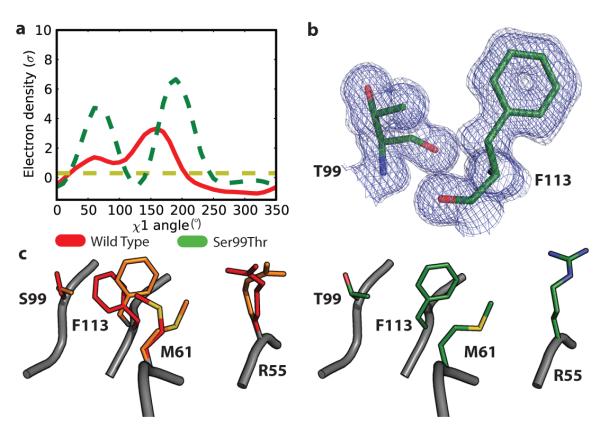
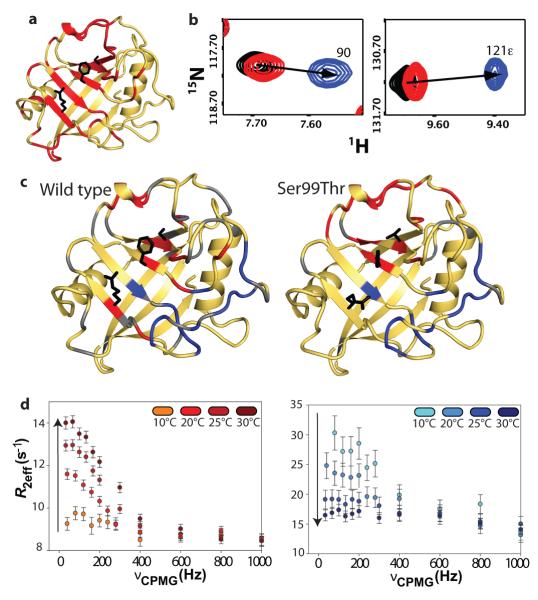
A long-standing challenge is to understand at the atomic level how protein dynamics contribute to enzyme catalysis. X-ray crystallography can provide snapshots of conformational substates sampled during enzymatic reactions, while NMR relaxation methods reveal the rates of interconversion between substates and the corresponding relative populations. However, these current methods cannot simultaneously reveal the detailed atomic structures of the rare states and rationalize the finding that intrinsic motions in the free enzyme occur on a timescale similar to the catalytic turnover rate. Here we introduce dual strategies of ambient-temperature X-ray crystallographic data collection and automated electron-density sampling to structurally unravel interconverting substates of the human proline isomerase, cyclophilin A (CYPA, also known as PPIA). A conservative mutation outside the active site was designed to stabilize features of the previously hidden minor conformation. This mutation not only inverts the equilibrium between the substates, but also causes large, parallel reductions in the conformational interconversion rates and the catalytic rate. These studies introduce crystallographic approaches to define functional minor protein conformations and, in combination with NMR analysis of the enzyme dynamics in solution, show how collective motions directly contribute to the catalytic power of an enzyme.
一个长期存在的挑战是在原子水平上理解蛋白质动力学如何促进酶催化作用。X射线晶体学可以提供酶促反应过程中采样的构象亚态的快照,而核磁共振弛豫方法则揭示了亚态之间的相互转换速率以及相应的相对丰度。然而,目前这些方法无法同时揭示稀有状态的详细原子结构,也无法解释游离酶中的内在运动发生在与催化周转速率相似的时间尺度上这一发现。在此,我们引入了常温X射线晶体学数据收集和自动电子密度采样的双重策略,以从结构上解析人脯氨酸异构酶亲环素A(CYPA,也称为PPIA)的相互转换亚态。在活性位点之外设计了一个保守突变,以稳定先前隐藏的次要构象的特征。这种突变不仅反转了亚态之间的平衡,还导致构象相互转换速率和催化速率大幅平行降低。这些研究引入了晶体学方法来定义功能性的蛋白质次要构象,并结合对溶液中酶动力学的核磁共振分析,展示了集体运动如何直接促进酶的催化能力。