Department of Orthopedic Surgery, Konkuk University School of Medicine, Seoul, Korea.
Clin Orthop Surg. 2009 Dec;1(4):194-200. doi: 10.4055/cios.2009.1.4.194. Epub 2009 Nov 25.
Diagnosing impingement syndrome without rotator cuff tear usually depends on the physical examination and roentgenography, and obtaining objective evidence for this condition is at best difficult. The purpose of this study was to ascertain whether quantitatively assessing this condition with using single photon emission computerized tomography (SPECT) can diagnose impingement syndrome and predict the postoperative results.
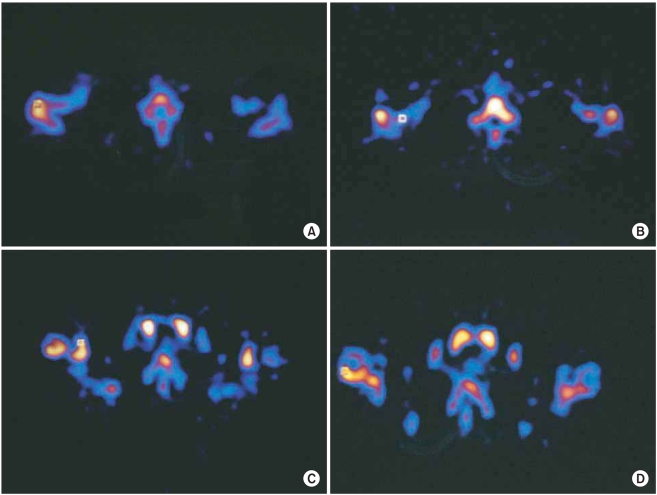
Before executing arthroscopic or open treatment, SPECT was performed on 73 patients and 24 volunteers and these people were followed up for 2 years. Any increased uptake on SPECT was investigated by using the axial view, which demonstrated the greatest uptake for the acromion, distal clavicle, greater tuberosity, lesser tuberosity and the coracoid process of the operated and non-operated sides.
The patients who were diagnosed as having impingement syndrome with or without rotator cuff tear showed increased uptake on the operative side compared to the non-operated side in the assessed locations. The greater tuberosity of the humerus could be used for quantitative measurement as a postoperative prognostic factor.
The bone SPECT method is useful for making the diagnosis of patients with impingement syndrome, and the results of quantitative assessment at the greater tuberosity can be used for evaluating the prognosis following the operation.
诊断无肩袖撕裂的撞击综合征通常依赖于体格检查和 X 线检查,而获得该疾病的客观证据充其量是困难的。本研究的目的是确定使用单光子发射计算机断层扫描(SPECT)定量评估这种情况是否可以诊断撞击综合征并预测术后结果。
在进行关节镜或开放性治疗之前,对 73 名患者和 24 名志愿者进行了 SPECT 检查,并对这些人进行了 2 年的随访。通过使用轴向视图研究 SPECT 上任何增加的摄取,该视图显示了肩峰、锁骨远端、大结节、小结节和手术侧和非手术侧喙突的摄取最大。
诊断为撞击综合征伴或不伴肩袖撕裂的患者在评估部位的手术侧与非手术侧相比,摄取增加。肱骨大结节可用于定量测量,作为术后预后因素。
骨 SPECT 方法有助于诊断撞击综合征患者,并且大结节的定量评估结果可用于评估术后的预后。