Department of Infectious and Tropical Diseases, London School of Hygiene & Tropical Medicine, London, United Kingdom.
PLoS One. 2009 Nov 24;4(11):e7972. doi: 10.1371/journal.pone.0007972.
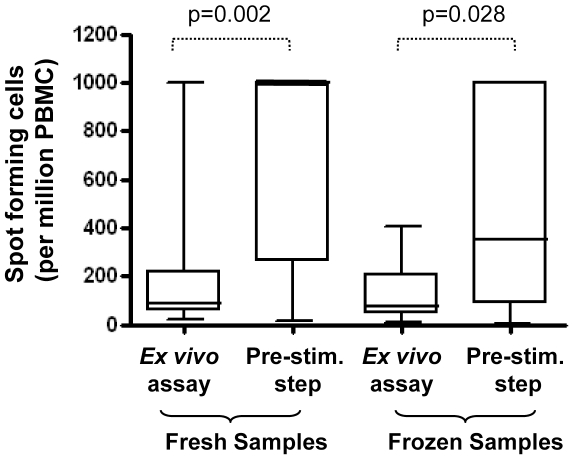
A number of different interferon-gamma ELISpot protocols are in use in laboratories studying antigen-specific immune responses. It is therefore unclear how results from different assays compare, and what factors most significantly influence assay outcome. One such difference is that some laboratories use a short in vitro stimulation period of cells before they are transferred to the ELISpot plate; this is commonly done in the case of frozen cells, in order to enhance assay sensitivity. Other differences that may be significant include antibody coating of plates, the use of media with or without serum, the serum source and the number of cells added to the wells. The aim of this paper was to identify which components of the different ELISpot protocols influenced assay sensitivity and inter-laboratory variation. Four laboratories provided protocols for quantifying numbers of interferon-gamma spot forming cells in human peripheral blood mononuclear cells stimulated with Mycobacterium tuberculosis derived antigens. The differences in the protocols were compared directly. We found that several sources of variation in assay protocols can be eliminated, for example by avoiding serum supplementation and using AIM-V serum free medium. In addition, the number of cells added to ELISpot wells should also be standardised. Importantly, delays in peripheral blood mononuclear cell processing before stimulation had a marked effect on the number of detectable spot forming cells; processing delay thus should be minimised as well as standardised. Finally, a pre-stimulation culture period improved the sensitivity of the assay, however this effect may be both antigen and donor dependent. In conclusion, small differences in ELISpot protocols in routine use can affect the results obtained and care should be given to conditions selected for use in a given study. A pre-stimulation step may improve the sensitivity of the assay, particularly when cells have been previously frozen.
有许多不同的干扰素-γ ELISpot 方案在研究抗原特异性免疫反应的实验室中使用。因此,不清楚不同检测结果如何比较,以及哪些因素对检测结果影响最大。其中一个差异是,一些实验室在将细胞转移到 ELISpot 板之前使用短时间的体外刺激期;这在冷冻细胞的情况下通常是为了提高检测灵敏度。其他可能很重要的差异包括板的抗体包被、使用含血清或不含血清的培养基、血清来源以及添加到孔中的细胞数量。本文的目的是确定不同 ELISpot 方案中的哪些成分会影响检测灵敏度和实验室间的变异性。四个实验室提供了用于定量人外周血单个核细胞中干扰素-γ斑点形成细胞数量的方案,这些细胞受到结核分枝杆菌来源抗原的刺激。直接比较了方案中的差异。我们发现,检测方案中的几个变异来源可以消除,例如避免血清补充和使用 AIM-V 无血清培养基。此外,还应标准化添加到 ELISpot 孔中的细胞数量。重要的是,刺激前外周血单个核细胞处理的延迟对可检测的斑点形成细胞数量有明显影响;因此,应尽量减少并标准化处理延迟。最后,刺激前的培养期可提高检测的灵敏度,但这种效果可能取决于抗原和供体。总之,常规使用中的 ELISpot 方案中的微小差异会影响获得的结果,因此在给定的研究中应注意选择使用的条件。刺激前的步骤可能会提高检测的灵敏度,特别是当细胞先前已被冷冻时。