Department of Pharmacology, The Hebrew University School of Pharmacy, Jerusalem, Israel.
Eur J Pharmacol. 2010 Mar 10;629(1-3):25-30. doi: 10.1016/j.ejphar.2009.11.066. Epub 2009 Dec 1.
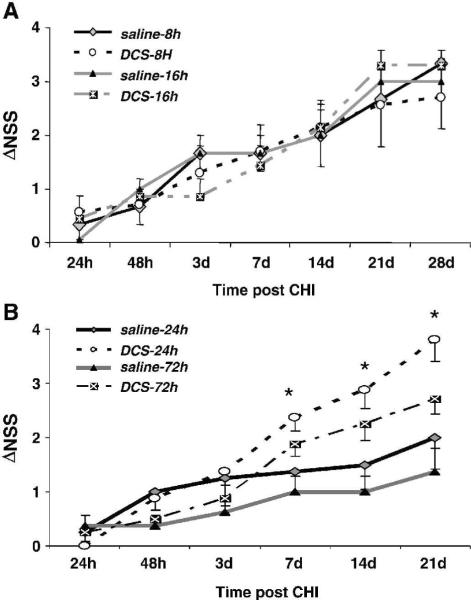
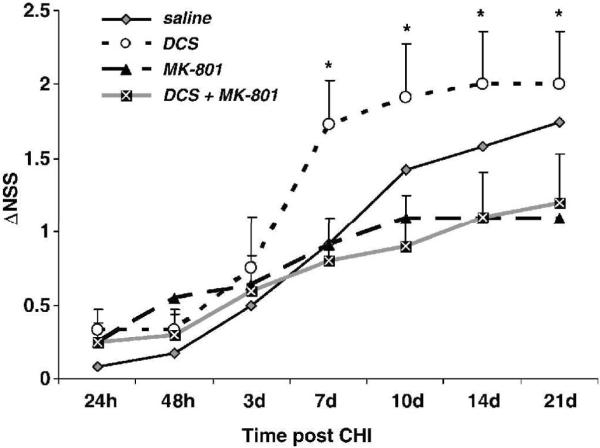
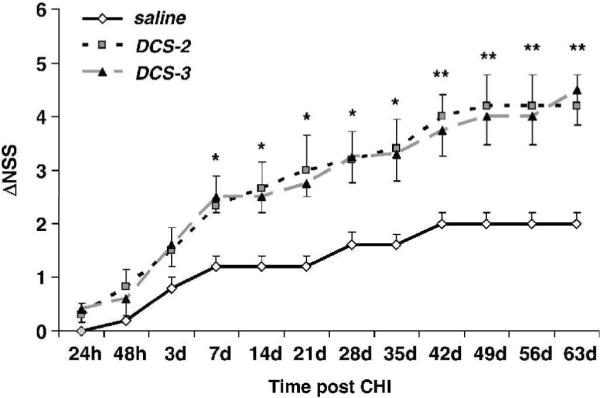
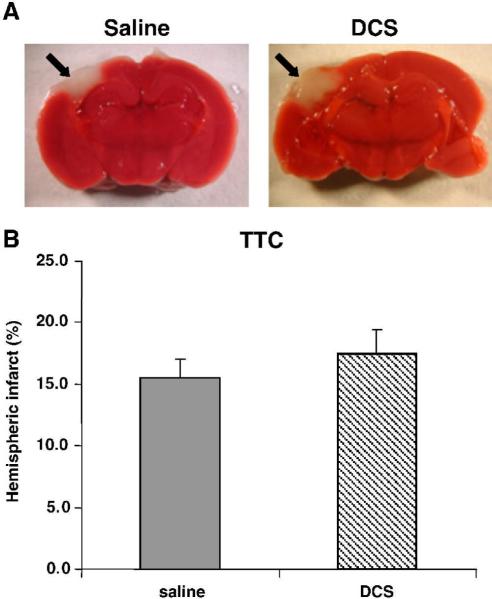
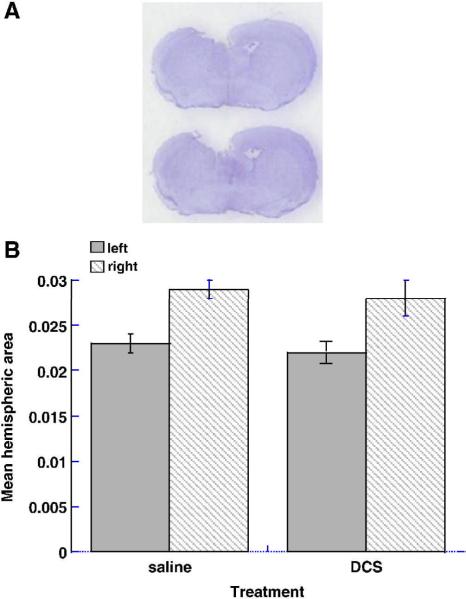
It has been long thought that hyperactivation of N-methyl-D-aspartate (NMDA) receptors underlies neurological decline after traumatic brain injury. However, all clinical trials with NMDA receptor antagonists failed. Since NMDA receptors are down-regulated from 4h to 2weeks after brain injury, activation at 24h, rather than inhibition, of these receptors, was previously shown to be beneficial in mice. Here, we tested the therapeutic window, dose regimen and mechanism of action of the NMDA receptor partial agonist D-cycloserine (DCS) in traumatic brain injury. Male mice were subjected to trauma using a weight-drop model, and administered 10mg/kg (i.p.) DCS or vehicle once (8, 16, 24, or 72h) twice (24 and 48h) or three times (24, 48 and 72h). Functional recovery was assessed for up to 60days, using a Neurological Severity Score that measures neurobehavioral parameters. In all groups in which treatment was begun at 24 or 72h neurobehavioral function was significantly better than in the vehicle-treated groups. Additional doses, on days 2 and 3 did not further improve recovery. Mice treated at 8h or 16h post injury did not differ from the vehicle-treated controls. Co-administration of the NMDA receptor antagonist MK-801 completely blocked the protective effect of DCS given at 24h. Infarct volume measured by 2,3,5-triphenyltetrazolium chloride staining at 48h or by cresyl violet at 28days was not affected by DCS treatment. Since DCS is used clinically for other indications, the present study offers a novel approach for treating human traumatic brain injury with a therapeutic window of at least 24h.
长期以来,人们一直认为 N-甲基-D-天冬氨酸(NMDA)受体的过度激活是创伤性脑损伤后神经功能下降的基础。然而,所有使用 NMDA 受体拮抗剂的临床试验都失败了。由于 NMDA 受体在脑损伤后 4 小时至 2 周内下调,之前的研究表明,在 24 小时时激活这些受体而不是抑制它们对小鼠有益。在这里,我们测试了 NMDA 受体部分激动剂 D-环丝氨酸(DCS)在创伤性脑损伤中的治疗窗、剂量方案和作用机制。雄性小鼠使用重物坠落模型进行创伤,给予 10mg/kg(腹腔注射)DCS 或载体一次(8、16、24 或 72 小时)两次(24 和 48 小时)或三次(24、48 和 72 小时)。使用神经严重程度评分评估长达 60 天的功能恢复,该评分测量神经行为参数。在所有在 24 小时或 72 小时开始治疗的组中,神经行为功能均明显优于载体治疗组。在第 2 天和第 3 天给予额外剂量不会进一步改善恢复。在损伤后 8 小时或 16 小时给予治疗的小鼠与载体处理的对照组无差异。NMDA 受体拮抗剂 MK-801 的共同给药完全阻断了在 24 小时给予 DCS 的保护作用。用 2,3,5-三苯基氯化四唑染色在 48 小时或用 Cresyl 紫在 28 天测量的梗塞体积不受 DCS 处理的影响。由于 DCS 临床上用于其他适应症,因此本研究为至少 24 小时的治疗窗提供了治疗人类创伤性脑损伤的新方法。