Brandeis University, Department of Biology, National Center of Behavioral Genomics and Volen Center for Complex Systems, Waltham, Massachusetts, USA.
Nat Neurosci. 2010 Jan;13(1):53-9. doi: 10.1038/nn.2444. Epub 2009 Dec 6.
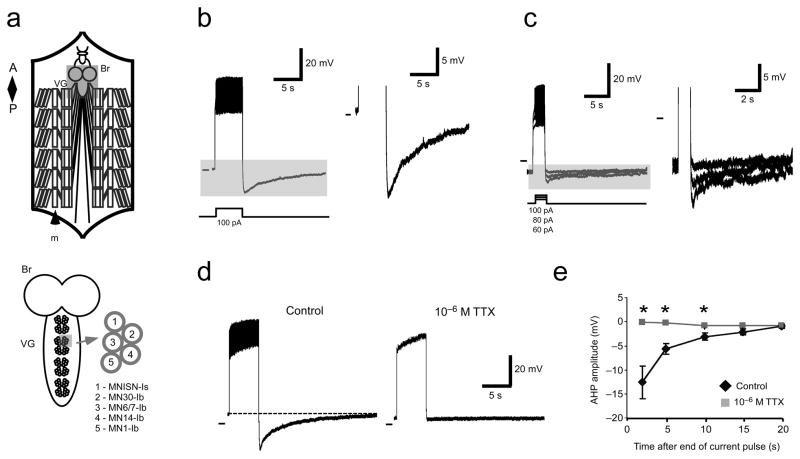
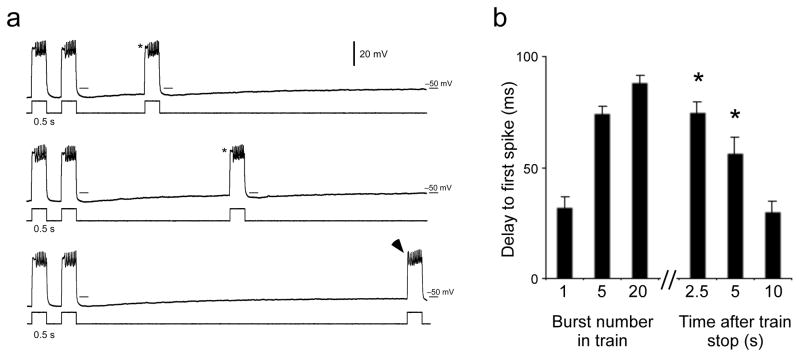
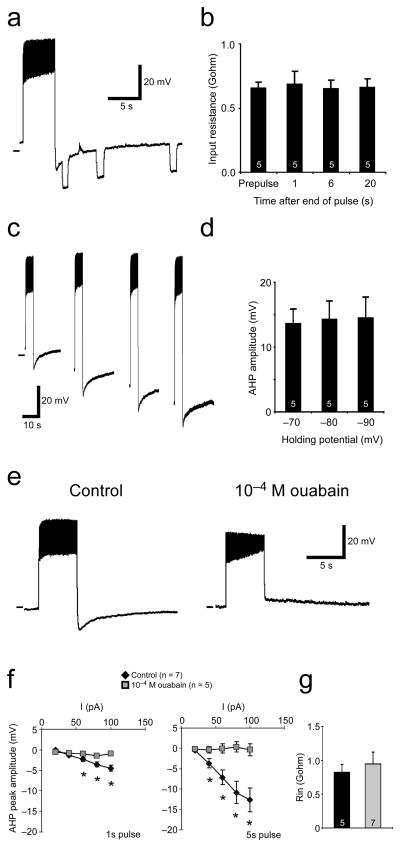
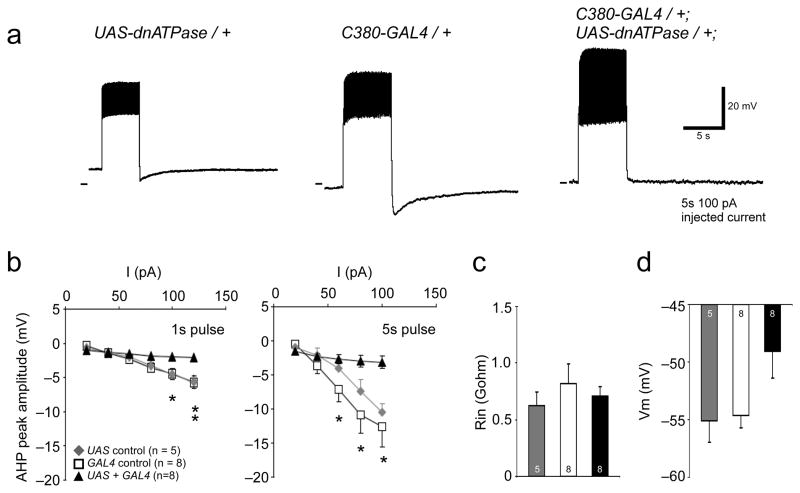
The output of a neural circuit results from an interaction between the intrinsic properties of neurons in the circuit and the features of the synaptic connections between them. The plasticity of intrinsic properties has been primarily attributed to modification of ion channel function and/or number. We have found a mechanism for intrinsic plasticity in rhythmically active Drosophila neurons that was not based on changes in ion conductance. Larval motor neurons had a long-lasting, sodium-dependent afterhyperpolarization (AHP) following bursts of action potentials that was mediated by the electrogenic activity of Na(+)/K(+) ATPase. This AHP persisted for multiple seconds following volleys of action potentials and was able to function as a pattern-insensitive integrator of spike number that was independent of external calcium. This current also interacted with endogenous Shal K(+) conductances to modulate spike timing for multiple seconds following rhythmic activity, providing a cellular memory of network activity on a behaviorally relevant timescale.
神经回路的输出是由回路中神经元的固有特性和它们之间突触连接的特征相互作用的结果。固有特性的可塑性主要归因于离子通道功能和/或数量的改变。我们发现了一种在节律性活跃的果蝇神经元中产生固有可塑性的机制,这种机制不是基于离子电导的变化。幼虫运动神经元在爆发动作电位后会产生持续时间较长的、钠离子依赖性的后超极化(AHP),这是由 Na(+)/K(+)ATP 酶的电活性介导的。这种 AHP 在动作电位爆发后的多秒钟内持续存在,并且能够作为一种对模式不敏感的、对 Spike 数量的积分器,与外部钙无关。这种电流还与内源性 Shal K(+)电导相互作用,以调节节律性活动后多秒钟的 Spike 时间,从而在行为相关的时间尺度上提供对网络活动的细胞记忆。