Department of General Surgery, Rui Jin Hospital, Shanghai Jiao Tong University, School of Medicine, Shanghai Institute of Digestive Surgery, Shanghai, China.
BMC Cancer. 2009 Dec 9;9:428. doi: 10.1186/1471-2407-9-428.
The selection of an anastomosis method after a distal gastrectomy is a highly debatable topic; however, the available documentation lacks the necessary research based on a comparison of early postoperative complications. This study was conducted to investigate the difference of early postoperative complications between Billroth I and Billroth II types of anastomosis for distal gastrectomies.
A total of 809 patients who underwent distal gastrectomies for gastric cancer during four years were included in the study. The only study endpoint was analysis of in-patients' postoperative complications. The risk adjusted complication rate was compared by POSSUM (Physiological and operative severity score for enumeration of morbidity and mortality) and the severity of complications was compared by Rui Jin Hospital classification of complication.
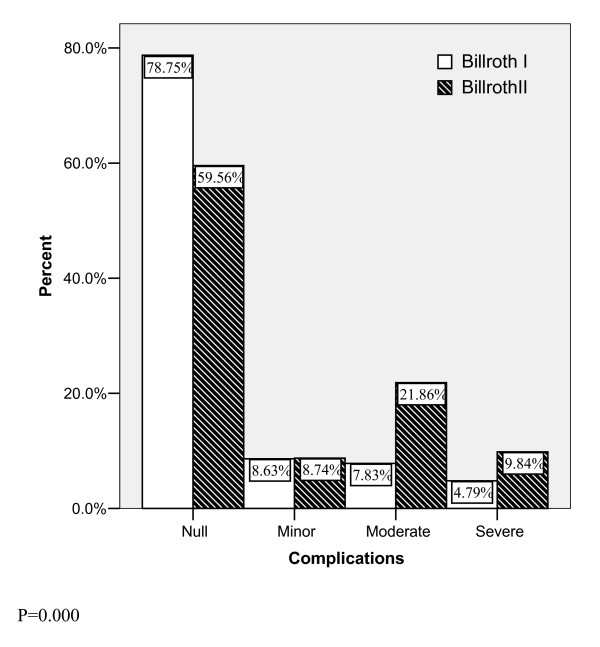
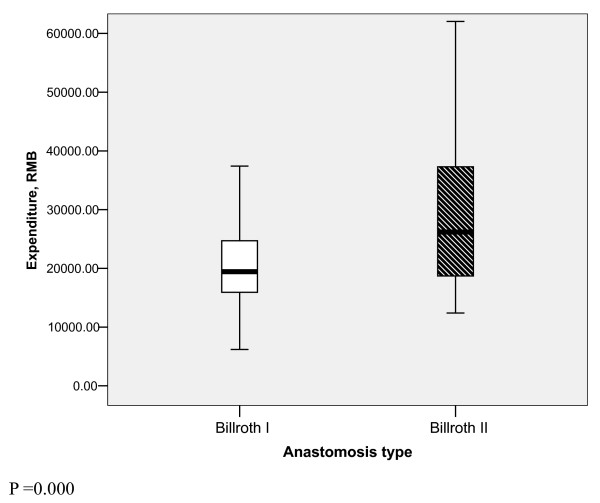
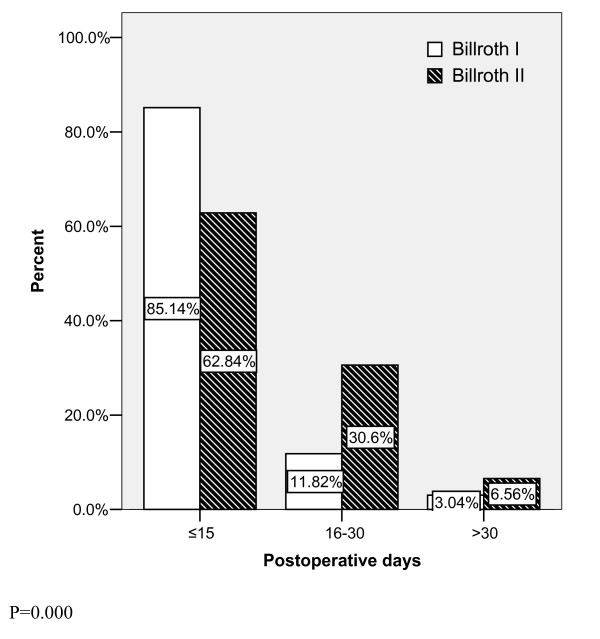
Complication rate of Billroth II type of anastomosis was almost double of that in Billroth I (P=0.000). Similarly, the risk adjusted complication rate was also higher in Billroth II group. More severe complications were observed and the postoperative duration was significantly longer in Billroth II type (P=0.000). Overall expenditure was significantly higher in Billroth II type (P=0.000).
Billroth II method of anastomosis was associated with higher rate of early postoperative complications. Therefore, we conclude that the Billroth I method should be the first choice after a distal gastrectomy as long as the anatomic and oncological environment of an individual patient allows us to perform it. However more prospective studies should be designed to compare the overall surgical outcomes of both anastomosis methods.
远端胃切除术后吻合方法的选择是一个极具争议的话题;然而,现有的文献缺乏基于对早期术后并发症比较的必要研究。本研究旨在探讨远端胃切除术后 Billroth I 型和 Billroth II 型吻合术早期术后并发症的差异。
本研究纳入了 809 例在四年间因胃癌行远端胃切除术的患者。唯一的研究终点是分析住院患者的术后并发症。通过 POSSUM(生理和手术严重度评分用于发病率和死亡率的评估)和瑞金医院并发症分类比较风险调整后的并发症发生率,并比较并发症的严重程度。
Billroth II 型吻合术的并发症发生率几乎是 Billroth I 型的两倍(P=0.000)。同样,Billroth II 组的风险调整后并发症发生率也更高。Billroth II 型吻合术组观察到更严重的并发症,术后持续时间也明显延长(P=0.000)。Billroth II 型吻合术的总支出明显更高(P=0.000)。
Billroth II 型吻合术与较高的早期术后并发症发生率相关。因此,我们得出结论,只要个体患者的解剖和肿瘤学环境允许我们进行手术,Billroth I 型应该是远端胃切除术后的首选方法。然而,应该设计更多的前瞻性研究来比较两种吻合方法的总体手术结果。