CNRS FRE 2960, Laboratoire d'Anthropobiologie, Université de Toulouse, Toulouse III Paul sabatier, 31073 Toulouse cedex 3, France.
BMC Genomics. 2009 Dec 14;10:605. doi: 10.1186/1471-2164-10-605.
Current models propose that mitochondrial DNA macrohaplogroups M and N evolved from haplogroup L3 soon after modern humans left Africa. Increasingly, however, analysis of isolated populations is filling in the details of, and in some cases challenging, aspects of this general model.
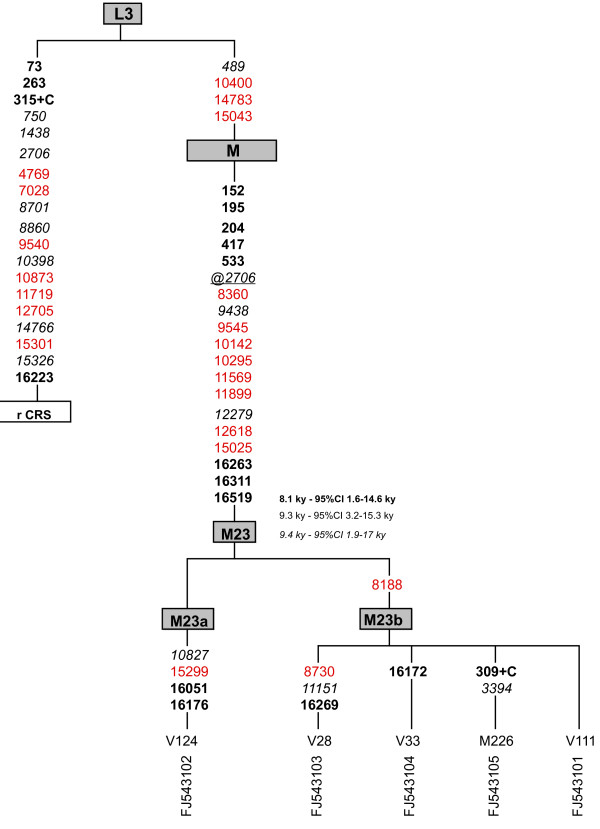
Here, we present the first comprehensive study of three such isolated populations from Madagascar: the Mikea hunter-gatherers, the neighbouring Vezo fishermen, and the Merina central highlanders (n = 266). Complete mitochondrial DNA genome sequences reveal several unresolved lineages, and a new, deep branch of the out-of-Africa founder clade M has been identified. This new haplogroup, M23, has a limited global distribution, and is restricted to Madagascar and a limited range of African and Southwest Asian groups.
The geographic distribution, phylogenetic placement and molecular age of M23 suggest that the colonization of Madagascar was more complex than previously thought.
目前的模型提出,线粒体 DNA 大单体群 M 和 N 是在现代人离开非洲后不久从单体群 L3 进化而来的。然而,越来越多的对孤立人群的分析正在填补这一普遍模式的细节,在某些情况下还在挑战这一模式的某些方面。
在这里,我们首次对来自马达加斯加的三个这样的孤立人群进行了全面研究:米克阿狩猎采集者、邻近的维佐渔民和梅里纳高原中部高地人(n=266)。完整的线粒体 DNA 基因组序列揭示了几个未解决的谱系,以及一个新的、非洲外起源支系 M 的深分支已经被确定。这个新的单体群 M23 全球分布有限,仅限于马达加斯加和非洲和西南亚地区的有限范围。
M23 的地理分布、系统发育位置和分子年龄表明,马达加斯加的殖民化比以前想象的要复杂。