Fregel Rosa, Seetah Krish, Betancor Eva, Suárez Nicolás M, Čaval Diego, Caval Saša, Janoo Anwar, Pestano Jose
Department of Genetics, Faculty of Medicine, University of Las Palmas de Gran Canaria, Las Palmas, Spain; Department of Genetics, Faculty of Biology, University of La Laguna, La Laguna, Spain; Department of Anthropology, Stanford University, Stanford, California, United States of America.
Department of Anthropology, Stanford University, Stanford, California, United States of America.
PLoS One. 2014 Mar 27;9(3):e93294. doi: 10.1371/journal.pone.0093294. eCollection 2014.
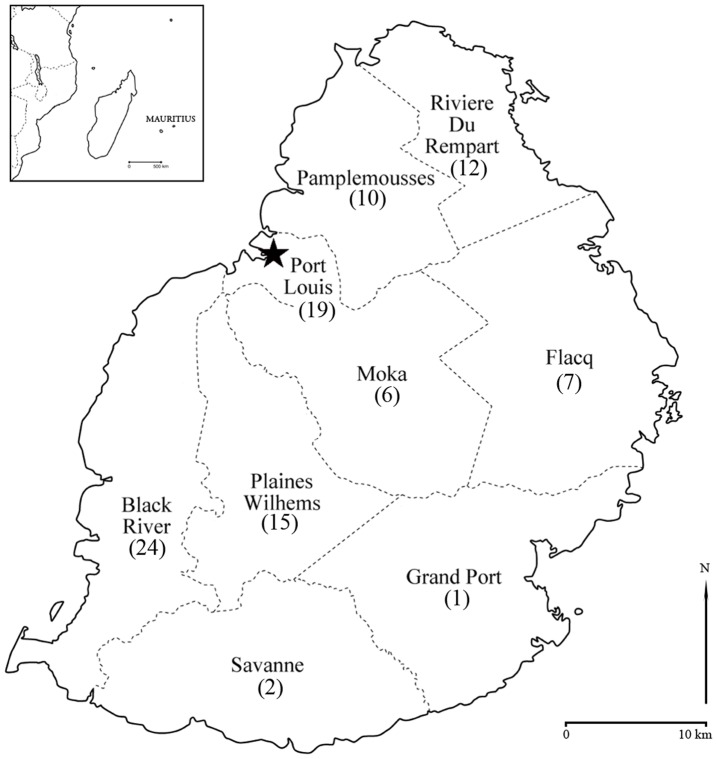
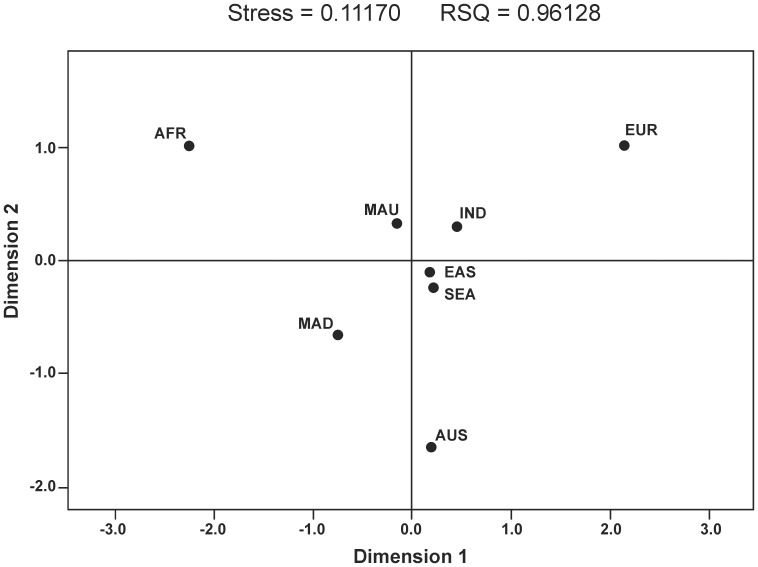
This article reports on the first genetic assessment of the contemporary Mauritian population. Small island nodes such as Mauritius played a critical role in historic globalization processes and revealing high-resolution details of labour sourcing is crucial in order to better understand early-modern diaspora events. Mauritius is a particularly interesting case given detailed historic accounts attesting to European (Dutch, French and British), African and Asian points of origin. Ninety-seven samples were analysed for mitochondrial DNA to begin unravelling the complex dynamics of the island's modern population. In corroboration with general demographic information, the majority of maternal lineages were derived from South Asia (58.76%), with Malagasy (16.60%), East/Southeast Asian (11.34%) and Sub-Saharan African (10.21%) also making significant contributions. This study pinpoints specific regional origins for the South Asian genetic contribution, showing a greater influence on the contemporary population from northern and southeast India. Moreover, the analysis of lineages related to the slave trade demonstrated that Madagascar and East Asia were the main centres of origin, with less influence from West Africa.
本文报道了对当代毛里求斯人口的首次基因评估。像毛里求斯这样的小岛屿节点在历史全球化进程中发挥了关键作用,揭示劳动力来源的高分辨率细节对于更好地理解早期现代侨民事件至关重要。鉴于详细的历史记载证实了欧洲(荷兰、法国和英国)、非洲和亚洲的起源地,毛里求斯是一个特别有趣的案例。对97个样本进行了线粒体DNA分析,以开始揭示该岛现代人口的复杂动态。与一般人口信息相一致,大多数母系血统来自南亚(58.76%),马达加斯加(16.60%)、东亚/东南亚(11.34%)和撒哈拉以南非洲(10.21%)也做出了重大贡献。这项研究确定了南亚基因贡献的具体区域来源,表明印度北部和东南部对当代人口的影响更大。此外,对与奴隶贸易相关的谱系分析表明,马达加斯加和东亚是主要起源中心,西非的影响较小。