Division of Biology, Imperial College London, Sir Alexander Fleming Building, Imperial College Road, London SW7 2AZ, UK.
J Exp Bot. 2010 Mar;61(3):755-63. doi: 10.1093/jxb/erp340. Epub 2009 Dec 14.
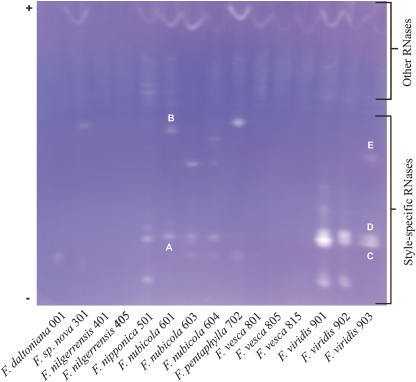
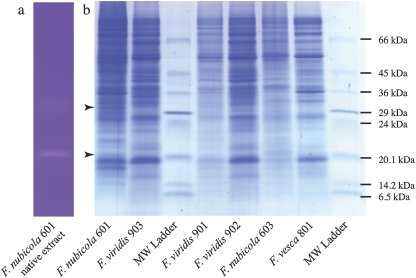
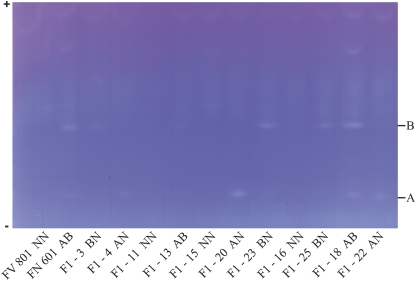
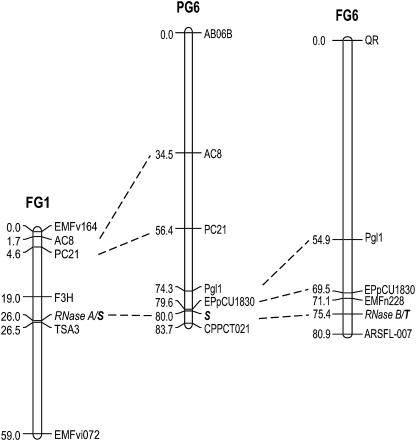
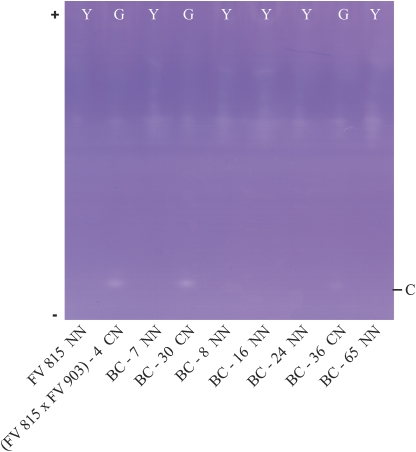
The self-incompatibility mechanism that reduces inbreeding in many plants of the Rosaceae is attributed to a multi-allelic S locus which, in the Prunoideae and Maloideae subfamilies, comprises two complementary genes, a stylar-expressed S-RNase and a pollen-expressed SFB. To elucidate incompatibility in the subfamily Rosoideae, stylar-specific RNases and self-(in)compatibility status were analysed in various diploid strawberries, especially Fragaria nubicola and F. viridis, both self-incompatible, and F. vesca, self-compatible, and in various progenies derived from them. Unexpectedly, two unlinked RNase loci, S and T, were found, encoding peptides distinct from Prunoideae and Maloideae S-RNases; the presence of a single active allele at either is sufficient to confer self-incompatibility. By contrast, in diploid Maloideae and Prunoideae a single locus encodes S-RNases that share several conserved regions and two active alleles are required for self-incompatibility. Our evidence implicates the S locus in unilateral inter-specific incompatibility and shows that S and T RNases can, remarkably, confer not only allele-specific rejection of cognate pollen but also unspecific rejection of Sn Tn pollen, where n indicates a null allele, consistent with the the presence of the pollen component, SFB, activating the cognitive function of these RNases. Comparison of relevant linkage groups between Fragaria and Prunus suggests that Prunus S-RNases, unique in having two introns, may have resulted from gene conversion in an ancestor of Prunus. In addition, it is shown that there is a non-S locus that is essential for self-incompatibility in diploid Fragaria.
蔷薇科许多植物的自交不亲和机制归因于一个多等位基因 S 座,在梨亚科和苹果亚科中,该座由两个互补基因组成,一个花柱表达的 S-RNase 和一个花粉表达的 SFB。为了阐明蔷薇科的不亲和性,在各种二倍体草莓中分析了花柱特异性 RNase 和自(不)亲和状态,特别是自交不亲和的弗吉尼亚草莓(Fragaria nubicola)和绿草莓(F. viridis),以及自交亲和的草莓(F. vesca),并在它们的各种后代中进行了分析。出乎意料的是,发现了两个不连锁的 RNase 座 S 和 T,它们编码的肽与梨亚科和苹果亚科的 S-RNase 不同;任一座的单个活性等位基因的存在足以赋予自交不亲和性。相比之下,在二倍体苹果亚科和梨亚科中,单个座编码 S-RNase,它们共享几个保守区域,需要两个活性等位基因才能实现自交不亲和性。我们的证据表明 S 座参与了单侧种间不亲和性,并表明 S 和 T RNase 不仅可以特异性地排斥同源花粉,而且可以非特异性地排斥 Sn Tn 花粉,其中 n 表示无效等位基因,这与花粉成分 SFB 的存在一致,该成分激活了这些 RNase 的认知功能。在草莓和李属之间的相关连锁群的比较表明,李属的 S-RNase 具有两个内含子,这可能是李属祖先基因转换的结果。此外,还表明在二倍体草莓中存在一个非 S 座,该座对于自交不亲和性是必需的。