Du Jianke, Ge Chunfeng, Li Tingting, Wang Sanhong, Gao Zhihong, Sassa Hidenori, Qiao Yushan
Laboratory of Fruit Crop Biotechnology, College of Horticulture, Nanjing Agricultural University, Nanjing, 210095, Jiangsu, China.
Laboratory of Genetics and Plant Breeding, Graduate School of Horticulture, Chiba University, Matsudo, 271-8510, Chiba, Japan.
Hortic Res. 2021 Aug 1;8(1):185. doi: 10.1038/s41438-021-00623-x.
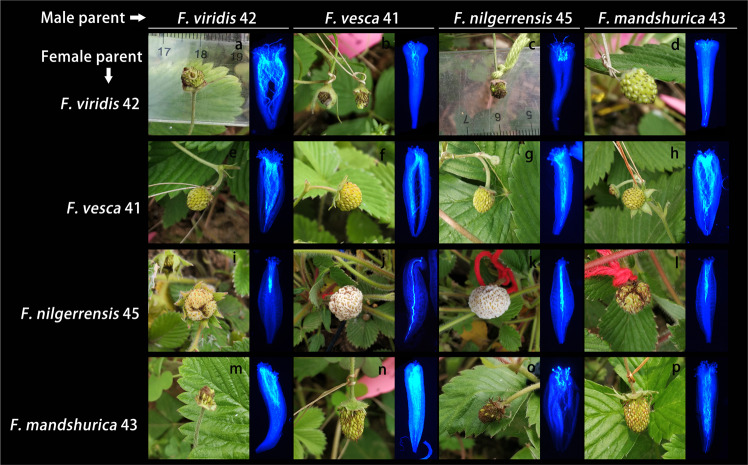
Strawberry (Fragaria spp.) is a member of the Rosoideae subfamily in the family Rosaceae. The self-incompatibility (SI) of some diploid species is a key agronomic trait that acts as a basic pollination barrier; however, the genetic mechanism underlying SI control in strawberry remains unclear. Two candidate S-RNases (S- and S-RNase) identified in the transcriptome of the styles of the self-incompatible Fragaria viridis 42 were confirmed to be SI determinants at the S locus following genotype identification and intraspecific hybridization using selfing progenies. Whole-genome collinearity and RNase T2 family analysis revealed that only an S locus exists in Fragaria; however, none of the compatible species contained S-RNase. Although the results of interspecific hybridization experiments showed that F. viridis (SI) styles could accept pollen from F. mandshurica (self-compatible), the reciprocal cross was incompatible. S and S-RNase contain large introns, and their noncoding sequences (promotors and introns) can be transcribed into long noncoding RNAs (lncRNAs). Overall, the genus Fragaria exhibits S-RNase-based gametophytic SI, and S-RNase loss occurs at the S locus of compatible germplasms. In addition, a type of SI-independent unilateral incompatibility exists between compatible and incompatible Fragaria species. Furthermore, the large introns and neighboring lncRNAs in S-RNase in Fragaria could offer clues about S-RNase expression strategies.
草莓(Fragaria spp.)是蔷薇科蔷薇亚科的一员。一些二倍体草莓品种的自交不亲和性(SI)是一项关键农艺性状,它作为一种基本的授粉障碍;然而,草莓中自交不亲和性控制的遗传机制仍不清楚。在自交不亲和的绿色草莓42花柱转录组中鉴定出的两个候选S-RNases(S-和S-RNase),在使用自交后代进行基因型鉴定和种内杂交后,被确认为S位点的自交不亲和决定因素。全基因组共线性和RNase T2家族分析表明,草莓中仅存在一个S位点;然而,所有可亲和品种均不含S-RNase。尽管种间杂交实验结果表明,绿色草莓(自交不亲和)的花柱可以接受来自东北草莓(自交亲和)的花粉,但反交不亲和。S-和S-RNase含有大的内含子,其非编码序列(启动子和内含子)可以转录成长链非编码RNA(lncRNAs)。总体而言,草莓属表现出基于S-RNase的配子体自交不亲和性,并且在可亲和种质的S位点发生S-RNase缺失。此外,在可亲和与不可亲和的草莓品种之间存在一种不依赖自交不亲和性的单边不亲和性。此外,草莓S-RNase中的大内含子和相邻的lncRNAs可能为S-RNase的表达策略提供线索。