Department of Zoology and National Research Center Frontiers in Genetics, University of Geneva, Geneva, Switzerland.
PLoS One. 2009 Dec 16;4(12):e8328. doi: 10.1371/journal.pone.0008328.
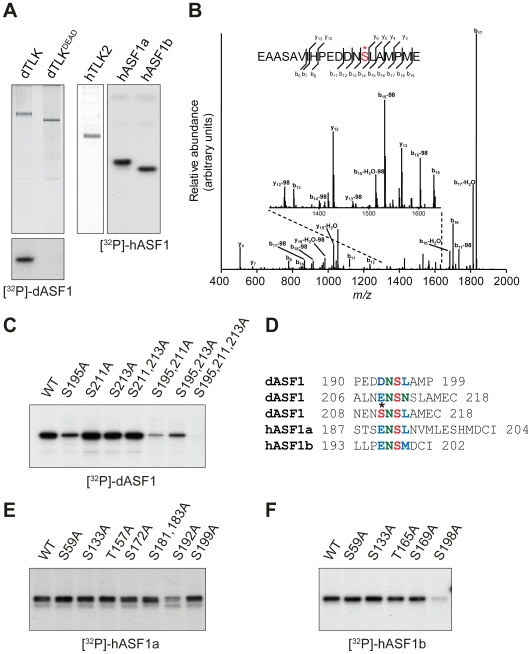
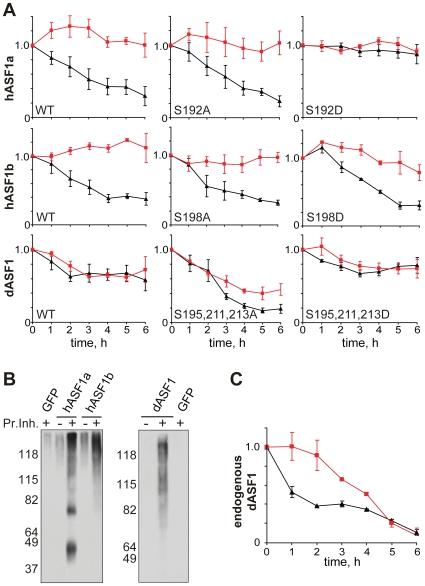
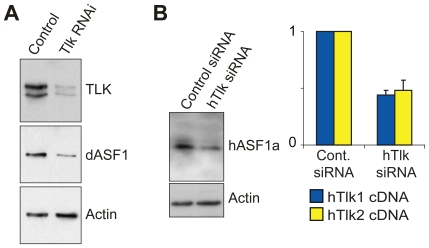
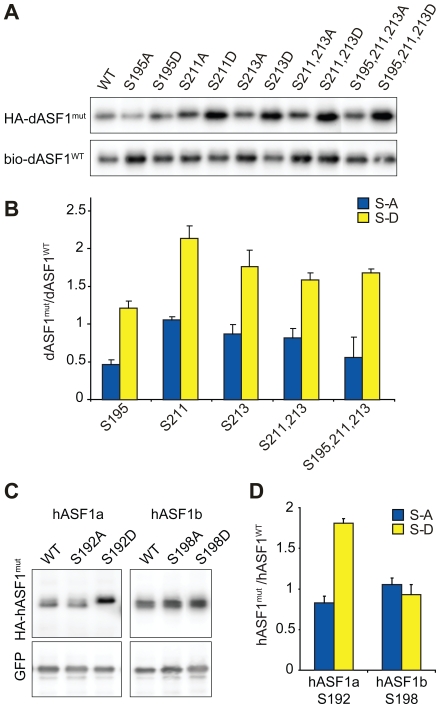
Histone chaperones are at the hub of a diverse interaction networks integrating a plethora of chromatin modifying activities. Histone H3/H4 chaperone ASF1 is a target for cell-cycle regulated Tousled-like kinases (TLKs) and both proteins cooperate during chromatin replication. However, the precise role of post-translational modification of ASF1 remained unclear. Here, we identify the TLK phosphorylation sites for both Drosophila and human ASF1 proteins. Loss of TLK-mediated phosphorylation triggers hASF1a and dASF1 degradation by proteasome-dependent and independent mechanisms respectively. Consistent with this notion, introduction of phosphorylation-mimicking mutants inhibits hASF1a and dASF1 degradation. Human hASF1b is also targeted for proteasome-dependent degradation, but its stability is not affected by phosphorylation indicating that other mechanisms are likely to be involved in control of hASF1b levels. Together, these results suggest that ASF1 cellular levels are tightly controlled by distinct pathways and provide a molecular mechanism for post-translational regulation of dASF1 and hASF1a by TLK kinases.
组蛋白伴侣处于多样化相互作用网络的中心,整合了大量染色质修饰活性。组蛋白 H3/H4 伴侣 ASF1 是细胞周期调控的 Tousled-like 激酶 (TLK) 的靶标,并且这两种蛋白质在染色质复制过程中合作。然而,ASF1 的翻译后修饰的确切作用仍不清楚。在这里,我们确定了果蝇和人类 ASF1 蛋白的 TLK 磷酸化位点。TLK 介导的磷酸化丧失分别通过蛋白酶体依赖和非依赖机制触发 hASF1a 和 dASF1 的降解。与这一观点一致,引入磷酸化模拟突变体抑制 hASF1a 和 dASF1 的降解。人类 hASF1b 也被靶向蛋白酶体依赖性降解,但磷酸化不影响其稳定性,表明可能涉及其他机制来控制 hASF1b 的水平。总之,这些结果表明 ASF1 的细胞水平受到不同途径的严格控制,并为 TLK 激酶对 dASF1 和 hASF1a 的翻译后调控提供了分子机制。