Sensory Plasticity Laboratory, Pain Research Center, Department of Anesthesiology, Brigham and Women's Hospital and Harvard Medical School, Boston, MA 02115, USA Institute of Nautical Medicine, Nantong University, Nantong 226001, China Department of Anesthesiology, Shin-Kong Wu Ho-Su Memorial Hospital, Taipei, Taiwan Anesthesiology Pain Research Group, Anesthesiology Department, University Hospital Center and University of Lausanne CH-1011 Lausanne, Switzerland Department of Cell Biology and Morphology, University of Lausanne, CH-1005 Lausanne, Switzerland.
Pain. 2010 Feb;148(2):309-319. doi: 10.1016/j.pain.2009.11.017.
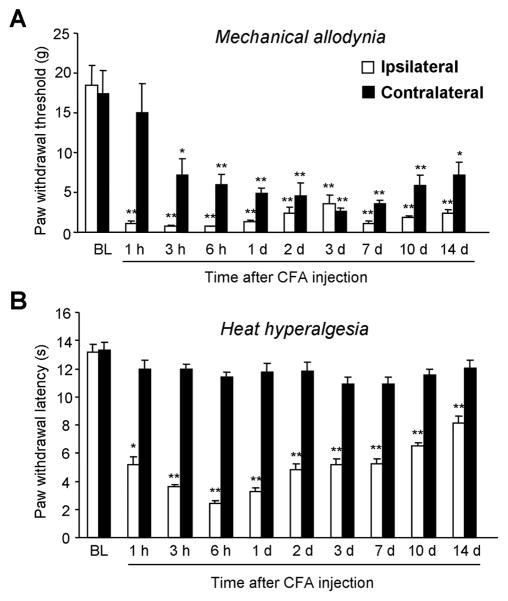
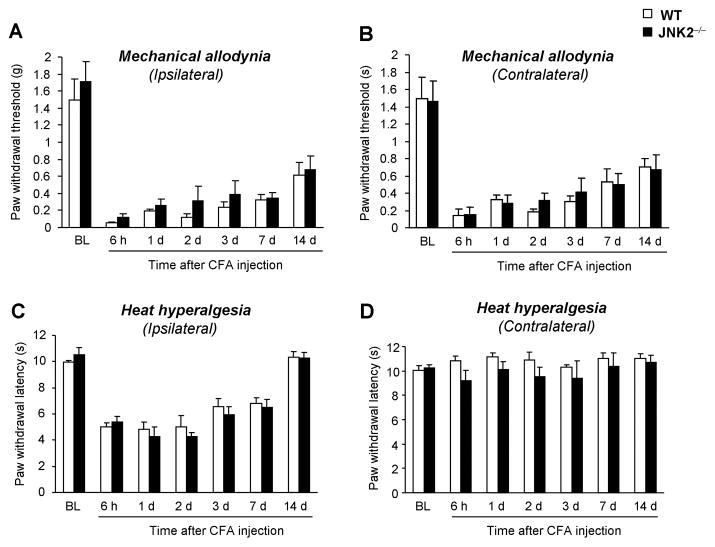
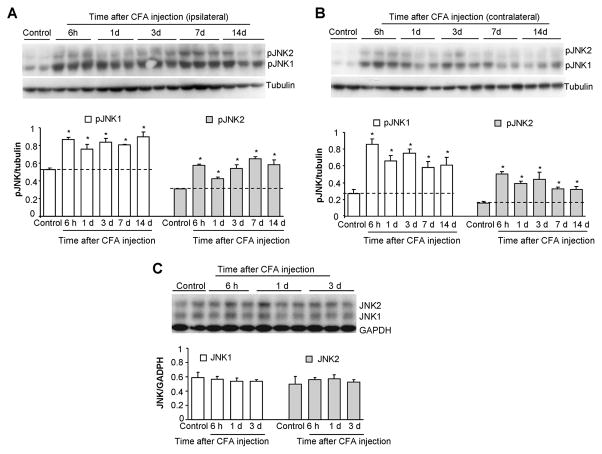
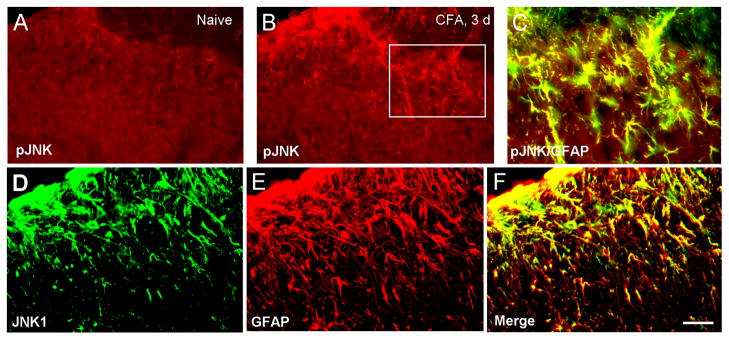
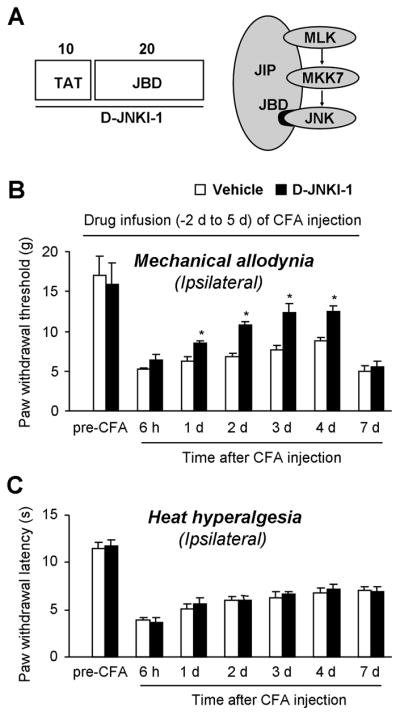
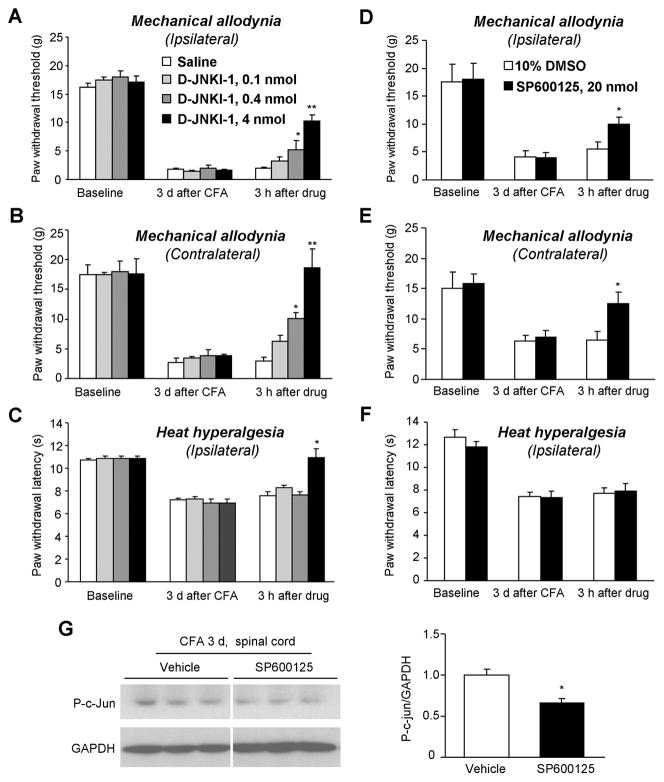
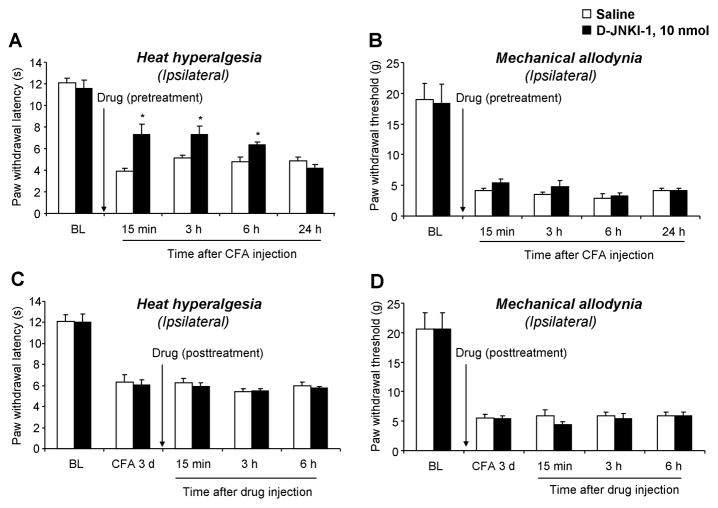
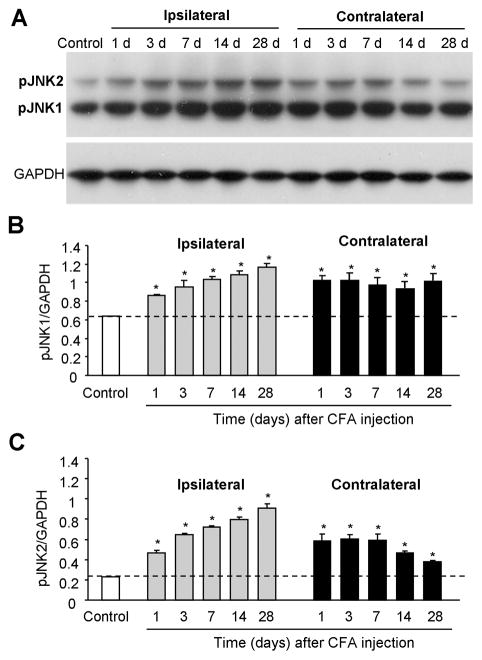
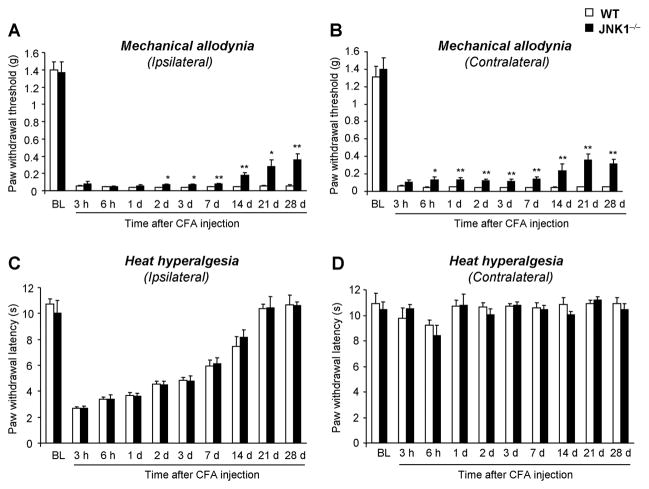
Peripheral inflammation induces persistent central sensitization characterized by mechanical allodynia and heat hyperalgesia that are mediated by distinct mechanisms. Compared to well-demonstrated mechanisms of heat hyperalgesia, mechanisms underlying the development of mechanical allodynia and contralateral pain are incompletely known. In this study, we investigated the distinct role of spinal JNK in heat hyperalgesia, mechanical allodynia, and contralateral pain in an inflammatory pain model. Intraplantar injection of complete Freund's adjuvant (CFA) induced bilateral mechanical allodynia but unilateral heat hyperalgesia. CFA also induced a bilateral activation (phosphorylation) of JNK in the spinal cord, and the phospho JNK1 (pJNK1) levels were much higher than that of pJNK2. Notably, both pJNK and JNK1 were expressed in GFAP-positive astrocytes. Intrathecal infusion of a selective peptide inhibitor of JNK, D-JNKI-1, starting before inflammation via an osmotic pump, reduced CFA-induced mechanical allodynia in the maintenance phase but had no effect on CFA-induced heat hyperalgesia. A bolus intrathecal injection of D-JNKI-1 or SP600126, a small molecule inhibitor of JNK also reversed mechanical allodynia bilaterally. In contrast, peripheral (intraplantar) administration of D-JNKI-1 reduced the induction of CFA-induced heat hyperalgesia but did not change mechanical allodynia. Finally, CFA-induced bilateral mechanical allodynia was attenuated in mice lacking JNK1 but not JNK2. Taken together, our data suggest that spinal JNK, in particular JNK1 plays an important role in the maintenance of persistent inflammatory pain. Our findings also reveal a unique role of JNK1 and astrocyte network in regulating tactile allodynia and contralateral pain.
外周炎症引起持续的中枢敏化,其特征是机械性痛觉过敏和热痛觉过敏,这些由不同的机制介导。与热痛觉过敏的已有充分证明的机制相比,机械性痛觉过敏和对侧疼痛发展的机制尚不完全清楚。在这项研究中,我们研究了脊髓 JNK 在炎症性疼痛模型中热痛觉过敏、机械性痛觉过敏和对侧疼痛中的不同作用。足底注射完全弗氏佐剂(CFA)引起双侧机械性痛觉过敏,但单侧热痛觉过敏。CFA 还导致脊髓中 JNK 的双侧激活(磷酸化),磷酸化 JNK1(pJNK1)水平明显高于 JNK2。值得注意的是,pJNK 和 JNK1 均在 GFAP 阳性星形胶质细胞中表达。通过渗透泵在炎症前开始鞘内输注 JNK 的选择性肽抑制剂 D-JNKI-1,可减少 CFA 诱导的维持期机械性痛觉过敏,但对 CFA 诱导的热痛觉过敏没有影响。鞘内注射 D-JNKI-1 或 JNK 的小分子抑制剂 SP600126 也可逆转双侧机械性痛觉过敏。相比之下,外周(足底)给予 D-JNKI-1 可减少 CFA 诱导的热痛觉过敏的诱导,但不改变机械性痛觉过敏。最后,JNK1 缺失而不是 JNK2 缺失可减轻 CFA 诱导的双侧机械性痛觉过敏。总之,我们的数据表明,脊髓 JNK,特别是 JNK1,在持续炎症性疼痛的维持中起重要作用。我们的研究结果还揭示了 JNK1 和星形胶质细胞网络在调节触觉过敏和对侧疼痛中的独特作用。