Department of Infection, Inflammation and Immunity, Institute for Lung Health, University of Leicester, Leicester, UK.
Clin Exp Allergy. 2010 Feb;40(2):279-88. doi: 10.1111/j.1365-2222.2009.03423.x. Epub 2009 Dec 16.
Airway smooth muscle (ASM) hyperplasia and mast cell localization within the ASM bundle are important features of asthma. The cause of this increased ASM mass is uncertain and whether it is a consequence of ASM-mast cell interactions is unknown.
We sought to investigate ASM proliferation and survival in asthma and the effects of co-culture with mast cells.
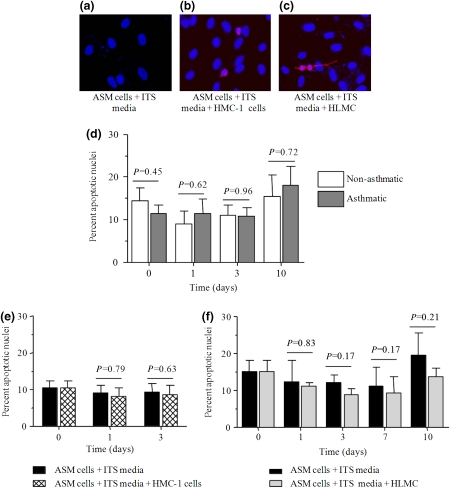
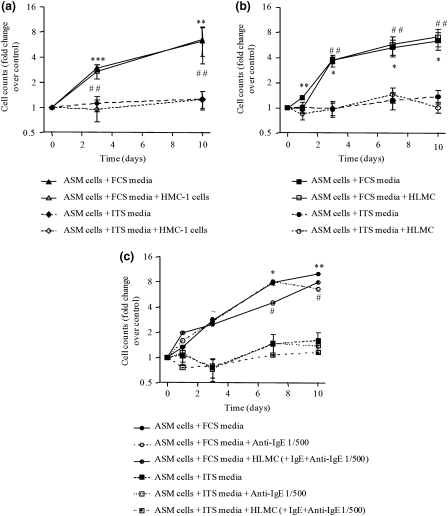
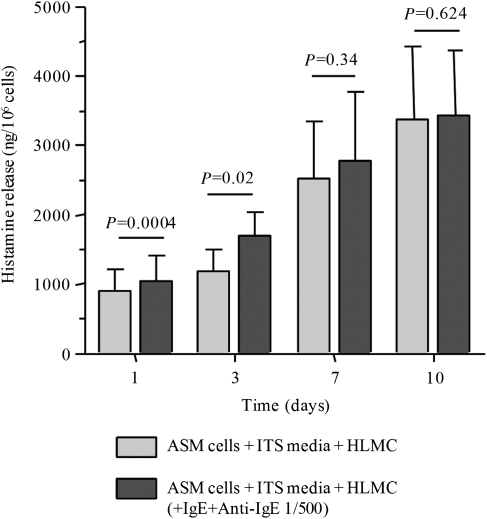
Primary ASM cultures were derived from 11 subjects with asthma and 12 non-asthmatic controls. ASM cells were cultured for up to 10 days in the presence or absence of serum either alone or in co-culture with the human mast cell line-1, unstimulated human lung mast cells (HLMC) or IgE/anti-IgE-activated HLMC. Proliferation was assessed by cell counts, CFSE assay and thymidine incorporation. Apoptosis and necrosis were analysed by Annexin V/propidium iodide staining using flow cytometry and by assessment of nuclear morphology using immunofluorescence. Mast cell activation was confirmed by the measurement of histamine release.
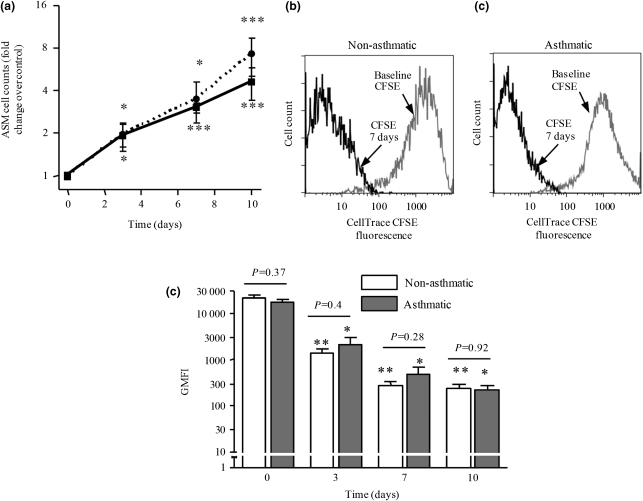
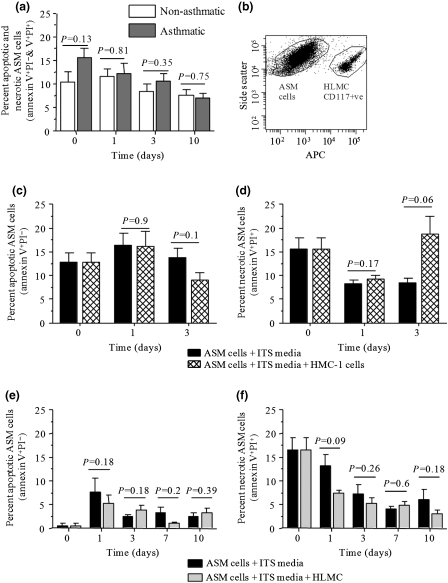
Using a number of techniques, we found that ASM proliferation and survival was not significantly different between cells derived from subjects with or without asthma. Co-culture with mast cells did not affect the rate of proliferation or survival of ASM cells.
Our findings do not support a role for increased airway smooth proliferation and survival as the major mechanism driving ASM hyperplasia in asthma.
气道平滑肌(ASM)增生和肥大细胞在 ASM 束内的定位是哮喘的重要特征。这种 ASM 质量增加的原因尚不确定,它是否是 ASM-肥大细胞相互作用的结果尚不清楚。
我们试图研究哮喘中 ASM 的增殖和存活,以及与肥大细胞共培养的影响。
从 11 例哮喘患者和 12 例非哮喘对照者中提取原代 ASM 培养物。ASM 细胞在存在或不存在血清的情况下培养长达 10 天,单独培养或与人类肥大细胞系-1、未刺激的人肺肥大细胞(HLMC)或 IgE/抗 IgE 激活的 HLMC 共培养。通过细胞计数、CFSE 测定和胸苷掺入来评估增殖。通过流式细胞术用 Annexin V/碘化丙啶染色分析细胞凋亡和坏死,并通过免疫荧光法评估核形态分析。通过测量组胺释放来确认肥大细胞的激活。
使用多种技术,我们发现来自哮喘患者和非哮喘患者的细胞之间 ASM 的增殖和存活没有显著差异。与肥大细胞共培养不会影响 ASM 细胞的增殖或存活速度。
我们的发现不支持气道平滑肌增殖和存活增加是哮喘中 ASM 过度增生的主要机制。