Department of Preventive Medicine, Keck School of Medicine, University of Southern California, Los Angeles, California 90033, USA.
Ophthalmology. 2010 Feb;117(2):199-206.e1. doi: 10.1016/j.ophtha.2009.06.063. Epub 2009 Dec 23.
To evaluate whether central (CVI) and peripheral visual impairment (PVI) are independent risk factors for falls and falls with injury 4 years later.
Population-based, prospective cohort study.
A population-based sample of 3203 adult Latinos.
Baseline presenting binocular central distance acuity was measured and impairment was classified as mild (20/40-20/63) or moderate/severe (<or=20/80). Peripheral visual impairment was classified as mild (-6 dB < mean deviation < -2 dB in worse eye), moderate/severe (mean deviation <or=-6 dB in worse eye).
Falls and falls with injury in the past 12 months were assessed by self-report at the 4-year follow-up visit.
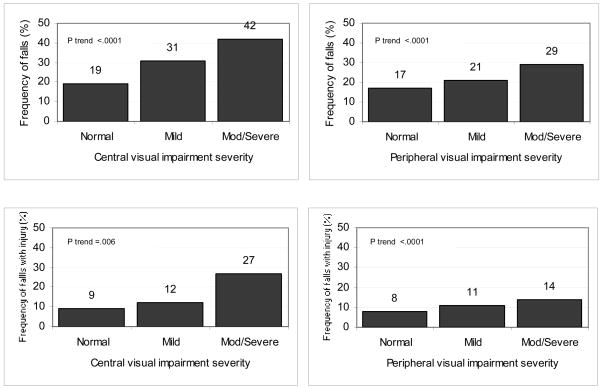
Out of 3203 individuals, 19% reported falls and 10% falls with injury 4 years after the baseline examination; participants with falls were more likely to be >or=60 years of age, be female, report lower income, have >2 comorbidities, report alcohol use, report wearing bifocal glasses, and report obesity. Among those who reported falls, 7% had CVI (visual acuity >20/40) compared with 4% who did not report falls; and 49% had PVI (mean deviation < -2 dB) compared with 39% of those who did not report falls (both P<0.0001). After adjusting for confounders, moderate to severe CVI and PVI were associated with increased risk for falls (odds ratio [OR], 2.36; 95% confidence interval [CI], 1.02-5.45; P(trend) = 0.04; and OR, 1.42; 95% CI, 1.06-1.91l P(trend) = 0.01, respectively) and with falls with injury (OR, 2.76; 95% CI, 1.10-7.02; P(value) = 0.03; and OR, 1.40; 95% CI, 0.94-2.05 P(trend) = 0.04, respectively).
Both CVI and PVI were independently associated with increased risk for falls and falls with injury 4 years after the initial examination in a dose-response manner. Although vision-related interventions for preventing falls have mainly focused on correcting CVI, this study suggests that targeting both central and peripheral components may be necessary to effectively reduce rates of falls and falls with injury related to vision loss.
评估中央(CVI)和周边视觉障碍(PVI)是否为 4 年后跌倒和跌倒受伤的独立危险因素。
基于人群的前瞻性队列研究。
基于人群的 3203 名成年拉丁裔样本。
测量基线呈现的双眼中央距离视力,并将损伤程度分类为轻度(20/40-20/63)或中度/重度(<20/80)。周边视觉障碍分为轻度(较差眼的平均偏差>-6 dB)和中度/重度(较差眼的平均偏差<-6 dB)。
在基线检查后 4 年通过自我报告评估过去 12 个月内的跌倒和跌倒受伤情况。
在 3203 名参与者中,19%报告在 4 年后出现跌倒,10%报告跌倒受伤;跌倒者更可能年龄>60 岁、女性、收入较低、患有>2 种合并症、报告饮酒、报告佩戴双光眼镜和报告肥胖。在报告跌倒的参与者中,7%有 CVI(视力>20/40),而未报告跌倒的参与者为 4%;49%有 PVI(平均偏差<-2 dB),而未报告跌倒的参与者为 39%(均<0.0001)。调整混杂因素后,中重度 CVI 和 PVI 与跌倒风险增加相关(优势比[OR],2.36;95%置信区间[CI],1.02-5.45;P(趋势)=0.04;OR,1.42;95%CI,1.06-1.91;P(趋势)=0.01),与跌倒受伤相关(OR,2.76;95%CI,1.10-7.02;P(值)=0.03;OR,1.40;95%CI,0.94-2.05;P(趋势)=0.04)。
在初始检查后 4 年,CVI 和 PVI 均与跌倒和跌倒受伤风险增加独立相关,呈剂量反应关系。尽管预防跌倒的视力相关干预措施主要侧重于纠正 CVI,但本研究表明,针对中央和周边成分可能是有效降低与视力丧失相关的跌倒和跌倒受伤率的必要条件。