McKean-Cowdin Roberta, Varma Rohit, Wu Joanne, Hays Ron D, Azen Stanley P
Department of Preventive Medicine, Keck School of Medicine, University of Southern California, Los Angeles, California, USA.
Am J Ophthalmol. 2007 Jun;143(6):1013-23. doi: 10.1016/j.ajo.2007.02.022. Epub 2007 Apr 2.
To examine the association between severity of visual field loss (VFL) and self-reported health-related quality of life (HRQOL) in a population-based sample.
Population-based cross-sectional study.
Participants in the Los Angeles Latino Eye Study (LALES) underwent a comprehensive ophthalmic examination including visual field testing by the Humphrey Automated Field Analyzer II (Swedish Interactive Thresholding Algorithm [SITA] Standard 24-2) [Carl Zeiss Meditec, Dublin, California, USA]. Mean deviation (MD) scores were used to determine severity of VFL both as a continuous variable and stratified by severity: no VFL (MD >or= -2 decibels [dB]), mild VFL (-6 dB < MD < -2 dB), and moderate to severe VFL (MD < -6 dB). HRQOL was assessed by the Medical Outcomes Study 12-item Short-Form Health Survey (SF-12) and the National Eye Institute Visual Function Questionnaire (NEI-VFQ-25). Linear regression analyses and analysis of covariance were used to assess the relationship between HRQOL scores and VFL.
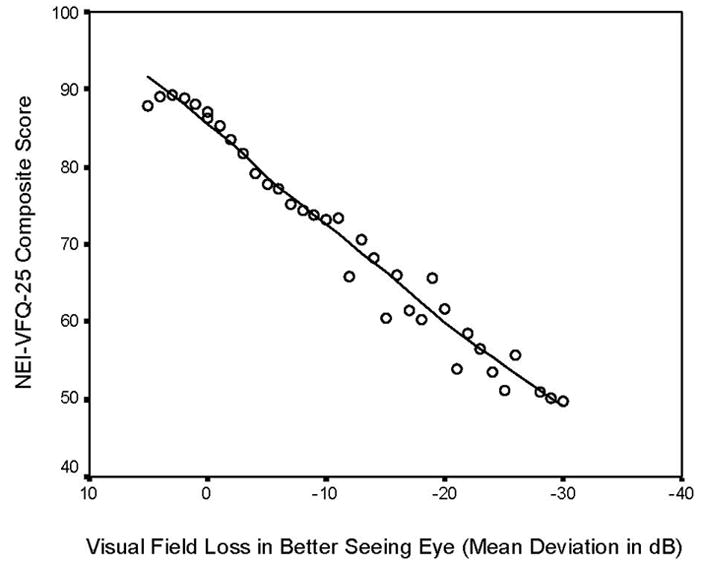
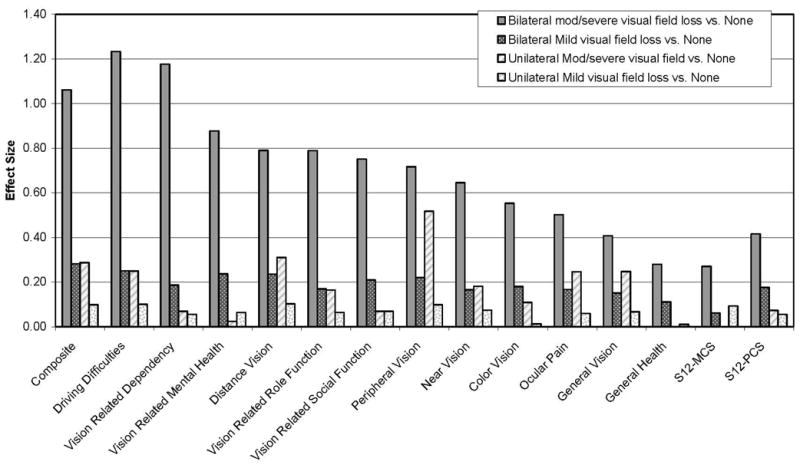
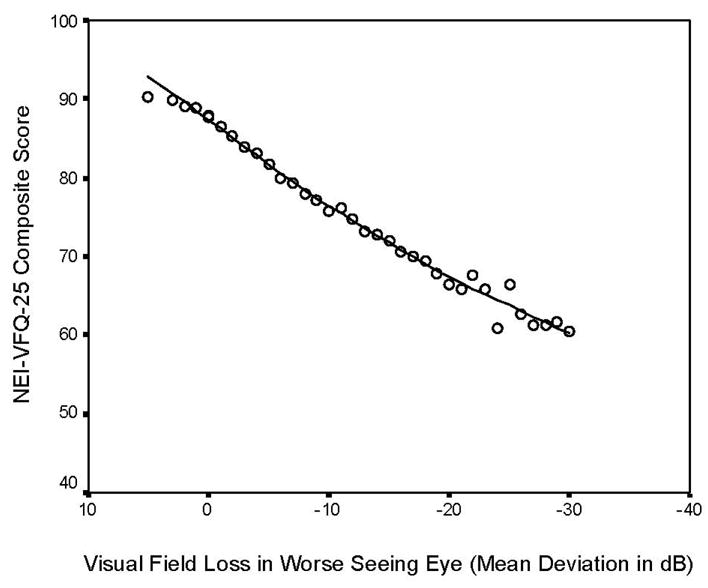
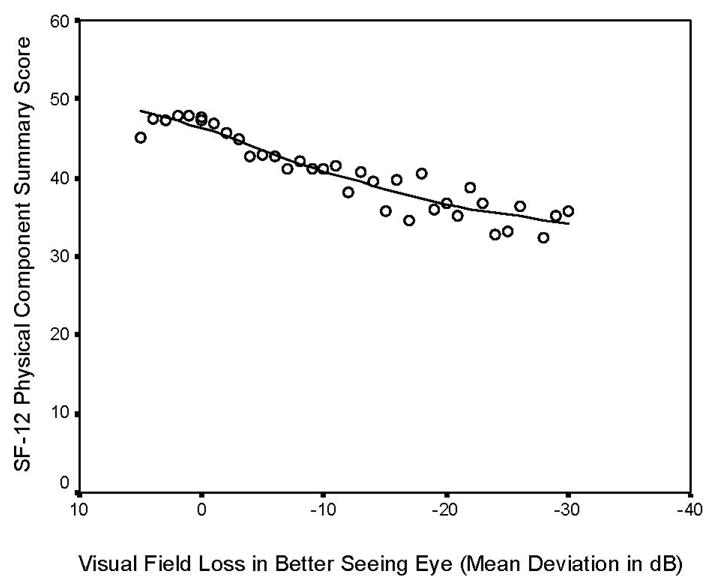
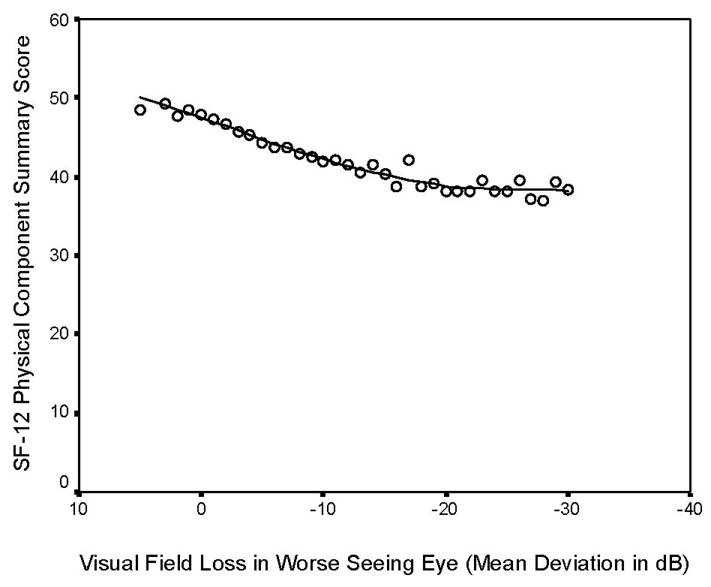
Of the 5,213 participants included in this study, 18% had unilateral mild, 1.5% unilateral moderate to severe, 19% bilateral mild, and 6.5% bilateral moderate to severe VFL. Worse NEI-VFQ-25 and SF-12 HRQOL scores were associated with VFL in a linear manner. Four- to 5-dB differences in VFL were associated with a five-point difference in the NEI-VFQ-25 composite and most subscale scores. Persons with VFL had the greatest difficulty with driving activities, dependency, mental health, distance vision, and peripheral vision.
HRQOL is diminished even in persons with relatively mild VFL on the basis of MD scores. Prevention and management of persons with VFL may be important in preventing or reducing poor HRQOL related to difficulties in driving, distance and peripheral vision activities, and a sense of dependency.
在一个基于人群的样本中,研究视野缺损(VFL)的严重程度与自我报告的健康相关生活质量(HRQOL)之间的关联。
基于人群的横断面研究。
洛杉矶拉丁裔眼病研究(LALES)的参与者接受了全面的眼科检查,包括使用Humphrey自动视野分析仪II(瑞典交互式阈值算法[SITA]标准24-2)[卡尔蔡司医疗技术公司,美国加利福尼亚州都柏林]进行视野测试。平均偏差(MD)得分用于确定VFL的严重程度,既作为连续变量,也按严重程度分层:无VFL(MD≥-2分贝[dB])、轻度VFL(-6 dB<MD<-2 dB)和中度至重度VFL(MD<-6 dB)。HRQOL通过医学结局研究12项简短健康调查(SF-12)和国家眼科研究所视觉功能问卷(NEI-VFQ-25)进行评估。采用线性回归分析和协方差分析来评估HRQOL得分与VFL之间的关系。
在本研究纳入的5213名参与者中,18%有单侧轻度VFL,1.5%有单侧中度至重度VFL,19%有双侧轻度VFL,6.5%有双侧中度至重度VFL。较差的NEI-VFQ-25和SF-12 HRQOL得分与VFL呈线性相关。VFL中4至5 dB的差异与NEI-VFQ-25综合得分及大多数子量表得分中5分的差异相关。有VFL的人在驾驶活动、依赖性、心理健康、远视力和周边视力方面困难最大。
根据MD得分,即使是VFL相对较轻的人,其HRQOL也会降低。预防和管理VFL患者对于预防或减少与驾驶、远视力和周边视力活动困难以及依赖感相关的不良HRQOL可能很重要。