McKean-Cowdin Roberta, Wang Ying, Wu Joanne, Azen Stanley P, Varma Rohit
Department of Preventive Medicine, Keck School of Medicine, University of Southern California, Los Angeles, California, USA.
Ophthalmology. 2008 Jun;115(6):941-948.e1. doi: 10.1016/j.ophtha.2007.08.037. Epub 2007 Nov 12.
To examine the association between health-related quality of life (HRQOL) and visual field (VF) loss in participants with open-angle glaucoma (OAG) in the Los Angeles Latino Eye Study (LALES).
Population-based cross-sectional study.
Two hundred thirteen participants with OAG and 2821 participants without glaucoma or VF loss.
Participants in the LALES-a population-based prevalence study of eye disease in Latinos 40 years and older, residing in Los Angeles, California-underwent a detailed eye examination including an assessment of their VF using the Humphrey Automated Field Analyzer (Swedish interactive thresholding algorithm Standard 24-2). Open-angle glaucoma was determined by clinical examination. Mean deviation scores were used to assess severity of VF loss. Health-related QOL was assessed by the Medical Outcomes Study 12-item Short-Form Health Survey (SF-12) and 25-item National Eye Institute Visual Function Questionnaire (NEI-VFQ-25). Linear regression and analysis of covariance were used to assess the relationship between HRQOL scores and VF loss after adjusting for sociodemographic variables and visual acuity.
The 25-item NEI-VFQ and SF-12 scores.
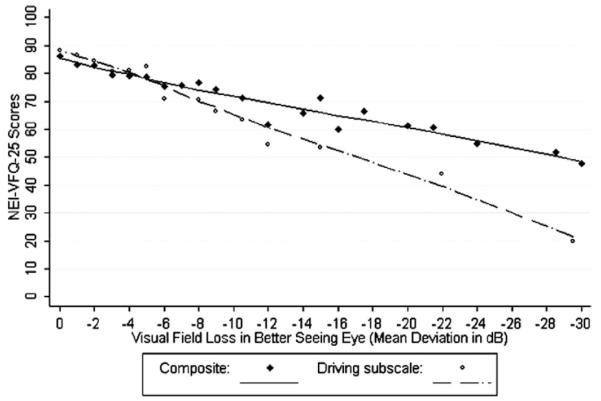
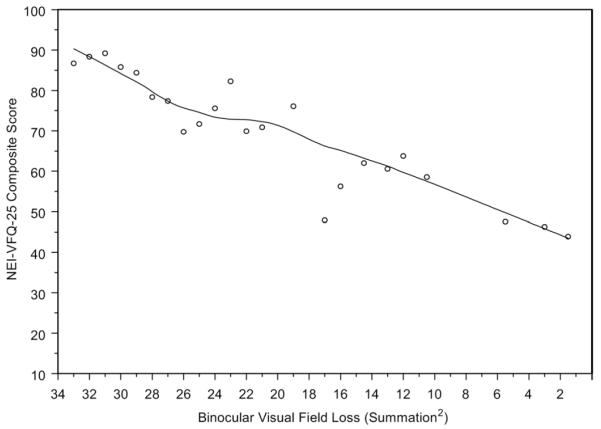
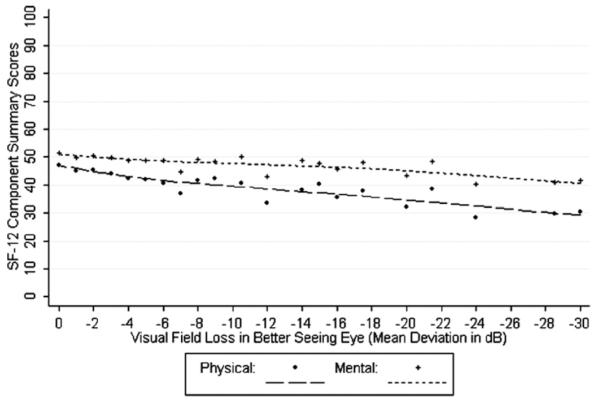
A trend of worse NEI-VFQ-25 scores for most subscales was observed with worse VF loss (using both monocular and calculated binocular data). Open-angle glaucoma participants with VF loss had lower scores than participants with no VF loss. This association was also present in participants who were previously undiagnosed and untreated for OAG (N = 160). Participants with any central VF loss had lower NEI-VFQ-25 scores than those with unilateral or bilateral peripheral VF loss. There was no significant impact of severity or location of VF loss on SF-12 scores.
Greater severity of VF loss in persons with OAG impacts vision-related QOL. This impact was present in persons who were previously unaware that they had glaucoma. Prevention of VF loss in persons with glaucoma is likely to reduce loss of vision-related QOL.
在洛杉矶拉丁裔眼病研究(LALES)中,研究开角型青光眼(OAG)患者的健康相关生活质量(HRQOL)与视野(VF)缺损之间的关联。
基于人群的横断面研究。
213例OAG患者以及2821例无青光眼或VF缺损的参与者。
LALES是一项针对居住在加利福尼亚州洛杉矶市的40岁及以上拉丁裔人群眼部疾病的基于人群的患病率研究。参与者接受了详细的眼科检查,包括使用汉弗莱自动视野分析仪(瑞典交互式阈值算法标准24-2)评估他们的视野。开角型青光眼通过临床检查确定。平均偏差分数用于评估VF缺损的严重程度。健康相关生活质量通过医学结局研究12项简短健康调查(SF-12)和25项国家眼科研究所视觉功能问卷(NEI-VFQ-25)进行评估。在调整社会人口统计学变量和视力后,使用线性回归和协方差分析来评估HRQOL分数与VF缺损之间的关系。
25项NEI-VFQ和SF-12分数。
随着VF缺损加重(使用单眼和计算得出的双眼数据),大多数子量表的NEI-VFQ-25分数呈现出更差的趋势。有VF缺损的开角型青光眼参与者的分数低于无VF缺损的参与者。这种关联在先前未被诊断和治疗的OAG参与者中也存在(N = 160)。有任何中央VF缺损的参与者的NEI-VFQ-25分数低于有单侧或双侧周边VF缺损的参与者。VF缺损的严重程度或位置对SF-12分数没有显著影响。
OAG患者中VF缺损的严重程度越高,对视力相关生活质量的影响越大。这种影响在先前不知道自己患有青光眼的人群中也存在。预防青光眼患者的VF缺损可能会减少视力相关生活质量的损失。