Anderson Alex Kojo
Department of Foods and Nutrition, The University of Georgia, 280 Dawson Hall, Athens, GA 30602, USA.
Int J Pediatr. 2009;2009:648091. doi: 10.1155/2009/648091. Epub 2009 Mar 12.
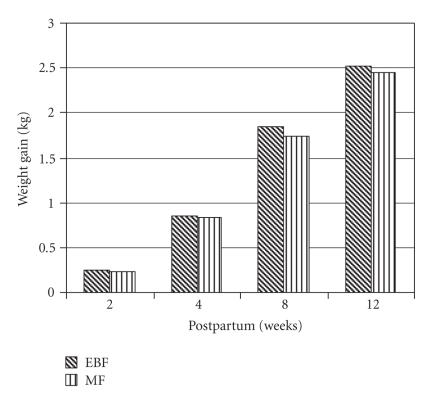
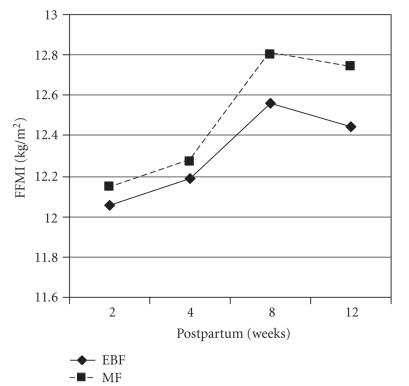
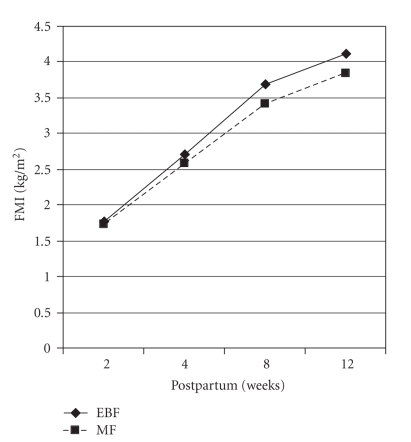
Research studies have produced conflicting results of the impact of breastfeeding on overweight/obesity. This study evaluated the impact of infant feeding on infant body composition. There were two groups of mother-infant pairs (exclusive breastfeeding [EBF; n = 27] and mixed feeding [MF; n = 13]) in this study. At baseline, participants were similar in their demographic characteristics except prepregnancy weight, where MF mothers tended to be heavier than their EBF counterparts (67.3 kg versus 59.9 kg; P = .034). Infant birth weight was slightly higher among the MF group than their EBF counterparts (3.5 kg versus 3.4 kg), although the differences were not statistically significant. At 3 months postpartum, mean infant FMI (4.1 kg/m(2) versus 3.8 kg/m(2)) and percent body fat (24.4% versus 23.1%) were slightly higher among EBF infants than MF infants. In terms of growth velocity, EBF infants gained weight faster than their MF counterparts, although the differences were not statistically significant. The findings from this study suggest that EBF may promote faster weight gain and increase in both fat mass index (FMI) and percent body fat in the early postpartum period in addition to the numerous health benefits enjoyed by the infant and the mother who exclusively breastfeeds her newborn.
关于母乳喂养对超重/肥胖影响的研究得出了相互矛盾的结果。本研究评估了婴儿喂养方式对婴儿身体成分的影响。本研究中有两组母婴对(纯母乳喂养[EBF;n = 27]和混合喂养[MF;n = 13])。在基线时,除孕前体重外,参与者的人口统计学特征相似,混合喂养组的母亲往往比纯母乳喂养组的母亲更重(67.3千克对59.9千克;P = 0.034)。混合喂养组婴儿的出生体重略高于纯母乳喂养组婴儿(3.5千克对3.4千克),尽管差异无统计学意义。产后3个月时,纯母乳喂养婴儿的平均脂肪质量指数(FMI)(4.1千克/平方米对3.8千克/平方米)和体脂百分比(24.4%对23.1%)略高于混合喂养婴儿。在生长速度方面,纯母乳喂养婴儿体重增加比混合喂养婴儿快,尽管差异无统计学意义。本研究结果表明,除了纯母乳喂养的婴儿和母亲能获得诸多健康益处外,纯母乳喂养在产后早期可能会促进体重更快增加,并使脂肪质量指数(FMI)和体脂百分比升高。