
阿司匹林加重的呼吸道疾病管理的最新进展。
Update on recent advances in the management of aspirin exacerbated respiratory disease.
机构信息
Department of Allergy and Rheumatology, Ajou University School of Medicine, Yeongtong-gu, Suwon, Korea.
出版信息
Yonsei Med J. 2009 Dec 31;50(6):744-50. doi: 10.3349/ymj.2009.50.6.744. Epub 2009 Dec 18.
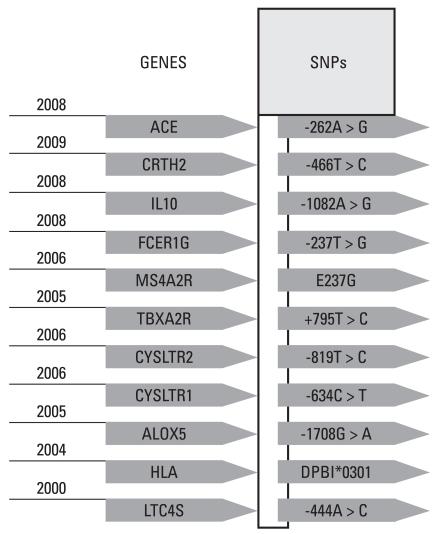
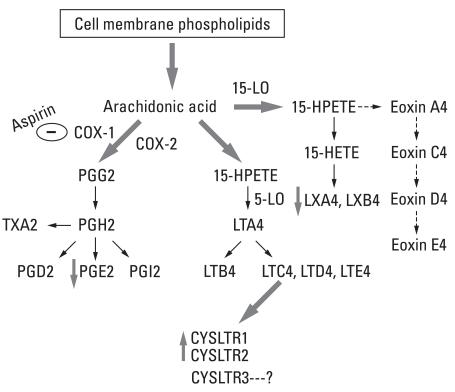
Aspirin intolerant asthma (AIA) is frequently characterized as an aspirin (ASA)-exacerbated respiratory disease (AERD). It is a clinical syndrome associated with chronic severe inflammation in the upper and lower airways resulting in chronic rhinitis, sinusitis, recurrent polyposis, and asthma. AERD generally develops secondary to abnormalities in inflammatory mediators and arachidonic acid biosynthesis expression. Upper and lower airway eosinophil infiltration is a key feature of AERD; however, the exact mechanisms of such chronic eosinophilic inflammation are not fully understood. Cysteinyl leukotriene over-production may be a key factor in the induction of eosinophilic activation. Genetic studies have suggested a role for variability of genes in disease susceptibility and response to medication. Potential genetic biomarkers contributing to the AERD phenotype include HLA-DPB1*301, LTC4S, ALOX5, CYSLT, PGE2, TBXA2R, TBX21, MS4A2, IL10 -1082A > G, ACE -262A > T, and CRTH2 -466T > C; the four-locus SNP set was composed of B2ADR 46A > G, CCR3 -520T > G, CysLTR1 -634C > T, and FCER1B -109T > C. Management of AERD is an important issue. Aspirin ingestion may result in significant morbidity and mortality, and patients must be advised regarding aspirin risk. Leukotriene receptor antagonists (LTRA) that inhibit leukotriene pathways have an established role in long-term AERD management and rhinosinusitis. Aspirin desensitization may be required for the relief of upper and lower airway symptoms in AERD patients. Future research should focus on identification of biomarkers for a comprehensive diagnostic approach.
阿司匹林不耐受型哮喘(AIA)常表现为阿司匹林(ASA)加重的呼吸道疾病(AERD)。它是一种与慢性上、下呼吸道炎症相关的临床综合征,导致慢性鼻炎、鼻窦炎、复发性息肉和哮喘。AERD 通常继发于炎症介质和花生四烯酸生物合成表达的异常。上、下气道嗜酸性粒细胞浸润是 AERD 的一个关键特征;然而,这种慢性嗜酸性粒细胞炎症的确切机制尚不完全清楚。半胱氨酰白三烯过度产生可能是诱导嗜酸性粒细胞活化的关键因素。遗传研究表明,基因变异在疾病易感性和对药物的反应中起作用。可能导致 AERD 表型的潜在遗传生物标志物包括 HLA-DPB1*301、LTC4S、ALOX5、CYSLT、PGE2、TBXA2R、TBX21、MS4A2、IL10-1082A>G、ACE-262A>T 和 CRTH2-466T>C;四个单核苷酸多态性(SNP)集由 B2ADR46A>G、CCR3-520T>G、CysLTR1-634C>T 和 FCER1B-109T>C 组成。AERD 的管理是一个重要问题。阿司匹林的摄入可能导致严重的发病率和死亡率,必须告知患者阿司匹林的风险。白三烯受体拮抗剂(LTRA)抑制白三烯途径在 AERD 长期管理和鼻-鼻窦炎中具有明确的作用。阿司匹林脱敏可能是缓解 AERD 患者上、下呼吸道症状所必需的。未来的研究应侧重于确定生物标志物,以进行全面的诊断方法。
 Zotero 插件