Division of Thoracic Imaging, Department of Radiology, Massachusetts General Hospital and Harvard Medical School, Boston, MA 02114, USA.
Korean J Radiol. 2010 Jan-Feb;11(1):46-53. doi: 10.3348/kjr.2010.11.1.46. Epub 2009 Dec 28.
To assess the effects of radiation dose reduction in the chest CT using a weight-based adjustment of the automatic exposure control (AEC) technique.
With Institutional Review Board Approval, 60 patients (mean age, 59.1 years; M:F = 35:25) and 57 weight-matched patients (mean age, 52.3 years, M:F = 25:32) were scanned using a weight-adjusted AEC and non-weight-adjusted AEC, respectively on a 64-slice multidetector CT with a 0.984:1 pitch, 0.5 second rotation time, 40 mm table feed/rotation, and 2.5 mm section thickness. Patients were categorized into 3 weight categories; < 60 kg (n = 17), 60-90 kg (n = 52), and > 90 kg (n = 48). Patient weights, scanning parameters, CT dose index volumes (CTDIvol) and dose length product (DLP) were recorded, while effective dose (ED) was estimated. Image noise was measured in the descending thoracic aorta. Data were analyzed using a standard statistical package (SAS/STAT) (Version 9.1, SAS institute Inc, Cary, NC).
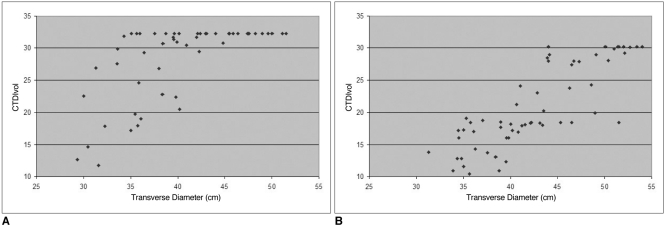
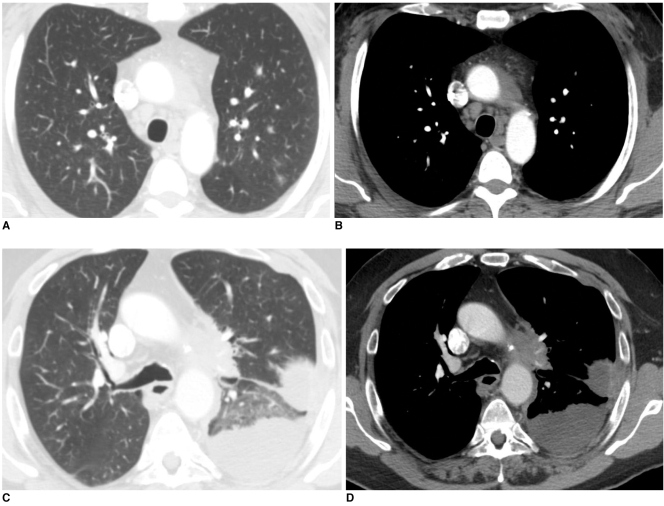
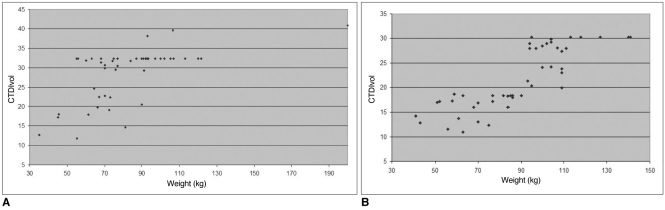
Compared to the non-weight-adjusted AEC, the weight-adjusted AEC technique resulted in an average decrease of 29% in CTDIvol and a 27% effective dose reduction (p < 0.0001). With weight-adjusted AEC, the CTDIvol decreased to 15.8, 15.9, and 27.3 mGy for the < 60, 60-90 and > 91 kg weight groups, respectively, compared to 20.3, 27.9 and 32.8 mGy, with non-weight-adjusted AEC. No significant difference was observed for objective image noise between the chest CT acquired with the non-weight-adjusted (15.0 +/- 3.1) and weight-adjusted (16.1 +/- 5.6) AEC techniques (p > 0.05).
The results of this study suggest that AEC should be tailored according to patient weight. Without weight-based adjustment of AEC, patients are exposed to a 17 - 43% higher radiation-dose from a chest CT.
评估基于体重调整自动曝光控制(AEC)技术在胸部 CT 中降低辐射剂量的效果。
本研究经机构审查委员会批准,分别使用体重调整 AEC 和非体重调整 AEC 对 60 例患者(平均年龄 59.1 岁;男/女=35/25)和 57 例体重匹配患者(平均年龄 52.3 岁,男/女=25/32)进行扫描。这些患者均在一台 64 排多层 CT 扫描仪上进行检查,扫描参数为 0.984:1 螺距、0.5 秒旋转时间、40mm 床速/旋转、2.5mm 层厚。将患者分为 3 个体重组;<60kg(n=17)、60-90kg(n=52)和>90kg(n=48)。记录患者体重、扫描参数、CT 剂量指数容积(CTDIvol)和剂量长度乘积(DLP),同时估算有效剂量(ED)。测量降主动脉的图像噪声。使用标准统计软件包(SAS/STAT)(版本 9.1,SAS 研究所,Cary,NC)进行数据分析。
与非体重调整 AEC 相比,体重调整 AEC 技术使 CTDIvol 平均降低 29%,有效剂量降低 27%(p<0.0001)。使用体重调整 AEC,体重<60kg、60-90kg 和>91kg 组的 CTDIvol 分别降至 15.8、15.9 和 27.3mGy,而非体重调整 AEC 组的 CTDIvol 分别为 20.3、27.9 和 32.8mGy。使用非体重调整(15.0±3.1)和体重调整(16.1±5.6)AEC 技术获得的胸部 CT 之间,客观图像噪声无显著差异(p>0.05)。
本研究结果表明,AEC 应根据患者体重进行调整。如果不基于体重调整 AEC,胸部 CT 会使患者暴露于 17%-43%更高的辐射剂量下。