INRA, UMR 406 Abeilles et Environnement, Laboratoire Biologie et Protection de l'abeille, Site Agroparc, 84914 Avignon, France.
Environ Microbiol. 2010 Mar;12(3):774-82. doi: 10.1111/j.1462-2920.2009.02123.x. Epub 2009 Dec 27.
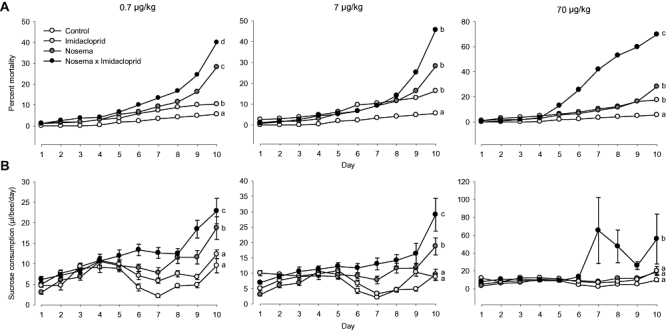
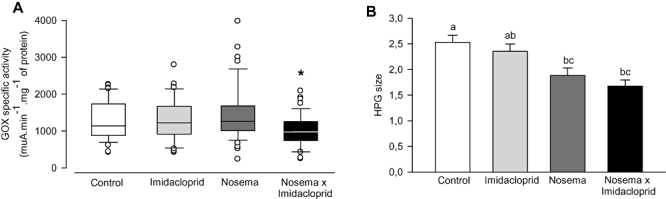
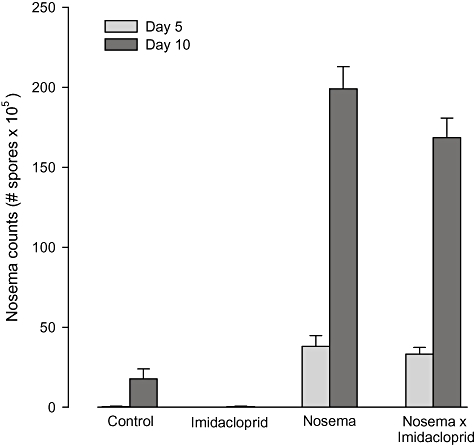
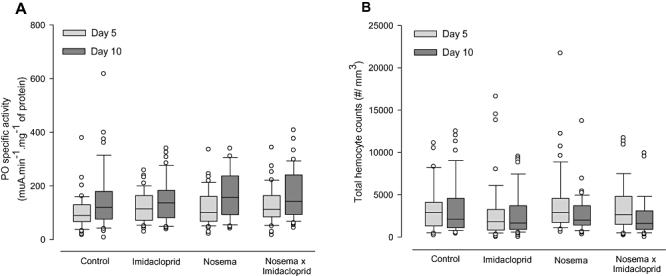
Global pollinators, like honeybees, are declining in abundance and diversity, which can adversely affect natural ecosystems and agriculture. Therefore, we tested the current hypotheses describing honeybee losses as a multifactorial syndrome, by investigating integrative effects of an infectious organism and an insecticide on honeybee health. We demonstrated that the interaction between the microsporidia Nosema and a neonicotinoid (imidacloprid) significantly weakened honeybees. In the short term, the combination of both agents caused the highest individual mortality rates and energetic stress. By quantifying the strength of immunity at both the individual and social levels, we showed that neither the haemocyte number nor the phenoloxidase activity of individuals was affected by the different treatments. However, the activity of glucose oxidase, enabling bees to sterilize colony and brood food, was significantly decreased only by the combination of both factors compared with control, Nosema or imidacloprid groups, suggesting a synergistic interaction and in the long term a higher susceptibility of the colony to pathogens. This provides the first evidences that interaction between an infectious organism and a chemical can also threaten pollinators, interactions that are widely used to eliminate insect pests in integrative pest management.
全球传粉媒介(如蜜蜂)的数量和多样性正在减少,这可能会对自然生态系统和农业造成不利影响。因此,我们通过研究传染性生物体和杀虫剂对蜜蜂健康的综合影响,来验证描述蜜蜂减少是多因素综合征的现有假说。我们证明了微孢子虫 Nosema 和新烟碱类杀虫剂(吡虫啉)之间的相互作用显著削弱了蜜蜂。短期内,这两种药剂的组合会导致个体死亡率和能量压力达到最高。通过量化个体和社会层面的免疫强度,我们表明,个体的血球数量或酚氧化酶活性均不受不同处理的影响。然而,与对照组、Nosema 或吡虫啉组相比,只有这两种因素的组合才会显著降低葡萄糖氧化酶的活性,从而使蜜蜂能够对蜂群和幼虫食物进行消毒,这表明存在协同作用,从长远来看,蜂群对病原体的易感性会更高。这首次提供了证据表明,传染性生物体和化学物质之间的相互作用也会威胁传粉媒介,这些相互作用被广泛用于综合虫害管理中消灭害虫。