AIDS Res Ther. 2010 Jan 5;7(1):1. doi: 10.1186/1742-6405-7-1.
A recent study reported a lower than expected specificity and positive predictive value of the rapid oral HIV test in the setting of routine emergency department (ED) screening. These results appeared inconsistent with the findings in another urban Emergency Department during the same time period.
To compare the specificity and positive predictive vale (PPV) of an oral rapid HIV test used in an ED screening program in Washington DC with that performed in the USHER clinical trial.
Period cross-sectional analysis of rapid oral HIV testing conducted in an ongoing HIV screening program emergency department patients.
The George Washington University Emergency Department (Washington DC) from 7 February to 1 October 2007.
1,560 adults seen in the ED for non-HIV-related presenting complaints, who participated in the HIV screening program.
Rapid HIV testing with the OraQuick ADVANCE Rapid HIV-1/2 Antibody Test (OraSure Technologies, Bethlehem, Pennsylvania). PATIENTS with reactive rapid test results were offered Western blot testing for confirmation.
Specificity and positive predictive value for the program were determined. Findings were compared to those found in the USHER trial.
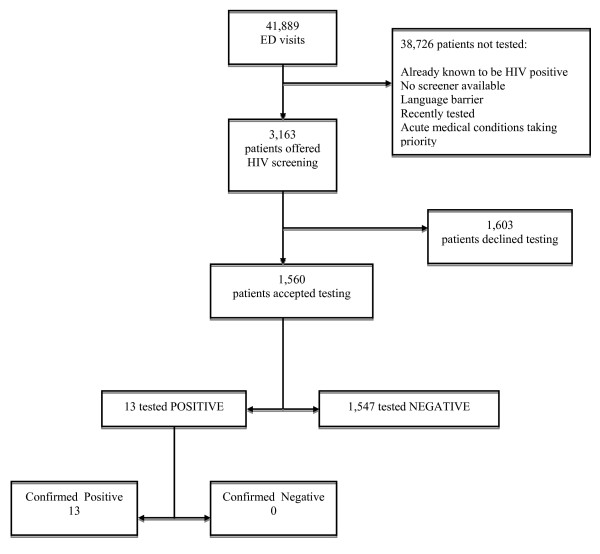
Of 1,560 patients screened for HIV, 13 [0.8%, 95% CI 0.38% to 1.28%] had a reactive HIV screening test, and all were confirmed to be positive by Western Blot. The specificity was 100% (95% CI 99.6%-100%).
Since non-reactive tests were not confirmed, the test sensitivity cannot be determined.
Review of our data conflict with findings from the USHER study surrounding false positive OraQuick HIV screening. Our data suggest that rapid HIV screening protocols implemented in EDs outside of the clinical trial paradigm perform effectively without an excess of false positive results. Compared with other screening tests, HIV rapid screening should remain an essential component of ED practice.
最近的一项研究报告称,在常规急诊(ED)筛查环境中,快速口腔 HIV 检测的特异性和阳性预测值低于预期。这些结果似乎与同一时期另一个城市急诊部门的研究结果不一致。
比较在华盛顿特区进行的 ED 筛查项目中使用的口腔快速 HIV 检测的特异性和阳性预测值(PPV)与 USHER 临床试验中的结果。
对正在进行的 HIV 筛查计划中在急诊患者中进行的快速口腔 HIV 检测进行的回顾性横断面分析。
2007 年 2 月 7 日至 10 月 1 日期间的乔治华盛顿大学急诊部(华盛顿特区)。
1560 名因非 HIV 相关就诊主诉在 ED 就诊的成年人,他们参加了 HIV 筛查计划。
使用 OraQuick ADVANCE 快速 HIV-1/2 抗体检测(OraSure 技术公司,宾夕法尼亚州伯利恒)进行快速 HIV 检测。对快速检测结果呈阳性的患者提供 Western blot 检测以确认。
确定了该计划的特异性和阳性预测值。并将结果与 USHER 试验中的结果进行比较。
在筛查 HIV 的 1560 名患者中,有 13 名(0.8%,95%CI 0.38%至 1.28%)的 HIV 筛查检测呈阳性反应,所有患者的 Western blot 检测均为阳性。特异性为 100%(95%CI 99.6%至 100%)。
由于未确认非反应性检测,因此无法确定检测灵敏度。
我们的数据审查与 USHER 研究中关于 OraQuick HIV 筛查假阳性的结果相矛盾。我们的数据表明,在临床试验范式之外的 ED 中实施的快速 HIV 筛查方案可以有效地进行,而不会出现过多的假阳性结果。与其他筛查测试相比,HIV 快速筛查应仍然是 ED 实践的重要组成部分。