Tissue Injury and Repair Group, School of Clinical and Laboratory Sciences, University of Manchester, Stopford Building, Oxford Road, Manchester, M13 9PT, UK.
Arthritis Res Ther. 2010;12(1):R1. doi: 10.1186/ar2898. Epub 2010 Jan 5.
Intervertebral disc (IVD) degeneration is considered a major underlying factor in the pathogenesis of chronic low back pain. Although the healthy IVD is both avascular and aneural, during degeneration there is ingrowth of nociceptive nerve fibres and blood vessels into proximal regions of the IVD, which may contribute to the pain. The mechanisms underlying neural ingrowth are, however, not fully understood. Semaphorin 3A (sema3A) is an axonal guidance molecule with the ability to repel nerves seeking their synaptic target. This study aimed to identify whether members of the Class 3 semaphorins were expressed by chondrocyte-like cells of the IVD addressing the hypothesis that they may play a role in repelling axons surrounding the healthy disc, thus maintaining its aneural condition.
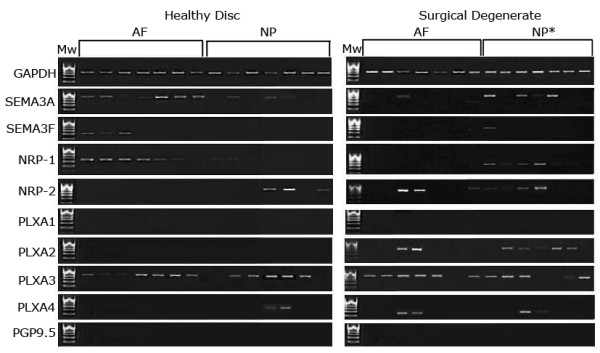
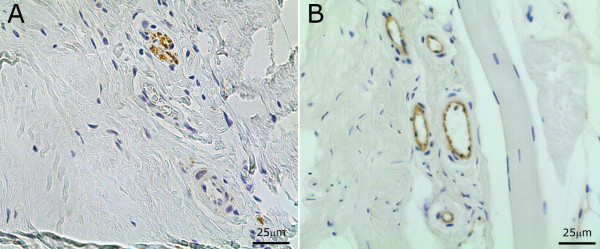
Human IVD samples were investigated using reverse transcription polymerase chain reaction (RT-PCR) to identify gene expression of sema3A, 3F and their receptors: neuropilins (1 and 2) and plexins (A1-4). Sema3A protein was also localised within sections of normal and degenerate human IVD and immunopositivity quantified. Serial sections were stained using PGP9.5 and CD31 to correlate semaphorin 3A expression with nerve and blood vessel ingrowth, respectively.
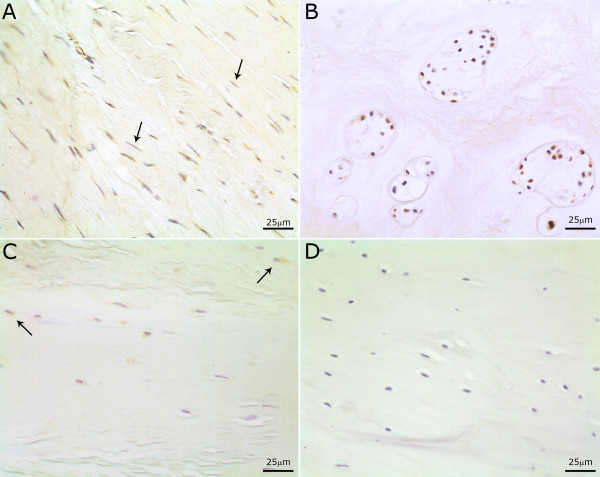
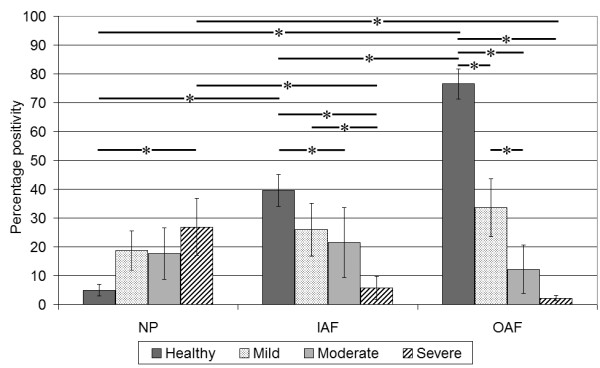
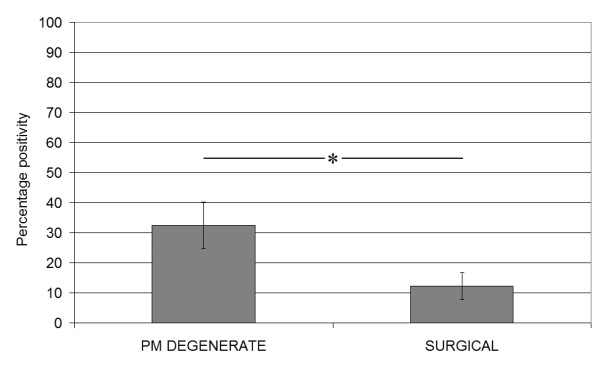
Sema3A protein was expressed highly in the healthy disc, primarily localised to the outer annulus fibrosus. In degenerate samples, sema3A expression decreased significantly in this region, although cell clusters within the degenerate nucleus pulposus exhibited strong immunopositivity. mRNA for sema3A receptors was also identified in healthy and degenerate tissues. CD31 and PGP9.5 were expressed most highly in degenerate tissues correlating with low expression of sema3A.
This study is the first to establish the expression of semaphorins and their receptors in the human IVD with a decrease seen in the degenerate painful IVD. Sema3A may therefore, amongst other roles, act as a barrier to neuronal ingrowth within the healthy disc.
椎间盘(IVD)退变被认为是慢性下腰痛发病机制的主要潜在因素。尽管健康的 IVD 既无血管也无神经,但在退变过程中,伤害性神经纤维和血管向 IVD 的近端生长,这可能导致疼痛。然而,神经生长的机制尚不完全清楚。Sema 家族 3A(sema3A)是一种轴突导向分子,具有排斥寻找其突触靶标的神经的能力。本研究旨在确定 IVD 软骨样细胞是否表达 Class 3 semaphorins,从而验证它们可能在排斥围绕健康椎间盘的轴突、从而维持其无神经状态方面发挥作用的假说。
采用逆转录聚合酶链反应(RT-PCR)检测人 IVD 样本中 sema3A、3F 及其受体神经纤毛蛋白(1 和 2)和神经丛蛋白(A1-4)的基因表达。还在正常和退变人 IVD 的切片中定位 Sema3A 蛋白,并对免疫阳性进行定量。用 PGP9.5 和 CD31 对连续切片进行染色,分别将 Sema 家族 3A 表达与神经和血管生长进行相关性分析。
Sema3A 蛋白在健康椎间盘表达水平较高,主要定位于纤维环外。在退变样本中,该区域的 Sema3A 表达显著降低,尽管退变核髓核中的细胞簇表现出强烈的免疫阳性。在健康和退变组织中也鉴定出 Sema3A 受体的 mRNA。CD31 和 PGP9.5 在退变组织中表达水平最高,与 Sema3A 的低表达相关。
本研究首次在人 IVD 中建立了 Sema 家族和它们的受体的表达,在退变的疼痛性 IVD 中观察到表达降低。因此,Sema3A 除了其他作用外,可能在健康椎间盘内作为神经元生长的屏障。