Melbourne School of Population Health, University of Melbourne, Melbourne, Australia.
PLoS Med. 2010 Jan;7(1):e1000210. doi: 10.1371/journal.pmed.1000210. Epub 2010 Jan 5.
Globally, suicide accounts for 5.2% of deaths among persons aged 15 to 44 years and its incidence is rising. In Australia, suicide rates peaked in 1997 and have been declining since. A substantial part of that decline stems from a plunge in suicides by one particular method: asphyxiation by motor vehicle exhaust gas (MVEG). Although MVEG remains the second most common method of suicide in Australia, its incidence decreased by nearly 70% in the decade to 2006. The extent to which this phenomenon has been driven by national laws in 1986 and 1999 that lowered permissible levels of carbon monoxide (CO) emissions is unknown. The objective of this ecological study was to test the relationship by investigating whether areas of Australia with fewer noxious vehicles per capita experienced lower rates of MVEG suicide.
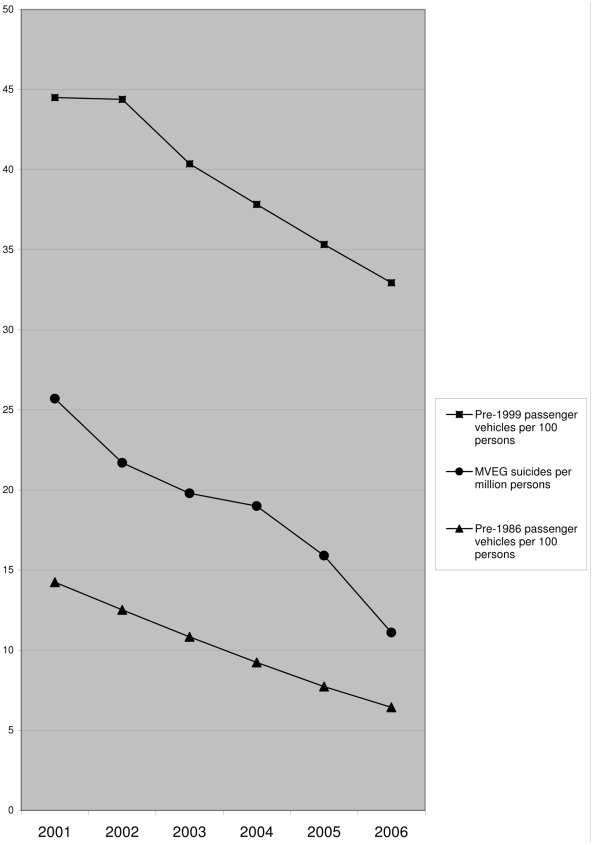
We merged data on MVEG suicides in Australia (2001-06) with data on the number and age of vehicles in the national fleet, as well as socio-demographic data from the national census. Poisson regression was used to analyse the relationship between the incidence of suicide within two levels of geographical area--postcodes and statistical subdivisions (SSDs)--and the population density of pre-1986 and pre-1999 passenger vehicles in those areas. (There was a mean population of 8,302 persons per postcode in the study dataset and 87,413 persons per SSD.) The annual incidence of MVEG suicides nationwide decreased by 57% (from 2.6 per 100,000 in 2001 to 1.1 in 2006) during the study period; the population density of pre-1986 and pre-1999 vehicles decreased by 55% (from 14.2 per 100 persons in 2001 to 6.4 in 2006) and 26% (from 44.5 per 100 persons in 2001 to 32.9 in 2006), respectively. Area-level regression analysis showed that the suicide rates were significantly and positively correlated with the presence of older vehicles. A percentage point decrease in the population density of pre-1986 vehicles was associated with a 6% decrease (rate ratio [RR] = 1.06; 95% confidence interval [CI] 1.05-1.08) in the incidence of MVEG suicide within postcode areas; a percentage point decrease in the population density of pre-1999 vehicles was associated with a 3% decrease (RR = 1.03; 95% CI 1.02-1.04) in the incidence of MVEG suicide.
Areas of Australia with fewer vehicles predating stringent CO emission laws experience lower rates of MVEG suicide. Although those emission laws were introduced primarily for environmental reasons, countries that lack them may miss the benefits of a serendipitous suicide prevention strategy. Please see later in the article for the Editors' Summary.
在全球范围内,自杀占 15 至 44 岁人群死亡人数的 5.2%,其发病率呈上升趋势。在澳大利亚,自杀率在 1997 年达到峰值,此后一直在下降。这种下降的很大一部分原因是由于一种特定方法的自杀率急剧下降:汽车尾气窒息(MVEG)。尽管 MVEG 仍然是澳大利亚第二常见的自杀方式,但在 2006 年的十年间,其发病率下降了近 70%。这种现象在多大程度上是由于 1986 年和 1999 年降低一氧化碳(CO)排放量允许水平的国家法律推动的尚不清楚。本生态研究的目的是通过调查澳大利亚人均有毒车辆较少的地区是否经历了较低的 MVEG 自杀率来检验这种关系。
我们将澳大利亚的 MVEG 自杀数据(2001-06 年)与国家车队的车辆数量和年龄以及全国人口普查的社会人口数据合并。泊松回归用于分析在两个地理区域(邮政编码和统计细分(SSD))内自杀发生率与这些地区 1986 年之前和 1999 年之前乘用车人口密度之间的关系。(在研究数据集中,每个邮政编码的平均人口为 8302 人,每个 SSD 的平均人口为 87413 人。)全国范围内的 MVEG 自杀年发病率在研究期间下降了 57%(从 2001 年的每 100,000 人 2.6 人下降到 2006 年的 1.1 人);1986 年之前和 1999 年之前的车辆人口密度分别下降了 55%(从 2001 年的每 100 人 14.2 人下降到 2006 年的每 100 人 6.4 人)和 26%(从 2001 年的每 100 人 44.5 人下降到 2006 年的每 100 人 32.9 人)。区域水平回归分析表明,自杀率与旧车辆的存在呈显著正相关。1986 年之前的车辆人口密度每降低一个百分点,与邮政编码地区 MVEG 自杀发生率降低 6%(RR=1.06;95%置信区间[CI]1.05-1.08)相关;1999 年之前的车辆人口密度每降低一个百分点,与 MVEG 自杀发生率降低 3%(RR=1.03;95%置信区间[CI]1.02-1.04)相关。
澳大利亚人均车辆较少的地区自杀率较低。尽管这些排放法规主要是出于环境原因而制定的,但缺乏这些法规的国家可能会错失一种意外的自杀预防策略带来的好处。请稍后在文章中查看编辑摘要。