Department of Internal Medicine, University of Tsukuba Institute of Clinical Medicine, 1-1-1 Tennodai, Tsukuba, Ibaraki, Japan.
Diabetologia. 2010 Mar;53(3):419-28. doi: 10.1007/s00125-009-1622-2. Epub 2010 Jan 7.
AIMS/HYPOTHESIS: The aim of the study was to clarify whether a therapeutic intervention focused on lifestyle modification affected the incidence of vascular complications in patients with established diabetes.
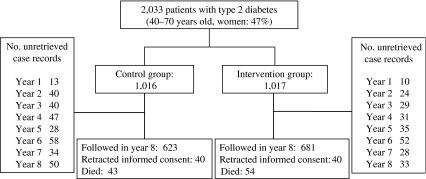
A total of 2,033 eligible Japanese men and women aged 40-70 years with type 2 diabetes from 59 institutes were randomised to a conventional treatment group (CON), which continued to receive the usual care, and a lifestyle intervention group (INT), which received education on lifestyle modification regarding dietary habits, physical activities and adherence to treatment by telephone counselling and at each outpatient clinic visit, in addition to the usual care. Randomisation and open-label allocation were done by a central computer system. Primary analysis regarding measurements of control status and occurrence of macro- and microvascular complications was based on 1,304 participants followed for an 8 year period.
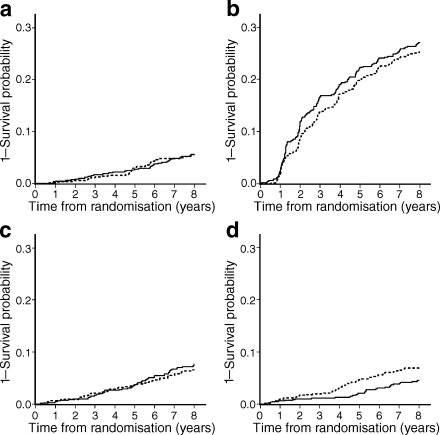
Although status of control of most classic cardiovascular risk factors, including body weight, glycaemia, serum lipids and BP, did not differ between groups during the study period, the incidence of stroke in the INT group (5.48/1,000 patient-years) was significantly lower than in the CON group (9.52/1,000 patient-years) by Kaplan- Meier analysis (p=0.02 by logrank test) and by multivariate Cox analysis (HR 0.62, 95% CI 0.39-0.98, p=0.04). The incidence of CHD, retinopathy and nephropathy did not differ significantly between groups. Lipoprotein(a) was another significant independent risk factor for stroke.
CONCLUSIONS/INTERPRETATION: These findings suggest that lifestyle modification had limited effects on most typical control variables, but did have a significant effect on stroke incidence in patients with established type 2 diabetes.
UMIN-CTR C000000222
The Ministry of Health, Labour and Welfare, Japan
目的/假设:本研究旨在阐明以生活方式改变为重点的治疗干预是否会影响已确诊糖尿病患者血管并发症的发生。
共有 2033 名来自 59 家机构的年龄在 40-70 岁之间的 2 型糖尿病日本男性和女性符合入选条件,他们被随机分为常规治疗组(CON)和生活方式干预组(INT)。CON 组继续接受常规治疗,INT 组则在常规治疗的基础上,通过电话咨询和每次门诊就诊,接受关于饮食习惯、身体活动和治疗依从性的生活方式改变教育。随机化和开放标签分配由中央计算机系统完成。主要分析是基于 1304 名随访 8 年的参与者,评估控制状态和大血管及微血管并发症的发生情况。
尽管在研究期间,两组大多数经典心血管危险因素(包括体重、血糖、血脂和血压)的控制状况没有差异,但 Kaplan-Meier 分析显示,INT 组的中风发生率(5.48/1000 患者年)明显低于 CON 组(9.52/1000 患者年)(logrank 检验 p=0.02),多变量 Cox 分析显示(HR 0.62,95%CI 0.39-0.98,p=0.04)。两组的 CHD、视网膜病变和肾病发生率无显著差异。脂蛋白(a)是中风的另一个独立危险因素。
结论/解释:这些发现表明,生活方式改变对大多数典型的控制变量影响有限,但对已确诊 2 型糖尿病患者的中风发生率有显著影响。
UMIN-CTR C000000222
日本厚生劳动省