Peking University School of Public Health, Beijing, China.
Environ Health Perspect. 2010 Jan;118(1):87-91. doi: 10.1289/ehp.0900818.
Heart rate variability (HRV), a marker of cardiac autonomic function, has been -associated with particulate matter (PM) air pollution, especially in older patients and those with cardio-vascular diseases. However, the effect of PM exposure on cardiac autonomic function in young, healthy adults has received less attention.
We evaluated the relationship between exposure to traffic-related PM with an aerodynamic diameter <or= 2.5 microm (PM2.5) and HRV in a highly exposed panel of taxi drivers.
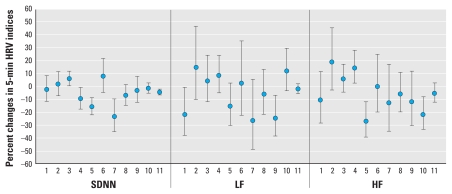
Continuous measurements of personal exposure to PM2.5 and ambulatory electrocardiogram monitoring were conducted on 11 young healthy taxi drivers for a 12-hr work shift during their work time (09002100 hr) before, during, and after the Beijing 2008 Olympic Games. Mixed-effects regression models were used to estimate associations between PM2.5 exposure and percent changes in 5-min HRV indices after combining data from the three time periods and controlling for potentially confounding variables.
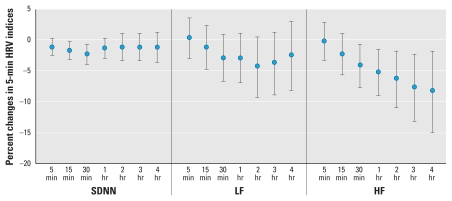
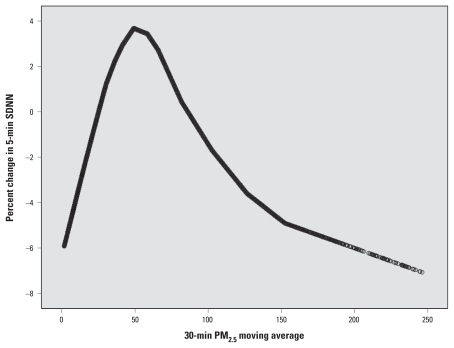
Personal exposures of taxi drivers to PM2.5 changed markedly across the three time -periods. The standard deviation of normal-to-normal (SDNN) intervals decreased by 2.2% [95% confidence interval (CI), 3.8% to 0.6%] with an interquartile range (IQR; 69.5 microg/m3) increase in the 30-min PM2.5 moving average, whereas the low-frequency and high-frequency powers decreased by 4.2% (95% CI, 9.0% to 0.8%) and 6.2% (95% CI, 10.7% to 1.5%), respectively, in association with an IQR increase in the 2-hr PM2.5 moving average.
Marked changes in traffic-related PM2.5 exposure were associated with altered cardiac autonomic function in young healthy adults.
心率变异性(HRV)是心脏自主功能的标志物,与颗粒物(PM)空气污染有关,尤其是在老年患者和心血管疾病患者中。然而,PM 暴露对年轻健康成年人心脏自主功能的影响受到的关注较少。
我们评估了高度暴露于出租车司机群体中交通相关的 PM2.5(空气动力学直径≤2.5 微米)与 HRV 之间的关系。
在 2008 年北京奥运会前后,对 11 名年轻健康的出租车司机进行了为期 12 小时的工作班次(0900-2100 小时)中个人 PM2.5 暴露的连续测量和动态心电图监测。使用混合效应回归模型,在合并三个时间段的数据并控制潜在混杂变量后,估计 PM2.5 暴露与 5 分钟 HRV 指数变化百分比之间的关系。
出租车司机的个人 PM2.5 暴露在三个时间段内明显变化。SDNN 间隔的标准差下降了 2.2%(95%置信区间:3.8%-0.6%),与 30 分钟 PM2.5 移动平均值增加 69.5μg/m3 相关,而低频和高频功率分别下降了 4.2%(95%置信区间:9.0%-0.8%)和 6.2%(95%置信区间:10.7%-1.5%),与 2 小时 PM2.5 移动平均值增加相关。
交通相关的 PM2.5 暴露的明显变化与年轻健康成年人心脏自主功能的改变有关。