Harvard School of Public Health, Boston, Massachusetts, USA.
Environ Health Perspect. 2010 May;118(5):607-13. doi: 10.1289/ehp.0901365. Epub 2010 Jan 7.
Sources of air pollution in developing country cities include transportation and industrial pollution, biomass and coal fuel use, and resuspended dust from unpaved roads.
Our goal was to understand within-neighborhood spatial variability of particulate matter (PM) in communities of varying socioeconomic status (SES) in Accra, Ghana, and to quantify the effects of nearby sources on local PM concentration.
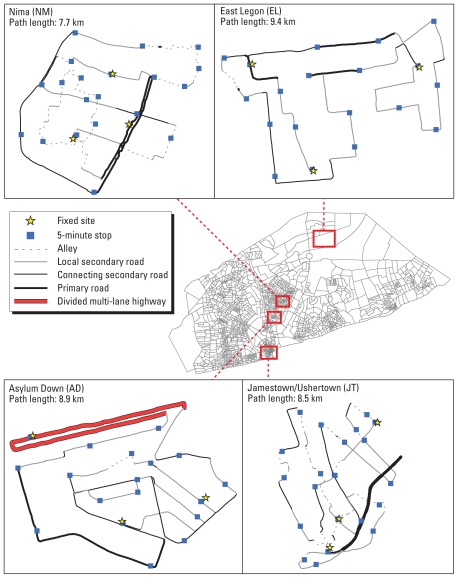
We conducted 1 week of morning and afternoon mobile and stationary air pollution measurements in four study neighborhoods. PM with aerodynamic diameters <or= 2.5 microm (PM2.5) and <or= 10 microm (PM10) was measured continuously, with matched global positioning system coordinates; detailed data on local sources were collected at periodic stops. The effects of nearby sources on local PM were estimated using linear mixed-effects models.
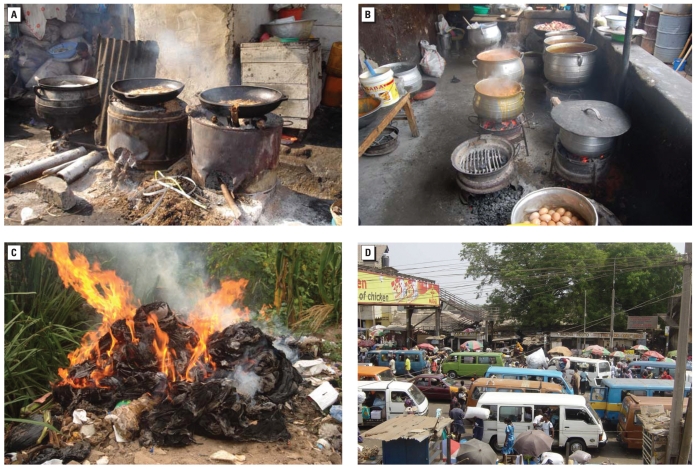
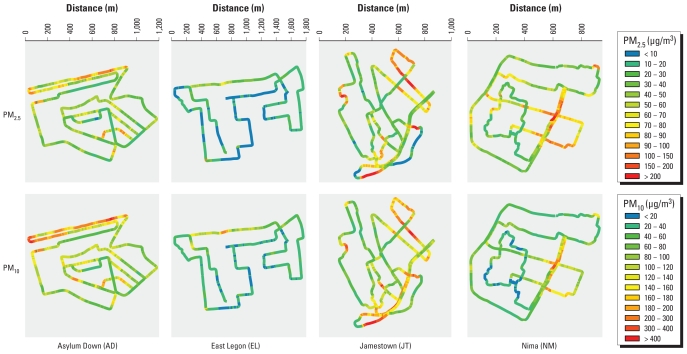
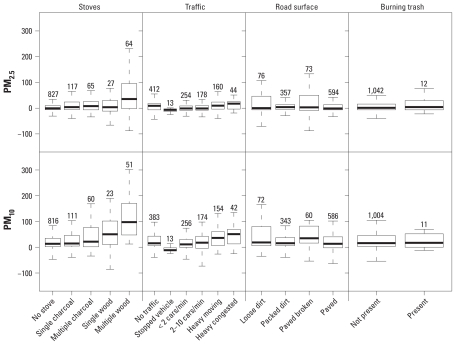
In our measurement campaign, the geometric means of PM2.5 and PM10 along the mobile monitoring path were 21 and 49 microg/m3, respectively, in the neighborhood with highest SES and 39 and 96 microg/m3, respectively, in the neighborhood with lowest SES and highest population density. PM2.5 and PM10 were as high as 200 and 400 microg/m3, respectively, in some segments of the path. After adjusting for other factors, the factors that had the largest effects on local PM pollution were nearby wood and charcoal stoves, congested and heavy traffic, loose dirt road surface, and trash burning.
Biomass fuels, transportation, and unpaved roads may be important determinants of local PM variation in Accra neighborhoods. If confirmed by additional or supporting data, the results demonstrate the need for effective and equitable interventions and policies that reduce the impacts of traffic and biomass pollution.
发展中国家城市的空气污染来源包括交通和工业污染、生物质和煤炭燃料的使用,以及未铺砌道路扬起的灰尘。
我们的目标是了解加纳阿克拉不同社会经济地位(SES)社区内颗粒物(PM)的局域空间变异性,并量化附近污染源对当地 PM 浓度的影响。
我们在四个研究社区进行了为期一周的早晨和下午移动和固定空气污染测量。使用匹配的全球定位系统坐标连续测量空气动力学直径<2.5 微米(PM2.5)和<10 微米(PM10)的 PM;在定期停车时收集有关当地污染源的详细数据。使用线性混合效应模型估计附近污染源对当地 PM 的影响。
在我们的测量活动中,SES 最高和人口密度最高的社区中,沿移动监测路径的 PM2.5 和 PM10 的几何平均值分别为 21 和 49 μg/m3,SES 最低和 PM10 最高的社区分别为 39 和 96 μg/m3。在路径的某些路段,PM2.5 和 PM10 高达 200 和 400 μg/m3。在调整其他因素后,对当地 PM 污染影响最大的因素是附近的木柴和木炭炉、拥挤和重型交通、松动的土路表面和垃圾燃烧。
生物燃料、交通和未铺砌的道路可能是阿克拉社区当地 PM 变化的重要决定因素。如果得到额外或支持性数据的证实,结果表明需要采取有效和公平的干预和政策,以减少交通和生物燃料污染的影响。