Division of Epidemiology and Disease Control, University of Texas School of Public Health, Houston, TX 77030, USA.
Cancer Epidemiol Biomarkers Prev. 2010 Jan;19(1):196-200. doi: 10.1158/1055-9965.EPI-09-0335.
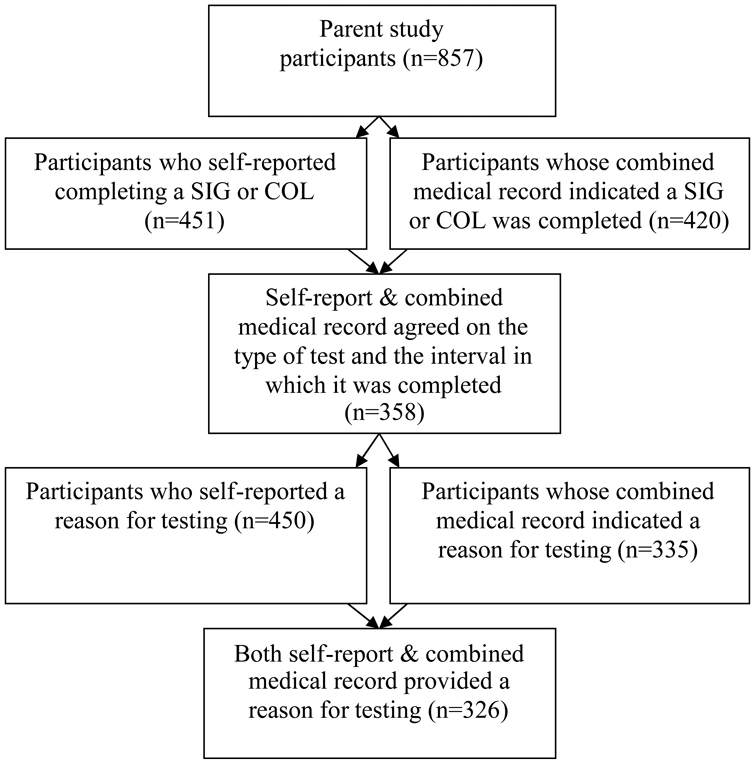
Assessment of accuracy of self-reported reason for colorectal cancer testing has been limited. We examined the accuracy and correlates of self-reported reason (screening or diagnosis) for having a sigmoidoscopy or colonoscopy. Patients who had received at least one sigmoidoscopy or colonoscopy within the past 5 years were recruited from a large multispecialty clinic in Houston, TX, between 2005 and 2007. We calculated concordance, positive predictive value, negative predictive value, sensitivity, and specificity between self-reported reason and the medical record (gold standard). Logistic regression was performed to identify correlates of accurate self-report. Self-reported reason for testing was more accurate when the sigmoidoscopy or colonoscopy was done for screening, rather than diagnosis. In the multivariable analysis for sigmoidoscopy, age was positively associated with accurately reporting reason for testing, whereas having two or more colorectal cancer tests during the study period (compared with only one test) was negatively associated with accuracy. In the multivariable analysis, none of the correlates was statistically associated with colonoscopy although a similar pattern was observed for number of tests. Determining the best way to identify those who have been tested for diagnosis, rather than screening, is an important next step.
对自我报告的结直肠癌检测原因的准确性评估一直受到限制。我们研究了自我报告的原因(筛查或诊断)接受乙状结肠镜检查或结肠镜检查的准确性和相关性。2005 年至 2007 年期间,我们从德克萨斯州休斯顿的一家大型多专科诊所招募了过去 5 年内至少接受过一次乙状结肠镜检查或结肠镜检查的患者。我们计算了自我报告的原因与病历(金标准)之间的一致性、阳性预测值、阴性预测值、敏感性和特异性。进行逻辑回归以确定准确自我报告的相关因素。当乙状结肠镜检查或结肠镜检查是为了筛查而不是诊断时,检测的自我报告原因更准确。在乙状结肠镜检查的多变量分析中,年龄与准确报告检测原因呈正相关,而在研究期间进行了两次或更多次结直肠癌检查(与仅进行一次检查相比)与准确性呈负相关。在多变量分析中,尽管观察到相似的模式,但没有一个相关性与结肠镜检查统计学相关。确定识别那些因诊断而不是筛查而接受检查的人的最佳方法是下一步的重要步骤。