Department of Biochemistry and Molecular Biology, University of Oklahoma Health Sciences Center, Oklahoma City, OK, USA.
BMC Med Genet. 2010 Jan 12;11:4. doi: 10.1186/1471-2350-11-4.
von Hippel-Lindau (VHL) disease is a hereditary cancer syndrome caused by germline mutations in the VHL gene. Patients have significant morbidity and mortality secondary to vascular tumors. Disease management is centered on tumor surveillance that allows early detection and treatment. Presymptomatic genetic testing is therefore recommended, including in at-risk children.
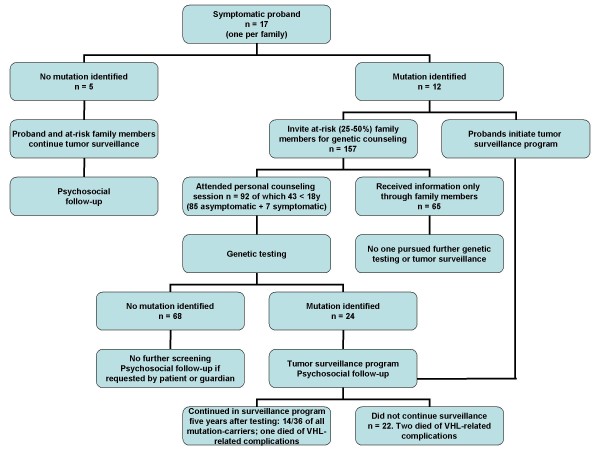
We tested 17 families (n = 109 individuals) for VHL mutations including 43 children under the age of 18. Personalized genetic counseling was provided pre and post-test and the individuals undergoing presymptomatic testing filled out questionnaires gathering socio-demographic, psychological and psychiatric data. Mutation analysis was performed by direct sequencing of the VHL gene. Mutation-carriers were screened for VHL disease-related tumors and were offered follow-up annual examinations.
Mutations were identified in 36 patients, 17 of whom were asymptomatic. In the initial screening, we identified at least one tumor in five of 17 previously asymptomatic individuals. At the end of five years, only 38.9% of the mutation-carriers continued participating in our tumor surveillance program. During this time, 14 mutation carriers developed a total of 32 new tumors, three of whom died of complications. Gender, education, income, marital status and religiosity were not found to be associated with adherence to the surveillance protocol. Follow-up adherence was also independent of pre-test depression, severity of disease, or number of affected family members. The only statistically significant predictor of adherence was being symptomatic at the time of testing (OR = 5; 95% CI 1.2 - 20.3; p = 0.02). Pre-test anxiety was more commonly observed in patients that discontinued follow-up (64.7% vs. 35.3%; p = 0.01).
The high initial uptake rate of genetic testing for VHL disease, including in minors, allowed the discontinuation of unnecessary screening procedures in non mutation-carriers. However, mutation-carriers showed poor adherence to long-term tumor surveillance. Therefore, many of them did not obtain the full benefit of early detection and treatment, which is central to the reduction of morbidity and mortality in VHL disease. Studies designed to improve adherence to vigilance protocols will be necessary to improve treatment and quality of life in patients with hereditary cancer syndromes.
希佩尔-林道(VHL)病是一种遗传性癌症综合征,由 VHL 基因突变引起。由于血管肿瘤,患者有显著的发病率和死亡率。疾病管理以肿瘤监测为中心,可早期发现和治疗。因此,建议进行包括有风险的儿童在内的无症状遗传检测。
我们对 17 个家族(n = 109 人)进行了 VHL 基因突变检测,包括 43 名 18 岁以下的儿童。进行了检测前后的个性化遗传咨询,接受无症状检测的个体填写了收集社会人口统计学、心理和精神病学数据的问卷。通过直接测序 VHL 基因进行突变分析。对 VHL 病相关肿瘤进行筛查,并对突变携带者进行年度随访检查。
在 36 名患者中发现了突变,其中 17 名患者无症状。在最初的筛查中,我们在 17 名之前无症状的个体中发现了至少一个肿瘤。在五年结束时,只有 38.9%的突变携带者继续参加我们的肿瘤监测计划。在此期间,14 名突变携带者共发展了 32 个新肿瘤,其中 3 人死于并发症。性别、教育程度、收入、婚姻状况和宗教信仰与是否遵守监测方案无关。随访的遵守情况也与检测前的抑郁、疾病的严重程度或受影响的家庭成员数量无关。唯一具有统计学意义的遵守预测因子是检测时的症状(OR = 5;95%CI 1.2 - 20.3;p = 0.02)。停止随访的患者中更常见的是检测前焦虑(64.7%比 35.3%;p = 0.01)。
VHL 病的遗传检测,包括未成年人,最初的检测率很高,可以避免对非突变携带者进行不必要的筛查。然而,突变携带者对长期肿瘤监测的依从性较差。因此,他们中的许多人没有充分受益于早期发现和治疗,这是降低 VHL 病发病率和死亡率的关键。需要设计改善警惕性监测协议的依从性的研究,以改善遗传性癌症综合征患者的治疗和生活质量。