Institute for Risk Assessment Sciences, Utrecht University, Utrecht, the Netherlands.
Environ Health Perspect. 2010 Apr;118(4):526-32. doi: 10.1289/ehp.0901127. Epub 2009 Nov 18.
Previous evaluations of the shape of the benzene-leukemia exposure-response curve (ERC) were based on a single set or on small sets of human occupational studies. Integrating evidence from all available studies that are of sufficient quality combined with flexible meta-regression models is likely to provide better insight into the functional relation between benzene exposure and risk of leukemia.
We used natural splines in a flexible meta-regression method to assess the shape of the benzene-leukemia ERC.
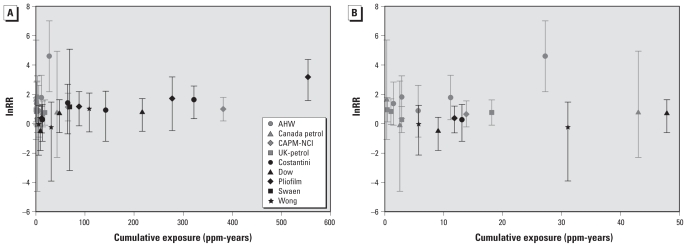
We fitted meta-regression models to 30 aggregated risk estimates extracted from nine human observational studies and performed sensitivity analyses to assess the impact of a priori assessed study characteristics on the predicted ERC.
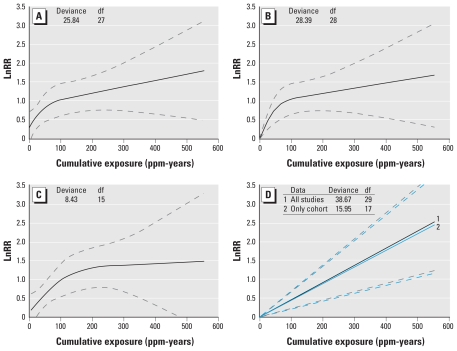
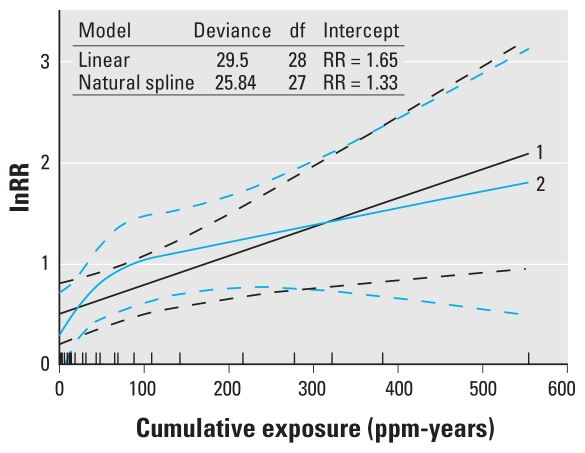
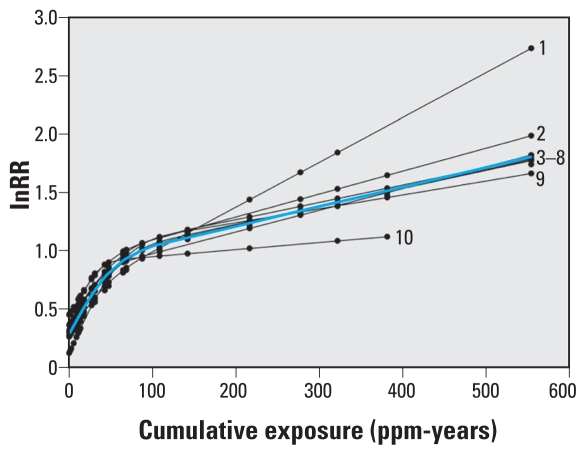
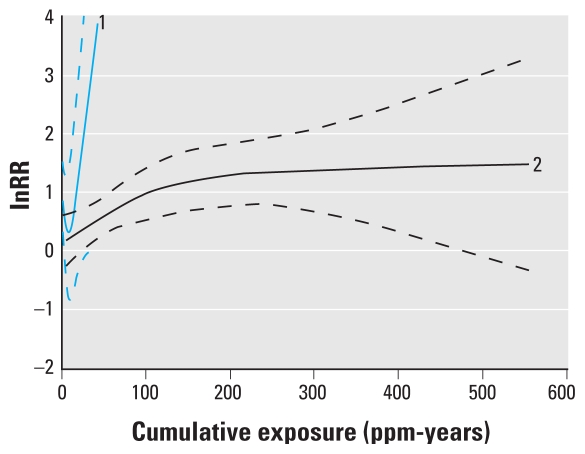
The natural spline showed a supralinear shape at cumulative exposures less than 100 ppm-years, although this model fitted the data only marginally better than a linear model (p = 0.06). Stratification based on study design and jackknifing indicated that the cohort studies had a considerable impact on the shape of the ERC at high exposure levels (> 100 ppm-years) but that predicted risks for the low exposure range (< 50 ppm-years) were robust.
Although limited by the small number of studies and the large heterogeneity between studies, the inclusion of all studies of sufficient quality combined with a flexible meta-regression method provides the most comprehensive evaluation of the benzene-leukemia ERC to date. The natural spline based on all data indicates a significantly increased risk of leukemia [relative risk (RR) = 1.14; 95% confidence interval (CI), 1.04-1.26] at an exposure level as low as 10 ppm-years.
之前对苯与白血病暴露反应曲线(ERC)形状的评估是基于一组或多组人体职业研究得出的。整合所有具有足够质量的现有研究证据,并结合灵活的荟萃回归模型,可能会更好地了解苯暴露与白血病风险之间的功能关系。
我们使用灵活的荟萃回归方法中的自然样条来评估苯与白血病 ERC 的形状。
我们从九项人体观察性研究中提取了 30 个聚合风险估计值,并拟合了荟萃回归模型,还进行了敏感性分析,以评估预先评估的研究特征对预测 ERC 的影响。
自然样条显示在累积暴露量小于 100ppm 年时呈超线性形状,尽管该模型拟合数据的效果仅略优于线性模型(p = 0.06)。基于研究设计和删除数据点的分层分析表明,队列研究对高暴露水平(>100ppm 年)下 ERC 的形状有较大影响,但低暴露范围(<50ppm 年)的预测风险是稳健的。
尽管受到研究数量少和研究之间异质性大的限制,但将所有具有足够质量的研究纳入并结合灵活的荟萃回归方法,对苯与白血病 ERC 进行了迄今为止最全面的评估。基于所有数据的自然样条表明,暴露水平低至 10ppm 年时,白血病的风险显著增加[相对风险(RR)=1.14;95%置信区间(CI),1.04-1.26]。