Laboratorio di Archeo-Antropologia molecolare/DNA Antico, Dipartimento di Biologia Molecolare, Cellulare e Animale, University of Camerino, Camerino, Italy.
PLoS One. 2010 Jan 8;5(1):e8629. doi: 10.1371/journal.pone.0008629.
The degradation of DNA represents one of the main issues in the genetic analysis of archeological specimens. In the recent years, a particular kind of post-mortem DNA modification giving rise to nucleotide misincorporation ("miscoding lesions") has been the object of extensive investigations.
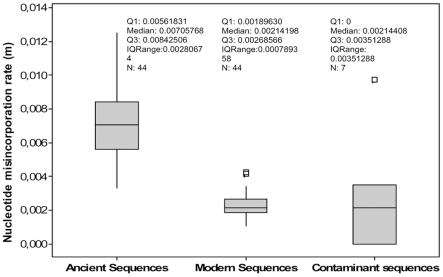
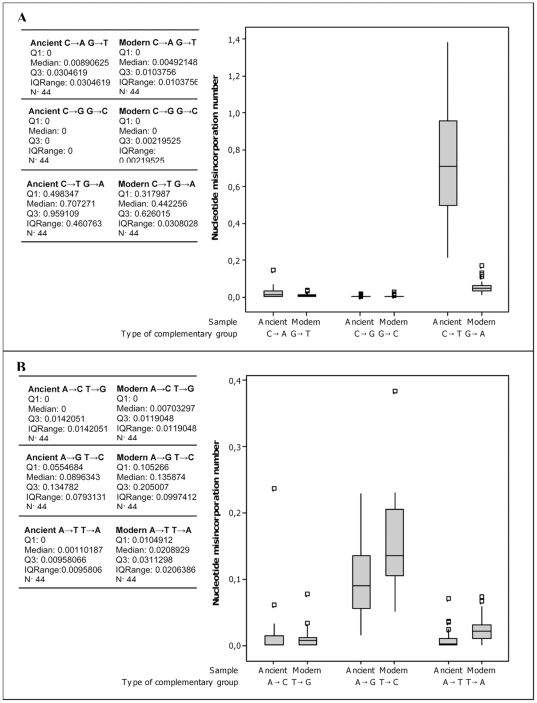
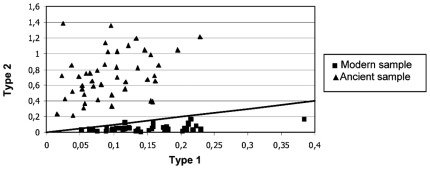
METHODOLOGY/PRINCIPAL FINDINGS: To improve our knowledge regarding the nature and incidence of ancient DNA nucleotide misincorporations, we have utilized 6,859 (629,975 bp) mitochondrial (mt) DNA sequences obtained from the 5,350-5,100-years-old, freeze-desiccated human mummy popularly known as the Tyrolean Iceman or Otzi. To generate the sequences, we have applied a mixed PCR/pyrosequencing procedure allowing one to obtain a particularly high sequence coverage. As a control, we have produced further 8,982 (805,155 bp) mtDNA sequences from a contemporary specimen using the same system and starting from the same template copy number of the ancient sample. From the analysis of the nucleotide misincorporation rate in ancient, modern, and putative contaminant sequences, we observed that the rate of misincorporation is significantly lower in modern and putative contaminant sequence datasets than in ancient sequences. In contrast, type 2 transitions represent the vast majority (85%) of the observed nucleotide misincorporations in ancient sequences.
CONCLUSIONS/SIGNIFICANCE: This study provides a further contribution to the knowledge of nucleotide misincorporation patterns in DNA sequences obtained from freeze-preserved archeological specimens. In the Iceman system, ancient sequences can be clearly distinguished from contaminants on the basis of nucleotide misincorporation rates. This observation confirms a previous identification of the ancient mummy sequences made on a purely phylogenetical basis. The present investigation provides further indication that the majority of ancient DNA damage is reflected by type 2 (cytosine-->thymine/guanine-->adenine) transitions and that type 1 transitions are essentially PCR artifacts.
DNA 的降解是考古标本遗传分析中的主要问题之一。近年来,一种导致核苷酸错配(“编码错误”)的特殊死后 DNA 修饰已成为广泛研究的对象。
方法/主要发现:为了提高我们对古代 DNA 核苷酸错配的性质和发生率的认识,我们利用了从 5350-5100 年前的冷冻干燥人类木乃伊(俗称蒂罗尔冰人或奥茨)中获得的 6859 个(629975bp)线粒体(mt)DNA 序列。为了生成这些序列,我们应用了一种混合 PCR/焦磷酸测序程序,该程序可以获得特别高的序列覆盖率。作为对照,我们使用相同的系统从同一模板拷贝数的古代样本中产生了另外 8982 个(805155bp)mtDNA 序列。通过分析古代、现代和假定污染序列中的核苷酸错配率,我们观察到在现代和假定污染序列数据集中的错配率明显低于古代序列。相比之下,2 型转换占古代序列中观察到的核苷酸错配的绝大多数(85%)。
结论/意义:本研究为从冷冻保存的考古标本中获得的 DNA 序列中核苷酸错配模式的知识提供了进一步的贡献。在冰人系统中,基于核苷酸错配率可以清楚地区分古代序列和污染物。这一观察结果证实了先前基于纯粹系统发育的对古代木乃伊序列的鉴定。本研究进一步表明,大多数古代 DNA 损伤反映了 2 型(胞嘧啶->胸腺嘧啶/鸟嘌呤->腺嘌呤)转换,而 1 型转换基本上是 PCR 伪影。