Department of Biological Sciences, Vanderbilt University, Nashville, Tennessee, USA.
PLoS One. 2010 Jan 1;5(1):e8552. doi: 10.1371/journal.pone.0008552.
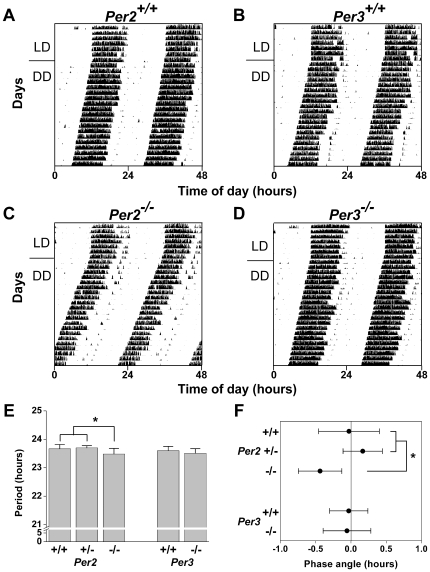
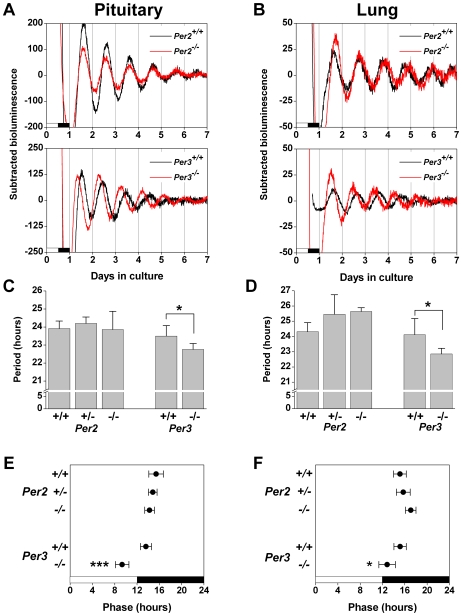
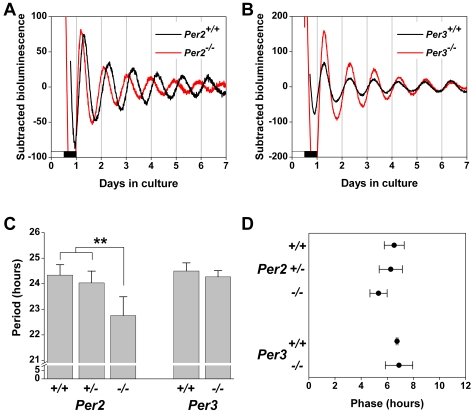
The mammalian circadian system, which is composed of a master pacemaker in the suprachiasmatic nuclei (SCN) as well as other oscillators in the brain and peripheral tissues, controls daily rhythms of behavior and physiology. Lesions of the SCN abolish circadian rhythms of locomotor activity and transplants of fetal SCN tissue restore rhythmic behavior with the periodicity of the donor's genotype, suggesting that the SCN determines the period of the circadian behavioral rhythm. According to the model of timekeeping in the SCN, the Period (Per) genes are important elements of the transcriptional/translational feedback loops that generate the endogenous circadian rhythm. Previous studies have investigated the functions of the Per genes by examining locomotor activity in mice lacking functional PERIOD proteins. Variable behavioral phenotypes were observed depending on the line and genetic background of the mice. In the current study we assessed both wheel-running activity and Per1-promoter-driven luciferase expression (Per1-luc) in cultured SCN, pituitary, and lung explants from Per2(-/-) and Per3(-/-) mice congenic with the C57BL/6J strain. We found that the Per2(-/-) phenotype is enhanced in vitro compared to in vivo, such that the period of Per1-luc expression in Per2(-/-) SCN explants is 1.5 hours shorter than in Per2+/+ SCN, while the free-running period of wheel-running activity is only 11 minutes shorter in Per2(-/-) compared to Per2+/+ mice. In contrast, circadian rhythms in SCN explants from Per3(-/-) mice do not differ from Per3+/+ mice. Instead, the period and phase of Per1-luc expression are significantly altered in Per3(-/-) pituitary and lung explants compared to Per3+/+ mice. Taken together these data suggest that the function of each Per gene may differ between tissues. Per2 appears to be important for period determination in the SCN, while Per3 participates in timekeeping in the pituitary and lung.
哺乳动物的生物钟系统由视交叉上核(SCN)中的主节拍器以及大脑和外周组织中的其他振荡器组成,控制着行为和生理的日常节律。SCN 的损伤会消除运动活动的昼夜节律,而胎儿 SCN 组织的移植则恢复了具有供体基因型周期性的节律行为,这表明 SCN 决定了昼夜节律行为的周期。根据 SCN 中的计时模型,Period(Per)基因是产生内源性昼夜节律的转录/翻译反馈回路的重要组成部分。以前的研究通过检查缺乏功能性 PERIOD 蛋白的小鼠的运动活动来研究 Per 基因的功能。根据小鼠的系和遗传背景,观察到了不同的行为表型。在本研究中,我们评估了 Per2(-/-)和 Per3(-/-)小鼠与 C57BL/6J 品系同源的 SCN、垂体和肺外植体中的轮跑活动和 Per1 启动子驱动的荧光素酶表达(Per1-luc)。我们发现,与体内相比,Per2(-/-)表型在体外得到了增强,以至于 Per2(-/-)SCN 外植体中 Per1-luc 表达的周期比 Per2(+/+)SCN 短 1.5 小时,而 Per2(-/-)与 Per2(+/+)小鼠相比,轮跑活动的自由运行周期仅短 11 分钟。相比之下,Per3(-/-)小鼠的 SCN 外植体中的昼夜节律与 Per3(+/+)小鼠没有差异。相反,与 Per3(+/+)小鼠相比,Per3(-/-)垂体和肺外植体中 Per1-luc 表达的周期和相位发生了显著改变。这些数据表明,每个 Per 基因的功能可能在不同的组织中有所不同。Per2 似乎对 SCN 中的周期确定很重要,而 Per3 则参与了垂体和肺的计时。